
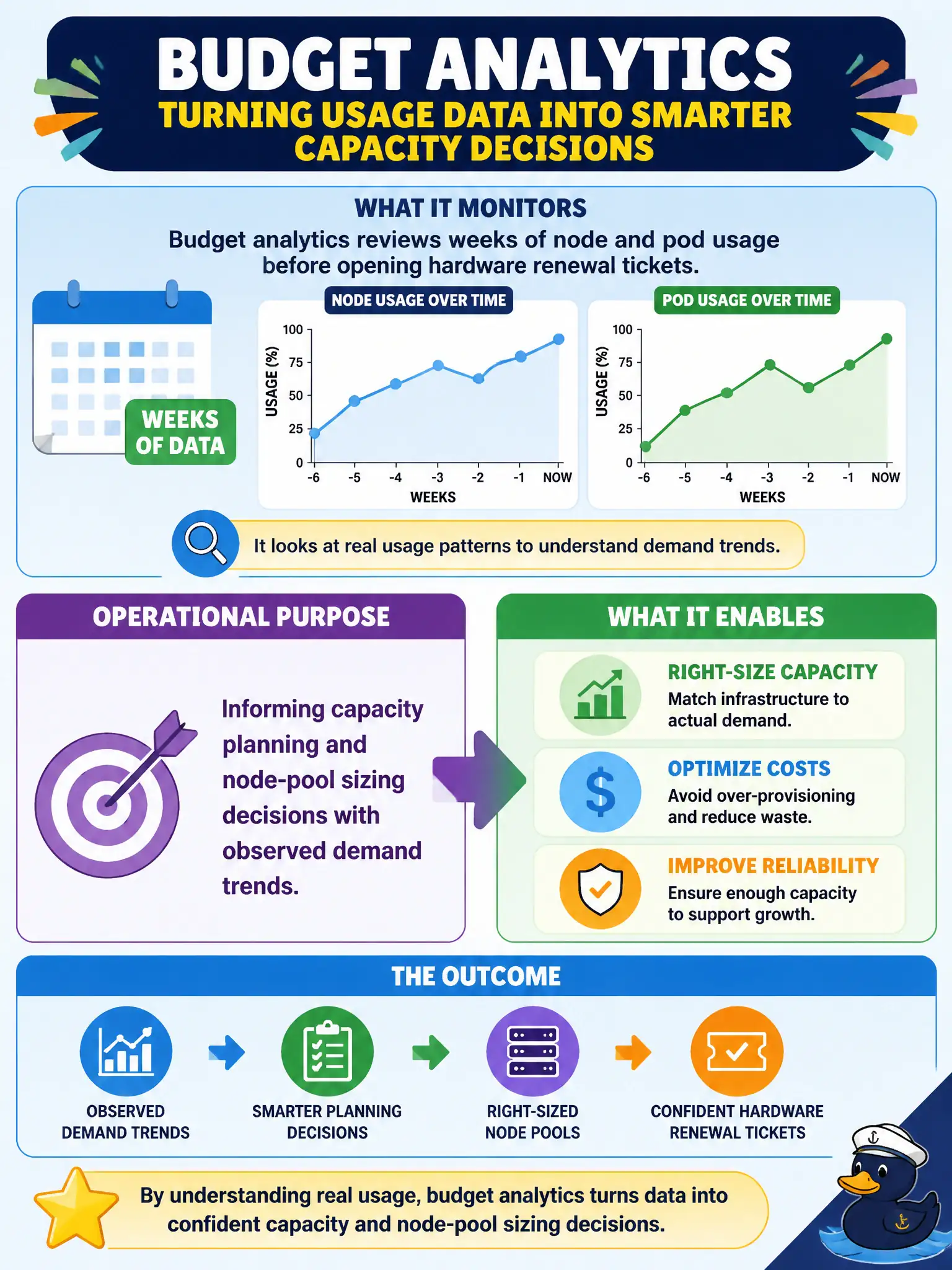
Budget analytics reviews weeks of node and pod usage before opening hardware renewal tickets. What operational purpose does that monitoring primarily serve?
Select an answer to reveal the explanation.
Short Explanation
Capacity tickets need receipts. Historical CPU and memory charts tell you whether to buy more nodes or just tidy requests—planning beats gut feel.
Full Explanation
Reviewing weeks of node and pod usage before opening hardware renewal tickets primarily serves capacity planning and node-pool sizing decisions with observed demand trends. Budget analytics turns monitoring into receipts for whether the city should purchase more nodes, reclaim waste through rightsizing, or defer spend—planning beats gut feel when taxpayer hardware is on the line. That monitoring purpose is not replacing RBAC entirely with anonymous access, which would be a severe security regression unrelated to capacity tickets. It is not about disabling eviction so Pending pods never appear; eviction and Pending remain important signals rather than something historical charts exist to erase. Forcing every PersistentVolume to ReadWriteMany is a storage access-mode choice, not the operational purpose of long-term CPU and memory monitoring. Exam caveat: Good capacity plans include headroom for DaemonSets, upgrades, and failure domains—not only average utilization. Present percentiles and growth trends, not a single quiet afternoon graph. Operational check: Export historical utilization, map demand to node-pool SKUs, attach graphs to the renewal ticket, and re-evaluate after rightsizing so the municipality avoids over-buying.