
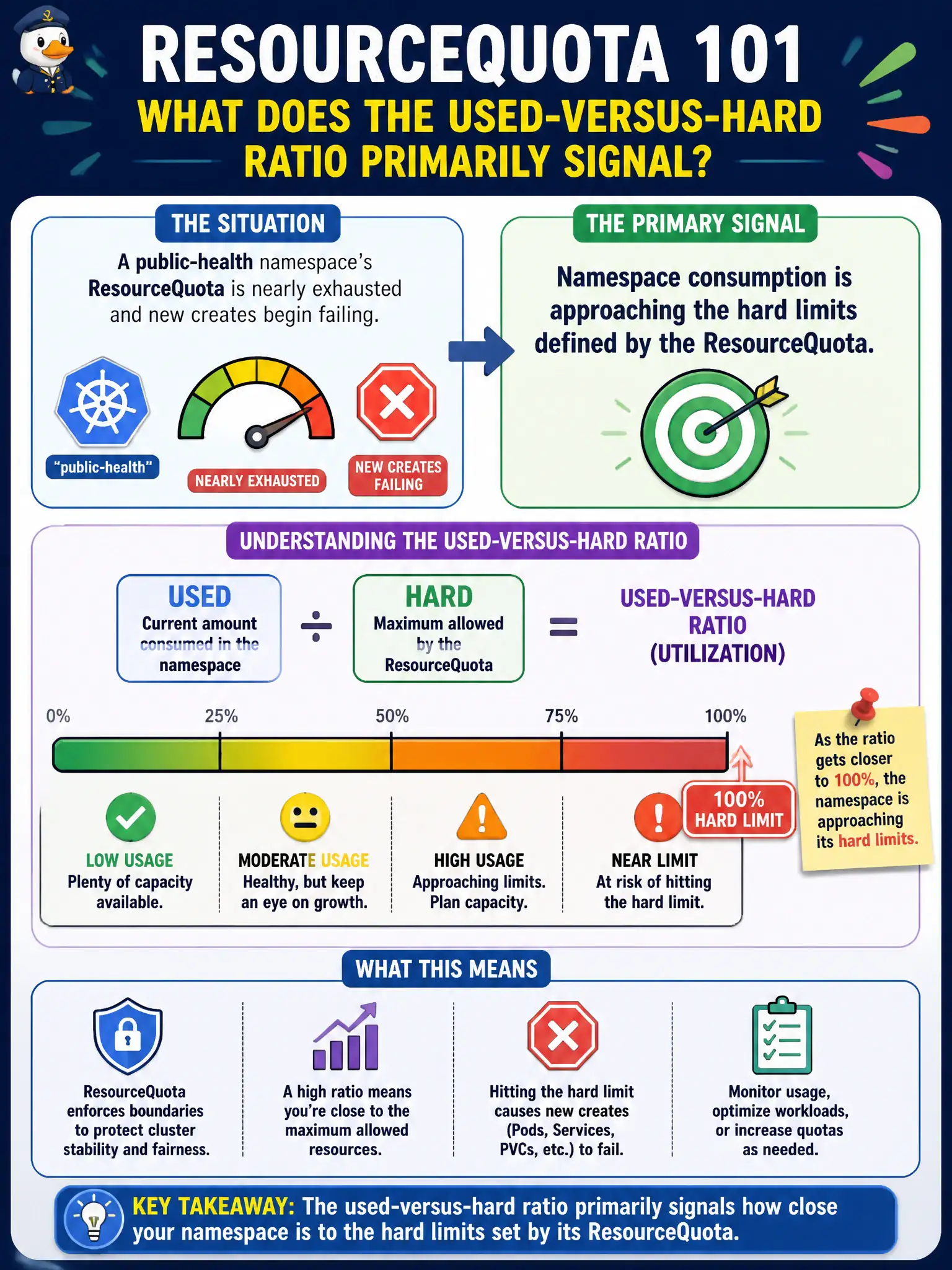
A public-health namespace's ResourceQuota is nearly exhausted and new creates begin failing. What does the used-versus-hard ratio primarily signal?
Select an answer to reveal the explanation.
Short Explanation
Think of ResourceQuota like a department spending cap. When used climbs toward hard, new tickets get rejected—your namespace is bumping into its allowance.
Full Explanation
A ResourceQuota sets hard upper bounds on aggregate namespace consumption such as CPU, memory, and object counts. When a public-health namespace’s used-versus-hard ratio nears exhaustion and new creates begin failing, that ratio primarily signals the namespace is approaching those hard limits—like a department spending cap that starts rejecting new tickets at the clerk’s window. The used-versus-hard signal does not mean the kube-apiserver certificate is about to expire; certificate expiry presents as TLS errors for clients, not as quota accounting ratios. It does not indicate CoreDNS ConfigMap keys are malformed; DNS misconfiguration breaks name resolution rather than ResourceQuota used/hard semantics. It does not mean every node has entered NotReady because of CNI failure; Ready and CNI issues are node and networking conditions, separate from namespace quota exhaustion. Exam caveat: Quota denials appear as Forbidden admission errors that name the exceeded resource—read the message carefully. Distinguish ResourceQuota from LimitRange (per-pod defaults and maxima) and from physical node capacity. Operational check: kubectl describe resourcequota in the namespace, identify which hard limit is nearly spent, free unused objects or raise the quota through change control, and retry the civic create that was denied.