
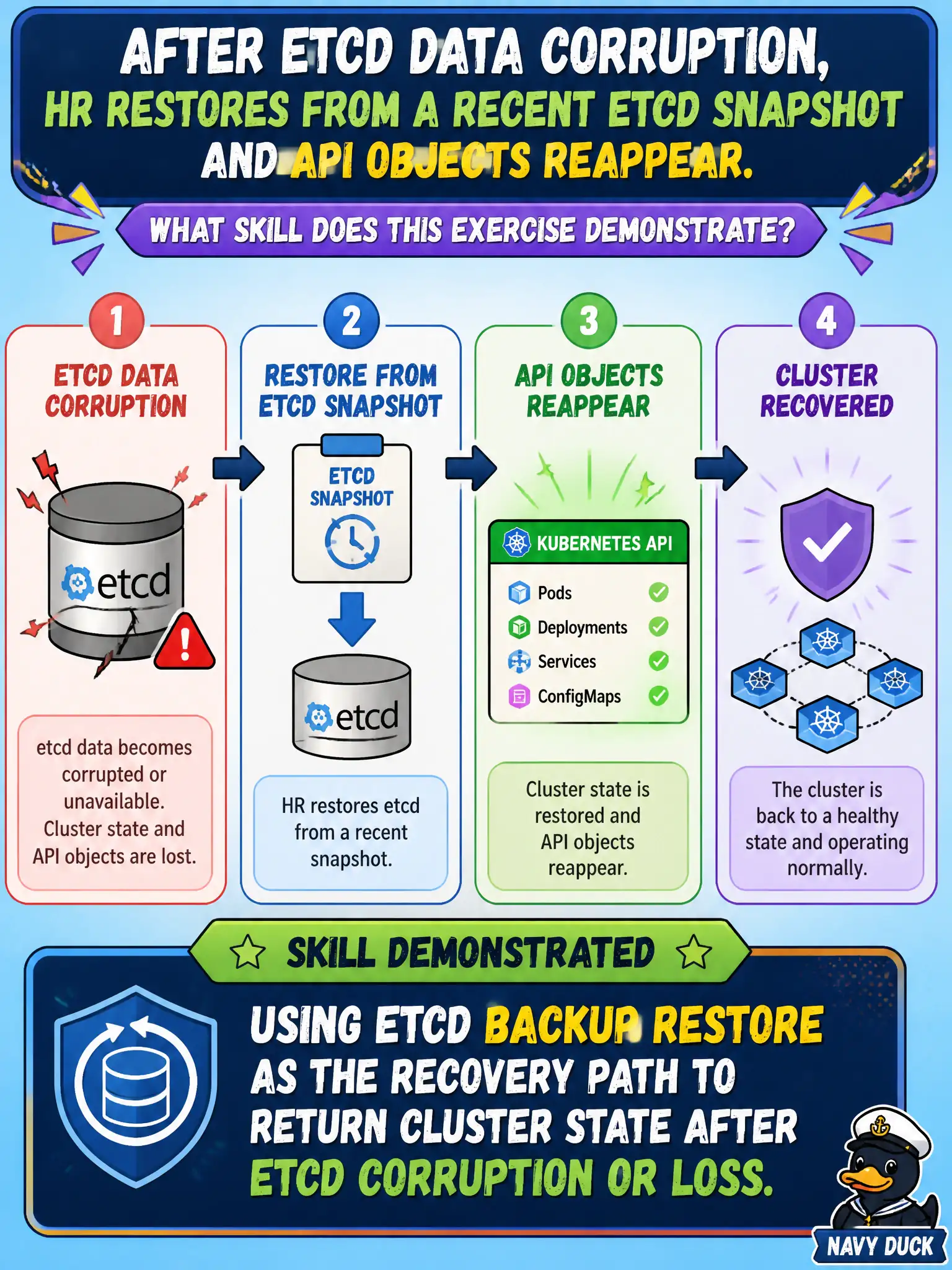
After etcd data corruption, HR restores from a recent etcd snapshot and API objects reappear. What skill does this exercise demonstrate?
Select an answer to reveal the explanation.
Short Explanation
When etcd's ledger is trash, you restore from last night's snapshot—the cluster's saved game—so API objects come back. That restore drill is core recovery muscle.
Full Explanation
etcd holds the cluster’s authoritative object state. After data corruption, restoring from a recent etcd snapshot returns API objects—Deployments, Services, RBAC, and civic configuration—demonstrating etcd backup restore as the recovery path. That restore drill is core operational muscle for HR and every other department platform. Rebuilding only kube-proxy DaemonSets cannot recreate all API objects without etcd; kube-proxy is Service dataplane, not the cluster datastore. Scaling Deployments does not regenerate lost etcd history after corruption; without a consistent snapshot restore, desired state in etcd remains damaged. Deleting /etc/kubernetes/manifests makes the control plane worse and does not force etcd to rewrite its database from DNS. Exam caveat: Restore procedures must match etcd versions, verify snapshot integrity, and often require stopping apiservers during restore to avoid split writes—follow the documented sequence rather than improvising file deletes. Operational check: Practice snapshot and restore in a lab, bring members up on restored data, confirm kubectl get for critical municipal objects, and schedule recurring encrypted off-box etcd backups with restore tests.