
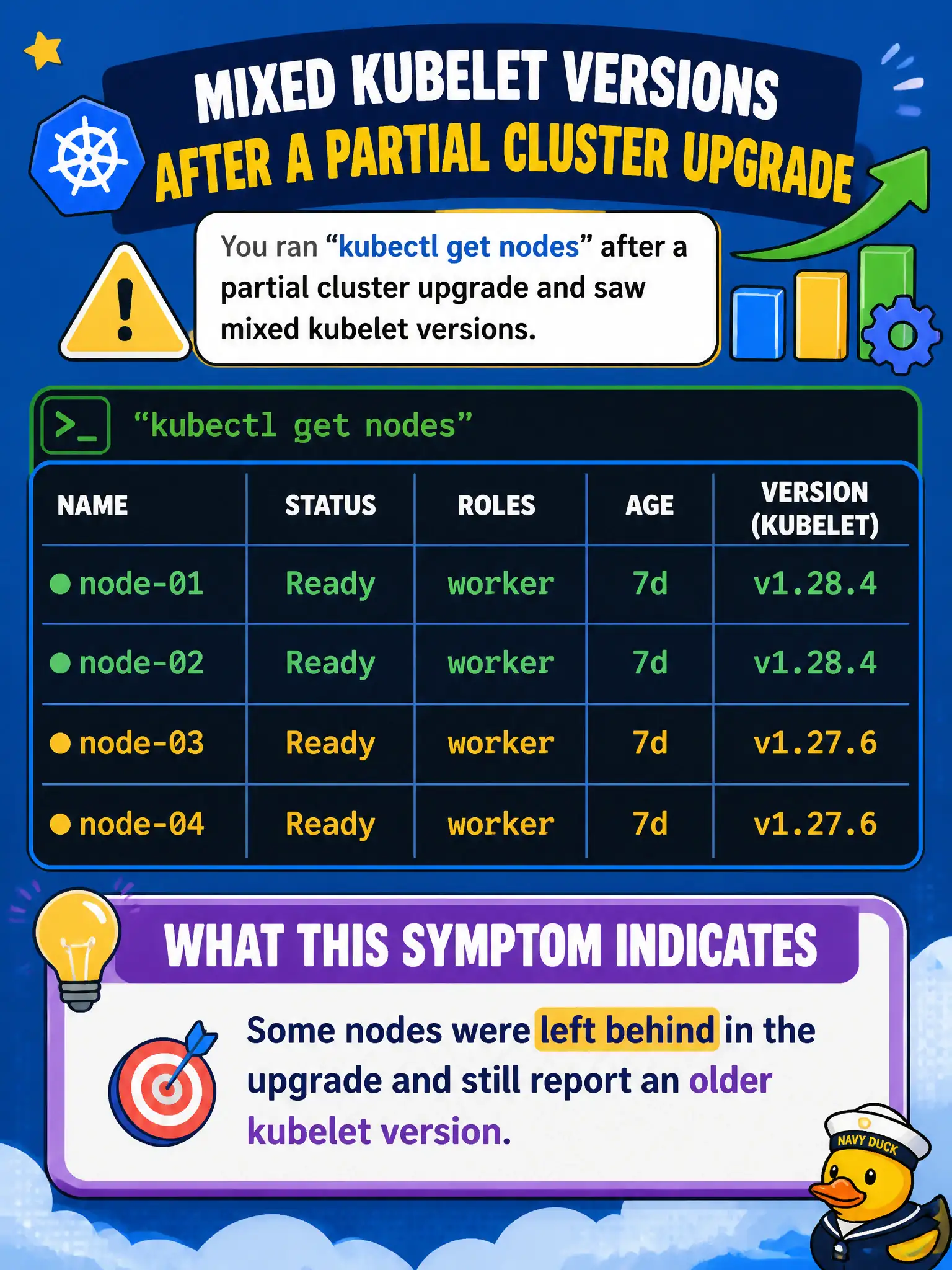
After a partial cluster upgrade, public-health operators run kubectl get nodes and see mixed kubelet versions. What does that symptom indicate?
Select an answer to reveal the explanation.
Short Explanation
Different version columns on get nodes are the upgrade scoreboard—someone’s kubelet didn’t get the new jersey yet.
Full Explanation
After a partial cluster upgrade, when public-health operators run kubectl get nodes and see mixed kubelet versions, that symptom indicates some nodes were left behind and still report an older kubelet version. Different version columns are the upgrade scoreboard—someone’s kubelet did not get the new jersey yet on that municipal fleet.
Version skew does not always mean every PodSecurityPolicy is disabled forever. Mixed versions do not prove etcd encryption-at-rest turned on automatically. Mixed versions do not always mean the CNI was uninstalled cluster-wide.
Exam caveat: Kubernetes supports limited version skew between control plane and kubelets—plan upgrades so workers catch up within supported skew. Functionality issues may appear if skew grows too large across many nodes.
Operational check: list node versions, identify lagging nodes, complete kubelet upgrades on those hosts following the platform runbook, and re-check kubectl get nodes for a uniform public-health target version. Keep civic change tickets precise: record object names, namespaces, and before/after observations so the next on-call engineer can replay the fix without guesswork. Prefer reversible steps and verify Ready or Bound state before closing the incident.