
A county node reports DiskPressure. What operational effect should administrators expect?
Select an answer to reveal the explanation.
Short Explanation
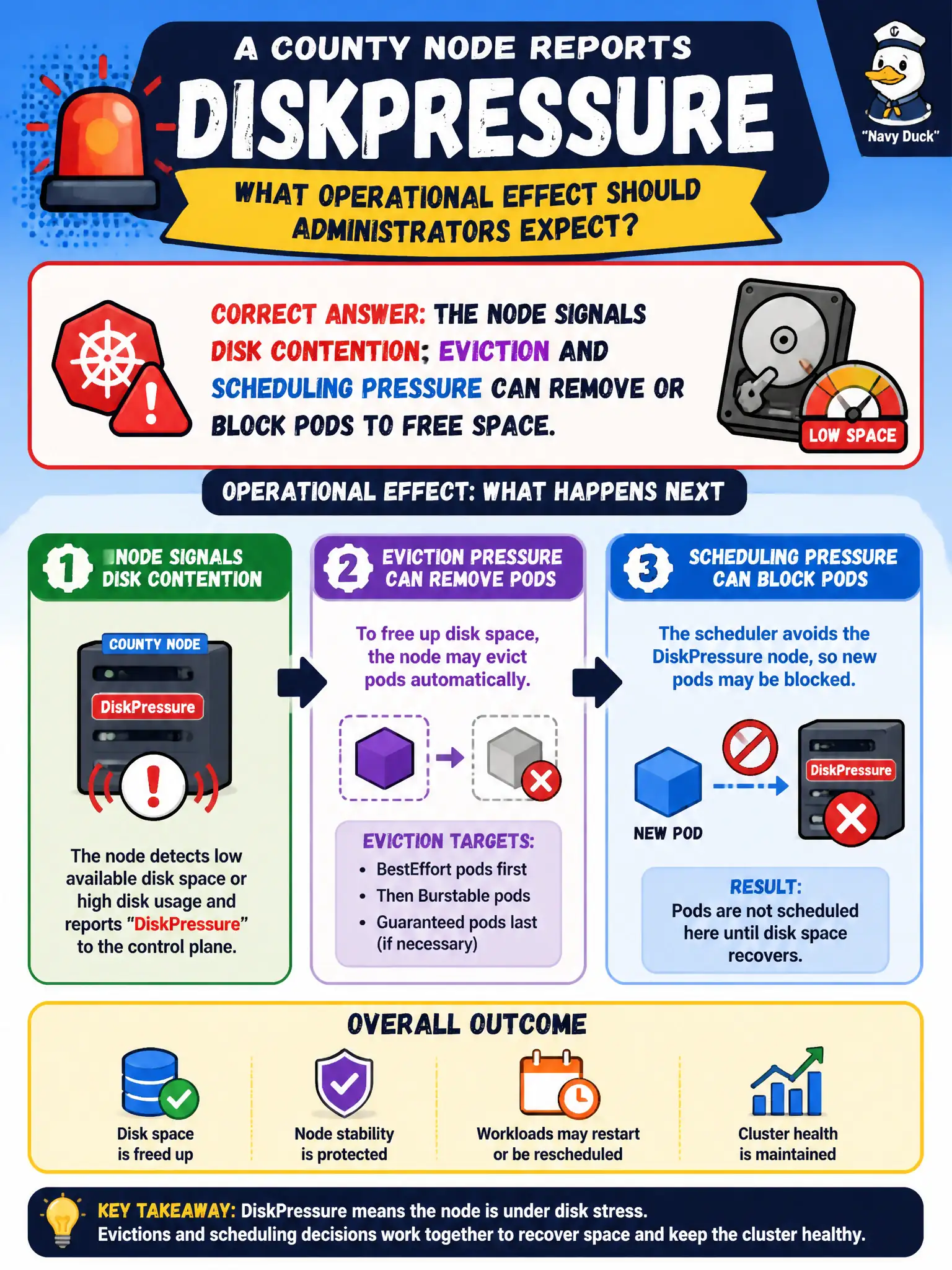
DiskPressure is the node waving a “disk almost full” flag—evictions and scheduling reluctance follow until space returns.
Full Explanation
When a county node reports DiskPressure, administrators should expect disk contention signals that can trigger eviction and scheduling pressure to remove or block Pods until space returns. DiskPressure is the node waving a nearly-full disk flag—evictions and scheduler reluctance follow for municipal workloads on that node.
DiskPressure does not only change the node’s Kubernetes minor version string. It does not always delete all PersistentVolumes cluster-wide. It does not only disable NetworkPolicies in that namespace.
Exam caveat: free inodes as well as bytes; image GC and log cleanup are common remediations. Pods with local emptyDir data can be evicted under pressure.
Operational check: kubectl describe node for DiskPressure, inspect disk/inode usage on the node, clean images/logs safely, confirm the condition clears, and reschedule county workloads as capacity returns. Keep civic change tickets precise: record object names, namespaces, and before/after observations so the next on-call engineer can replay the fix without guesswork. Keep civic change tickets precise: record object names, namespaces, and before/after observations so the next on-call engineer can replay the fix without guesswork.