
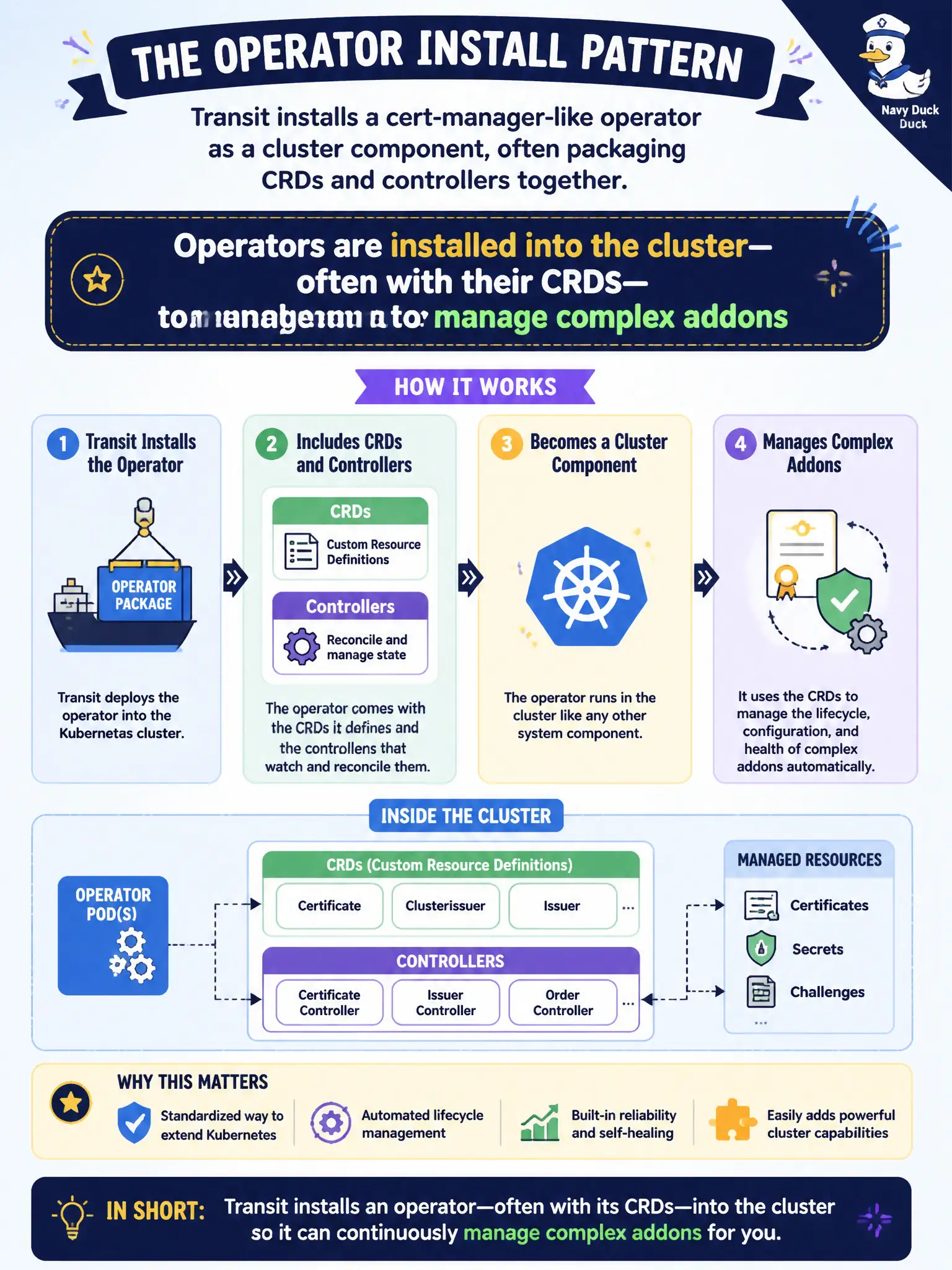
Transit installs a cert-manager-like operator as a cluster component, often packaging CRDs and controllers together. Which statement best describes that install pattern?
Select an answer to reveal the explanation.
Short Explanation
cert-manager-style operators live in the cluster like any other carefully packaged addon—Helm chart in, CRDs plus controllers running as workloads. They are not laptop-only scripts and not just PDF docs. Install them where they can watch the API.
Full Explanation
Transit installing a cert-manager-like operator as a cluster component typically installs operators into the cluster—often with their CRDs—to manage complex addons. They live in-cluster like carefully packaged addons (Helm chart in, CRDs plus controllers running), not laptop-only scripts or PDF-only docs. Operators need not run only on the administrator’s laptop and never inside the cluster. Operators do not replace kubelet on every node and can commonly be installed with Helm. Operators are not purely documentation packages with no controllers or CRDs. Exam caveat: CKA-depth awareness: operators are installed cluster components with CRDs+controllers. Operational check: helm install or kubectl apply the operator bundle, verify CRDs and controller Deployment, and create a smoke-test Certificate-like CR. In municipal platform operations, record the rationale in the change ticket so future on-call staff know which control was chosen and which failure modes the rejected options would create for city services. Re-validate after the next maintenance window that the same control still holds under the cluster’s current minor version and addon revisions used by the civic platform team. Keep the verification evidence—command output or config snippets—with the municipal runbook so audits can prove the control was applied as designed.