
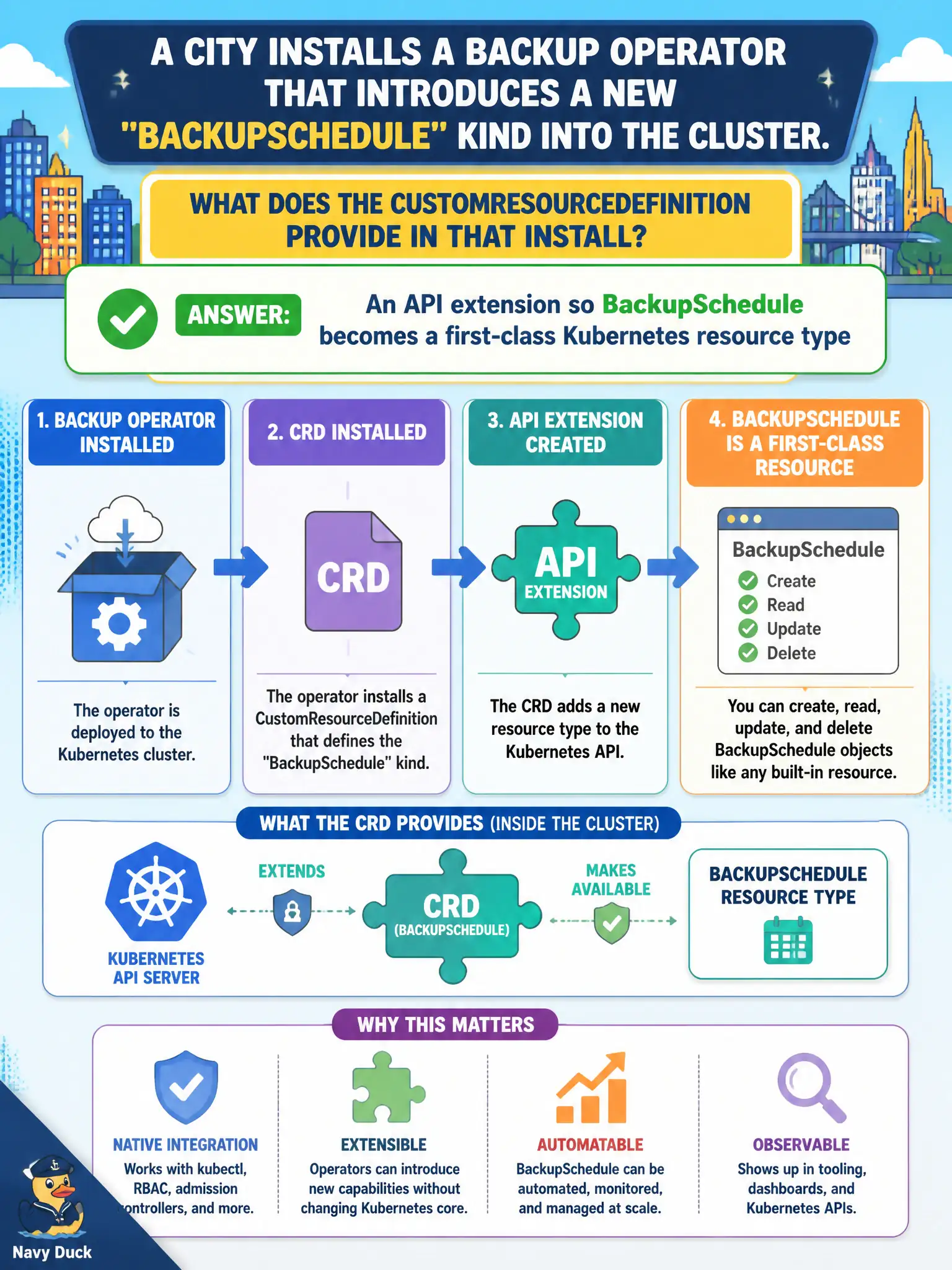
A city installs a backup operator that introduces a new BackupSchedule kind into the cluster. What does the CustomResourceDefinition provide in that install?
Select an answer to reveal the explanation.
Short Explanation
A CRD is like adding a new form type to city hall’s records system—suddenly BackupSchedule is a real kind kubectl understands. It does not replace etcd or wipe Deployments. The operator then watches those custom objects.
Full Explanation
When a city installs a backup operator that introduces BackupSchedule, the CustomResourceDefinition provides an API extension so BackupSchedule becomes a first-class Kubernetes resource type. A CRD is a new form type in city hall’s records system—kubectl understands it—without replacing etcd or wiping Deployments. A CRD is not a replacement for etcd that stores only backup bytes outside the API. Installing a CRD does not automatically delete all built-in Deployments in favor of BackupSchedule. A CRD is not a CNI plugin that schedules backups onto hostNetwork Pods only. Exam caveat: CRD extends the API; the operator controller then reconciles instances. Operational check: Apply the CRD, kubectl api-resources | grep BackupSchedule, create a sample CR, and confirm the operator reacts in municipal backup namespaces. In municipal platform operations, record the rationale in the change ticket so future on-call staff know which control was chosen and which failure modes the rejected options would create for city services. Re-validate after the next maintenance window that the same control still holds under the cluster’s current minor version and addon revisions used by the civic platform team.