
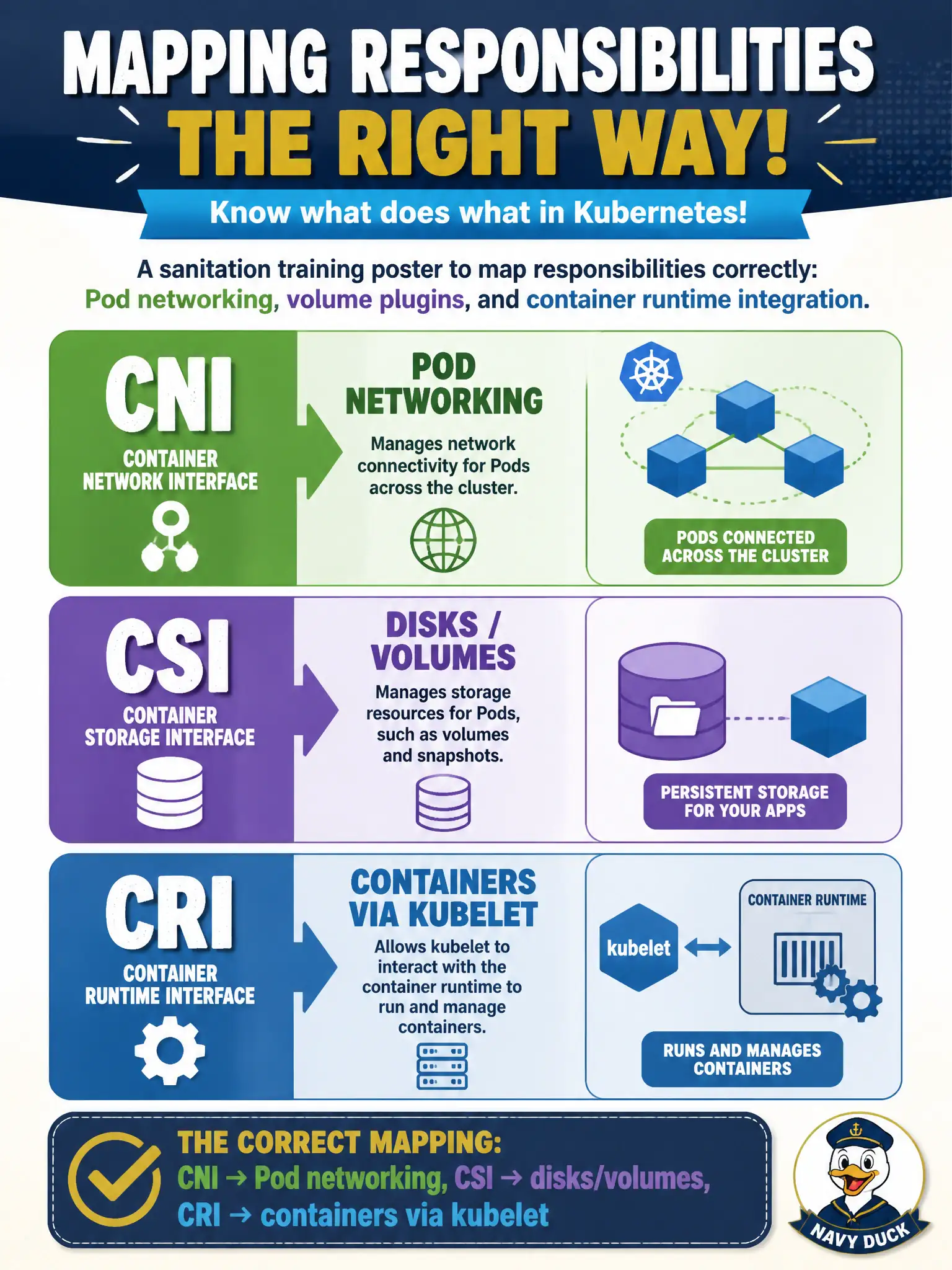
A sanitation training poster must map responsibilities correctly: Pod networking, volume plugins, and container runtime integration. Which mapping is accurate?
Select an answer to reveal the explanation.
Short Explanation
Easy mnemonic for the poster: Network→CNI, Storage→CSI, Runtime→CRI. Mix those up and the training class will wire disks to the network plugin. Keep the three lanes straight.
Full Explanation
The accurate sanitation training mapping is CNI → Pod networking, CSI → disks/volumes, and CRI → containers via kubelet. Network, Storage, Runtime—three lanes on the poster. Mixing them wires disks to the network plugin and confuses municipal troubleshooting. CNI→disks, CSI→containers, CRI→Pod networking reverses all three responsibilities. CNI→containers, CSI→Pod networking, CRI→disks is equally scrambled. CNI→etcd backups, CSI→Ingress, CRI→NetworkPolicies invents unrelated mappings. Exam caveat: Memorize CNI/CSI/CRI for CKA extension-interface questions. Operational check: When a Pod fails, classify the symptom (IP, mount, or container start) and inspect the matching subsystem first on sanitation clusters. In municipal platform operations, record the rationale in the change ticket so future on-call staff know which control was chosen and which failure modes the rejected options would create for city services. Re-validate after the next maintenance window that the same control still holds under the cluster’s current minor version and addon revisions used by the civic platform team. Keep the verification evidence—command output or config snippets—with the municipal runbook so audits can prove the control was applied as designed.