
A water utility places control-plane and etcd members for an HA cluster. Which placement practice improves failure tolerance?
Select an answer to reveal the explanation.
Short Explanation
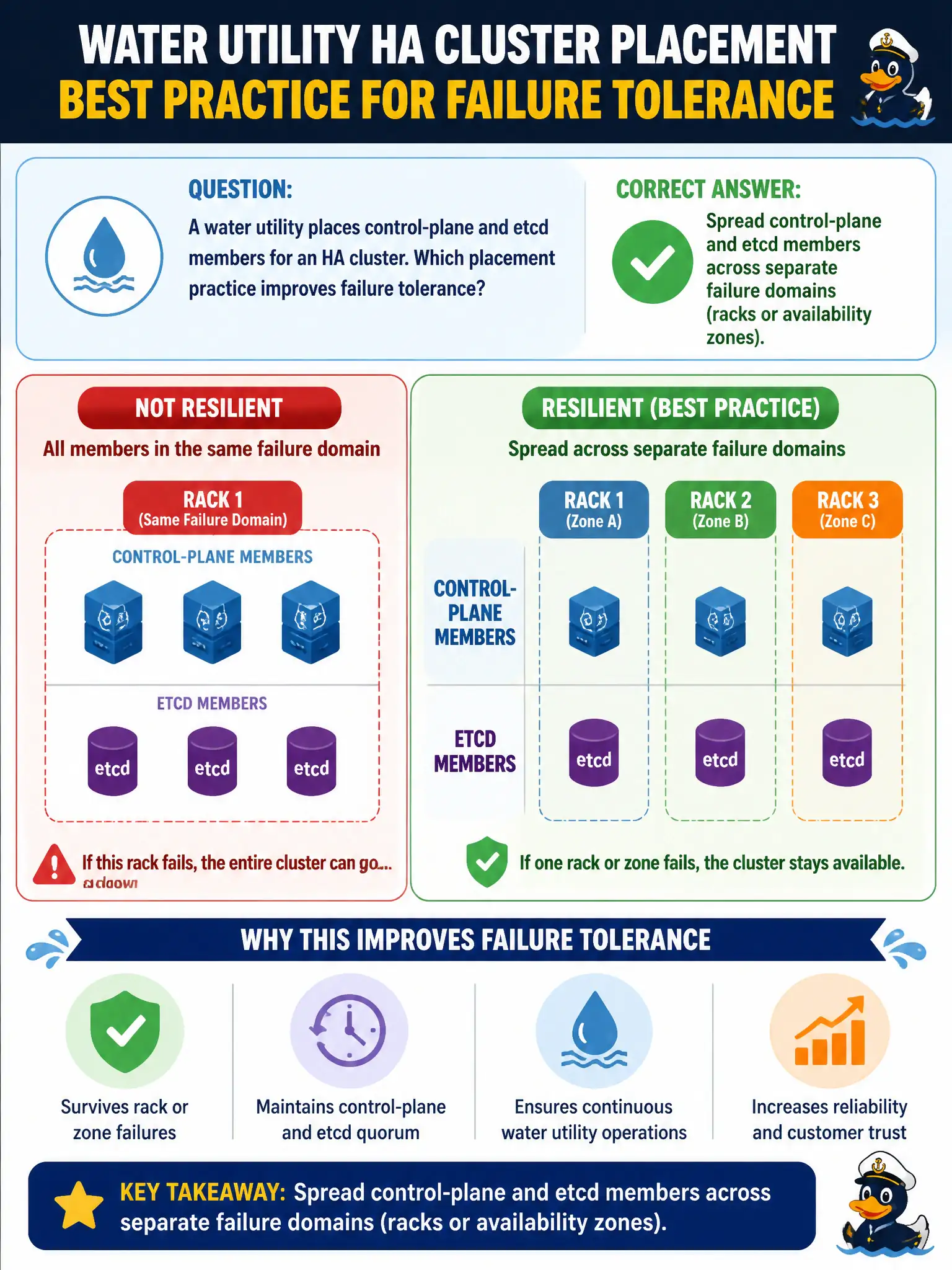
If all the brains sit on one rack, one power blip takes the whole government offline. Spread control-plane and etcd members across racks or zones so one failure domain can’t sink quorum. HA math fails if correlated fate shares a power strip.
Full Explanation
A water utility improves failure tolerance by spreading control-plane and etcd members across separate failure domains such as racks or availability zones. If all brains share one power strip, one blip takes the government offline despite “multiple” replicas. Colocating all control-plane VMs on one hypervisor host recreates a correlated SPOF. Putting every etcd member on the same rack switch as the storage array concentrates failure domains. Running all etcd members as sidecars inside a single apiserver Pod destroys independent membership. Exam caveat: Quorum size without failure-domain diversity is paper HA. Operational check: Place members in distinct racks/AZs, verify anti-affinity or IaC placement, and test loss of one domain while quorum holds. In municipal platform operations, record the rationale in the change ticket so future on-call staff know which control was chosen and which failure modes the rejected options would create for city services. Re-validate after the next maintenance window that the same control still holds under the cluster’s current minor version and addon revisions used by the civic platform team. Keep the verification evidence—command output or config snippets—with the municipal runbook so audits can prove the control was applied as designed.