
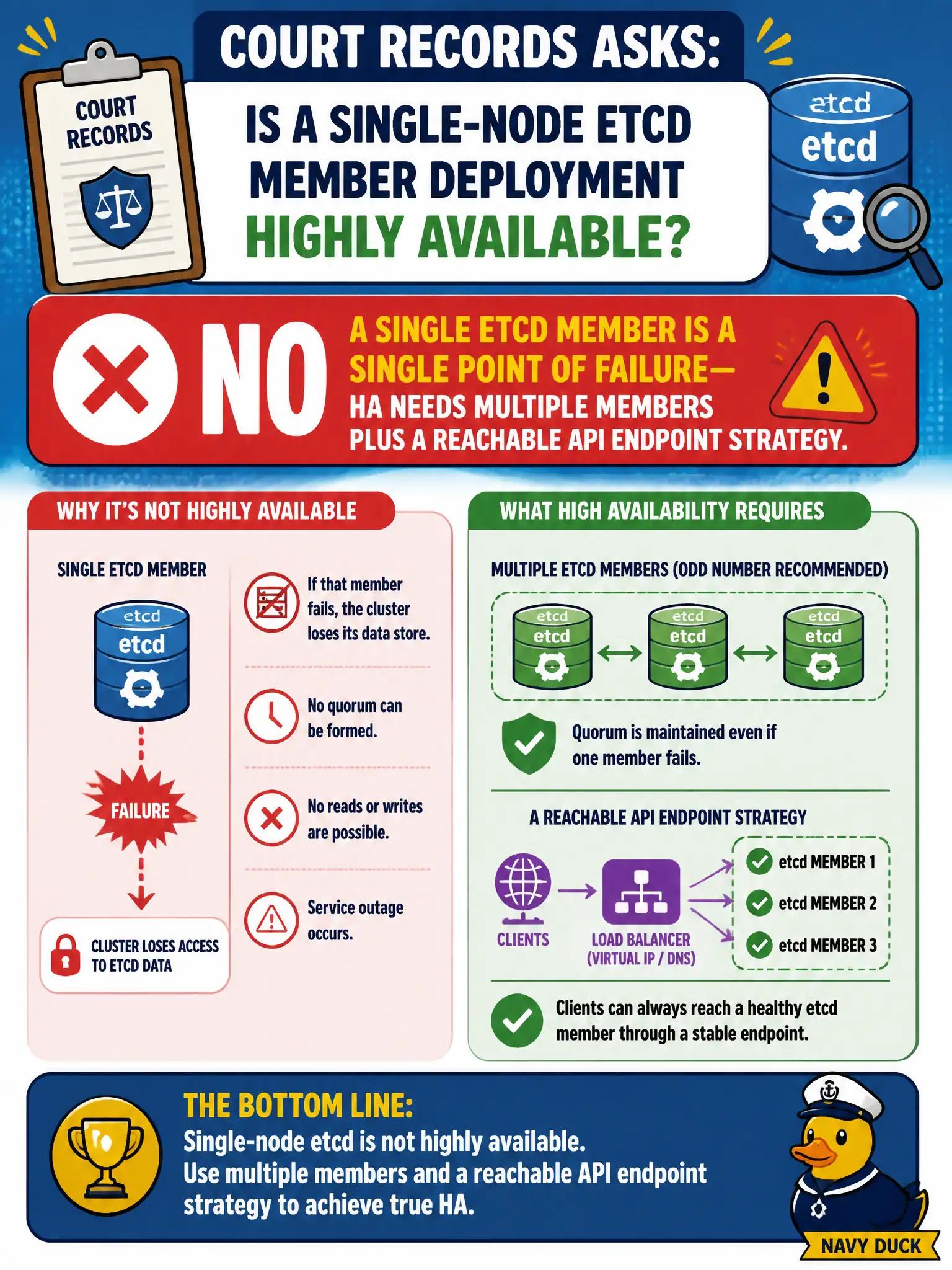
Court records asks whether a single-node etcd member deployment is highly available. What is the correct assessment?
Select an answer to reveal the explanation.
Short Explanation
One etcd is one basket for every egg in the cluster—drop that host and the API’s memory is gone. Snapshots help you recover later, but they are not the same as staying up through a failure. Real HA means multiple members and a way for clients to reach surviving apiservers.
Full Explanation
A single-node etcd member deployment is not highly available: it is a single point of failure. HA needs multiple members plus a reachable API endpoint strategy. One etcd is one basket for every egg; snapshots help recovery later but are not continuous availability for court records. Frequent disk snapshots on one member improve DR, not live HA through host loss. kube-apiserver local cache does not make one etcd member redundant for all failures. A lone external etcd member is not automatically HA simply because it is external. Exam caveat: Backup ≠ HA; distinguish RPO recovery from multi-member uptime. Operational check: If HA is required, expand to odd quorum members and an HA API endpoint; keep snapshots anyway for disaster recovery drills. In municipal platform operations, record the rationale in the change ticket so future on-call staff know which control was chosen and which failure modes the rejected options would create for city services. Re-validate after the next maintenance window that the same control still holds under the cluster’s current minor version and addon revisions used by the civic platform team. Keep the verification evidence—command output or config snippets—with the municipal runbook so audits can prove the control was applied as designed.