
Time skew across city racks breaks certificate validation during kubeadm join. What infrastructure practice prevents that class of failure?
Select an answer to reveal the explanation.
Short Explanation
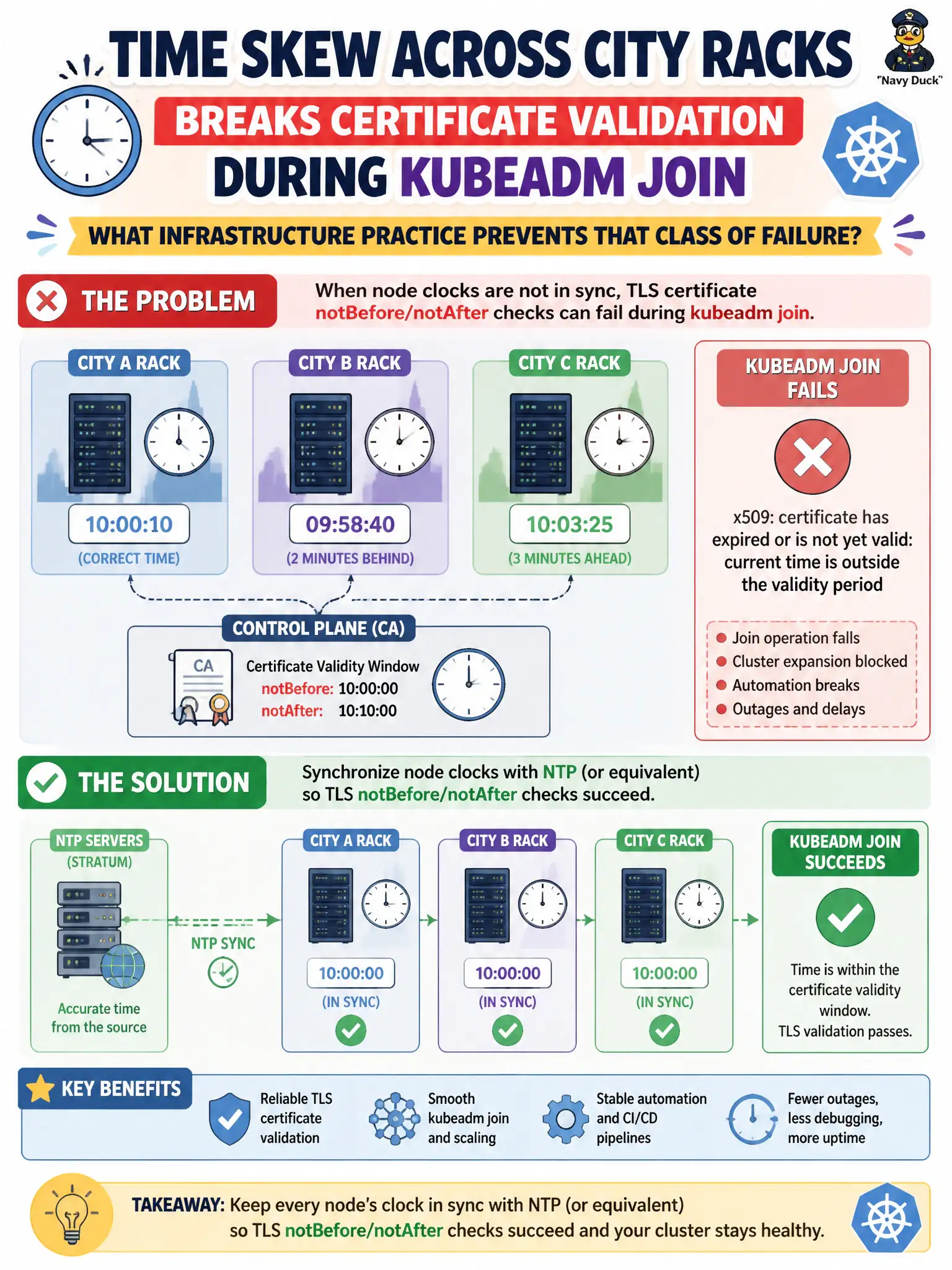
Certificates are sticklers for punctuality. If one rack thinks it is yesterday, join TLS looks expired or not-yet-valid. NTP—or solid time sync—keeps every node’s watch aligned with the control plane.
Full Explanation
Time skew across city racks breaks certificate validation during kubeadm join because TLS notBefore/notAfter checks depend on accurate system clocks. Synchronizing node clocks with NTP—or an equivalent reliable time service—keeps every rack’s watch aligned with the control plane so join mTLS succeeds. Certificates are sticklers for punctuality in civic PKI; a rack that still believes it is yesterday will reject otherwise valid bootstrap tokens and discovery hashes during join. Setting all node clocks permanently to Unix epoch guarantees validation failures instead of simplifying timezone math. Issuing API certificates with NotBefore one year in the future creates not-yet-valid errors for current clients and workers. Standardizing on kubeadm join --insecure-skip-tls-verify weakens trust boundaries and is not acceptable operational practice for production municipal clusters that must protect constituent data. Exam caveat: when join fails with certificate timing errors, suspect clock skew before regenerating the entire PKI. Operational check: enable chrony or ntpd across racks, verify timedatectl reports synchronized time within a small skew budget, retry kubeadm join, and record time sync as a mandatory step in the node build standard.