
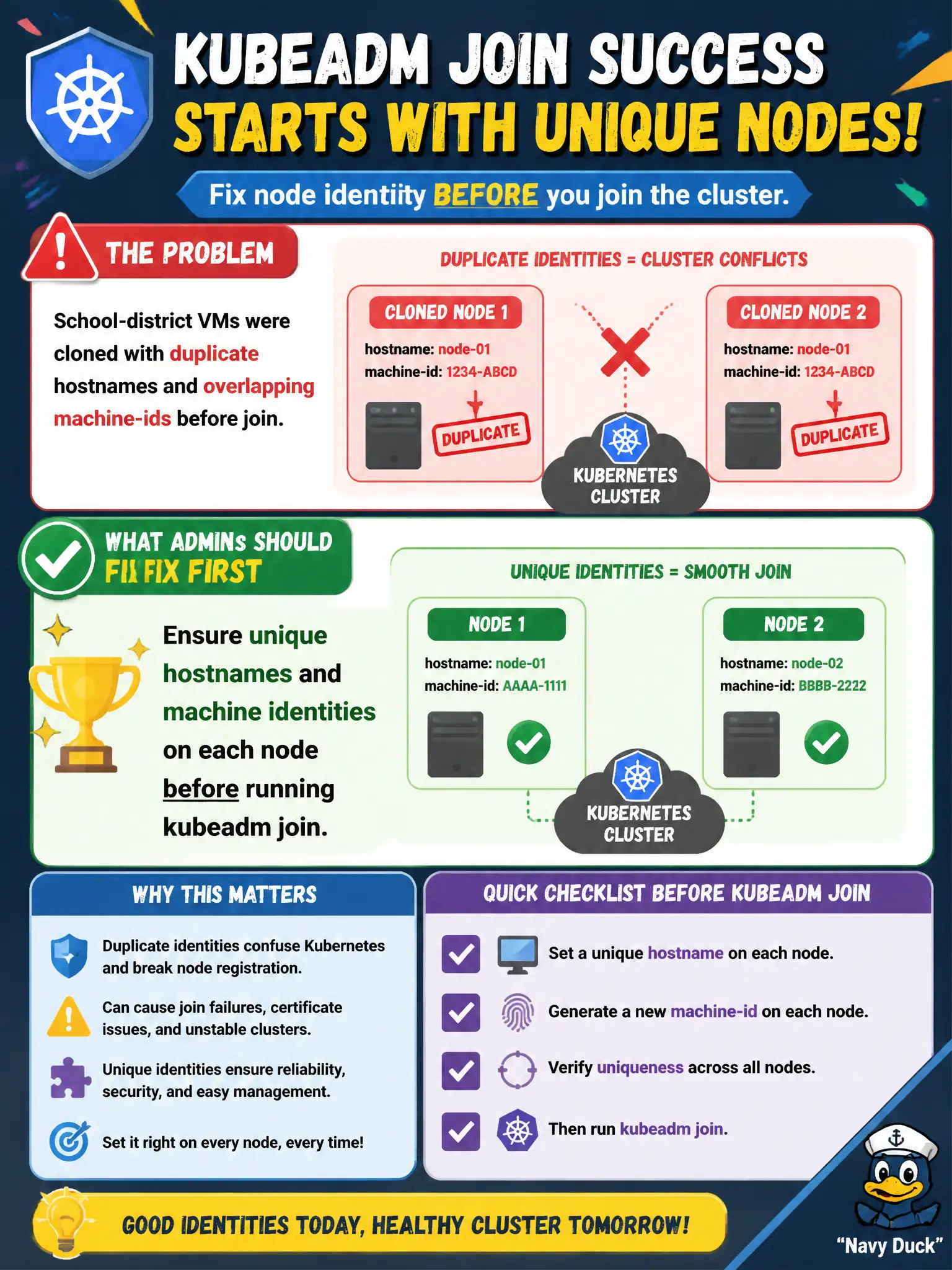
School-district VMs were cloned with duplicate hostnames and overlapping machine-ids before join. What should admins fix first?
Select an answer to reveal the explanation.
Short Explanation
Cloned VMs with the same nametag confuse the attendance sheet. Give each node a unique hostname and machine identity before kubeadm join. Duplicate IDs cause messy node objects—not something you paper over by turning off TLS.
Full Explanation
School-district VMs cloned with duplicate hostnames and overlapping machine-ids confuse node identity the way identical nametags confuse an attendance sheet. Administrators must ensure unique hostnames and machine identities on each node before kubeadm join so Node objects, certificates, and registrations do not collide or flap. Correct uniqueness on the operating system first; do not join a clone farm that still shares /etc/machine-id and hostname. Lowering kube-apiserver --max-requests-inflight does not resolve identity collisions among nodes. Assigning every VM the same kubernetes.io/hostname label after join makes uniqueness worse and confuses topology. Disabling TLS on the API server until hostnames are cleaned up exposes the control plane and still fails to create distinct node identities for the district fleet. Exam caveat: cloned-image hygiene—hostname, machine-id, and network identity—is a standard infrastructure prerequisite alongside swap and open ports. Operational check: regenerate machine-id, set unique hostnames with hostnamectl, confirm unique IPs, run kubeadm join, and verify distinct Node names via kubectl get nodes -o wide before releasing the pool to teachers’ workloads.