
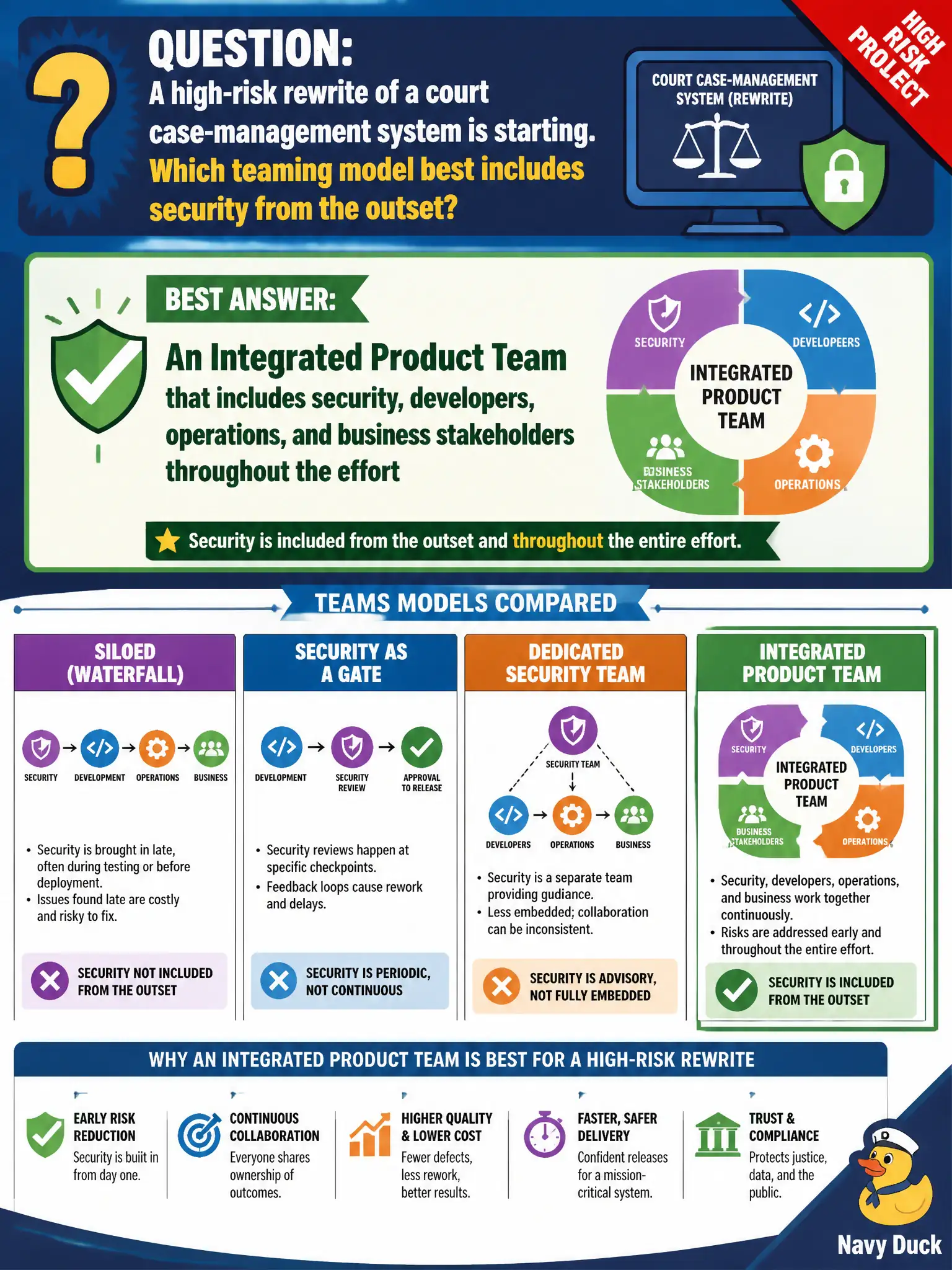
A high-risk rewrite of a court case-management system is starting. Which teaming model best includes security from the outset?
Select an answer to reveal the explanation.
Short Explanation
Big court-system rewrites need a band, not a solo: security, builders, ops, and the business in one IPT from day one—not a security cameo after code freeze.
Full Explanation
High-risk rewrites of court case-management systems need sustained cross-functional ownership. An Integrated Product Team (IPT) that includes security, developers, operations, and business stakeholders throughout the effort ensures security and operational constraints shape requirements and design continuously—not as a late cameo. Courts handle sensitive personal and procedural data; embedding security in the IPT improves threat modeling, access design, logging, and deployability while business owners keep legal workflow accuracy in view and operations keeps runtime realities visible.
A pure contracting office team that excludes developers and security until acceptance testing optimizes paperwork over product risk and discovers defects when change is most expensive. A siloed development group that invites security only after code freeze forces bolt-on controls and rushed exceptions. An operations-only bridge crew with no business or security representation may keep servers running yet miss both judicial process requirements and security design flaws.
Exam caveat: IPT-style inclusive teaming is a recognized way to integrate security into acquisition and development efforts. Security-from-the-outset beats security-at-the-end. Business and operations participation prevents solutions that are secure on paper but unusable or undeployable.
Operational check: charter the court rewrite IPT with named security, dev, ops, and business members; require security artifacts at each milestone; and measure whether threat-model and control decisions are recorded before major design freezes rather than after.