
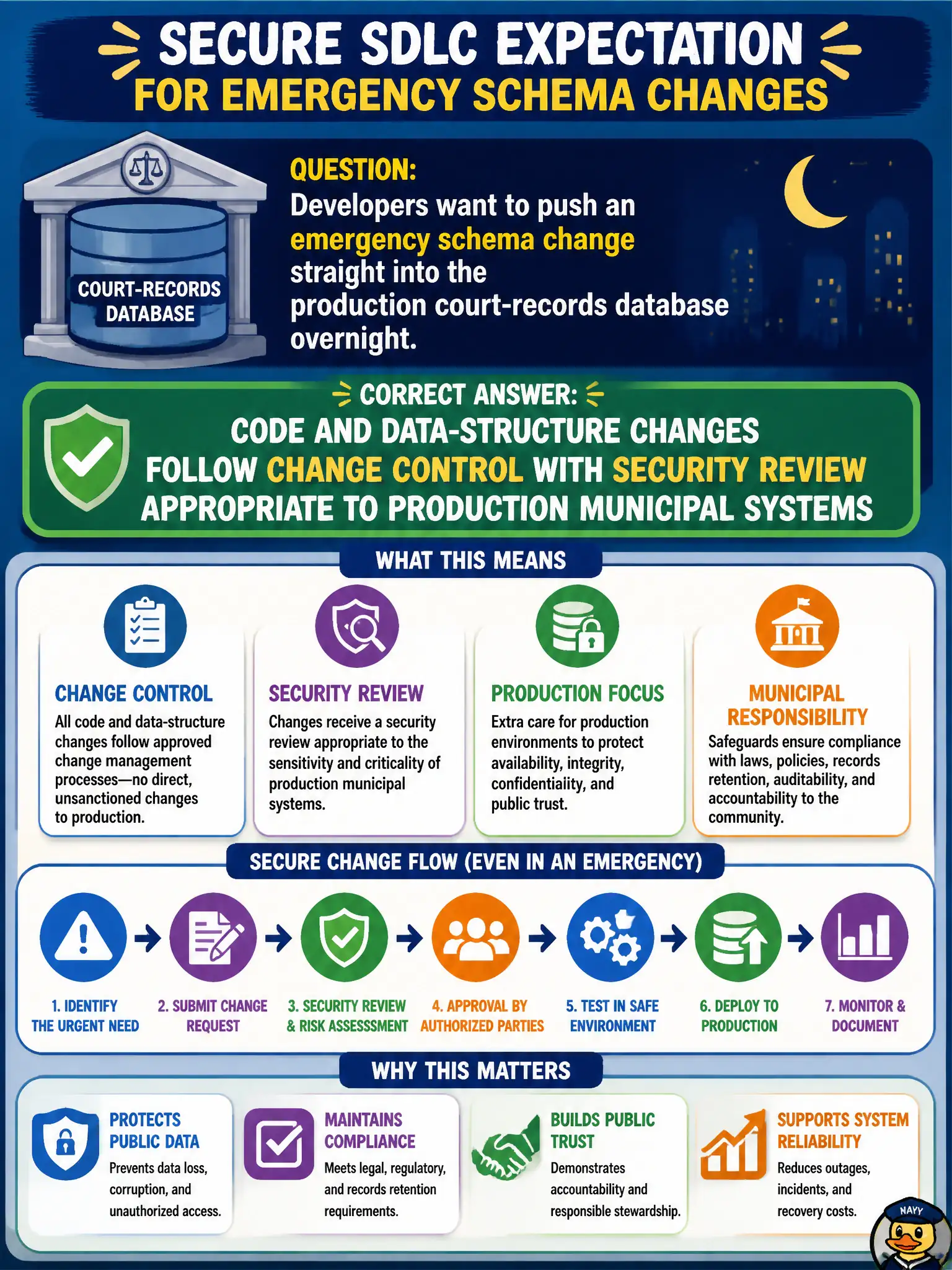
Developers want to push an emergency schema change straight into the production court-records database overnight. What secure-SDLC expectation should govern that change?
Select an answer to reveal the explanation.
Short Explanation
Even “gotta fix it tonight” schema edits need a ticket, eyes on the risk, and a trail. Trusted vibes are not change control—especially on court records.
Full Explanation
Secure-SDLC and production operations expectations require that code and data-structure changes—including emergency schema changes to a court-records database—follow change control with security review appropriate to the system’s sensitivity. Expedited paths can exist for true emergencies, but they still demand authorization, risk assessment (integrity of court data, injection paths, privilege impact), logging, and a recorded trail for later audit. Trust in a developer’s intentions does not replace accountability on systems that underpin justice processes.
Allowing production pushes with no tracking because the developer is trusted collapses under insider risk, mistakes, and personnel changes. Bypassing all logging on emergency changes to save time removes the evidence needed for both security investigation and court-data integrity disputes. Limiting change control to UI color tweaks while exempting schema changes ignores that structural data changes often carry higher integrity and availability risk than cosmetic edits.
Exam caveat: change management applies to emergency fixes with accelerated but still controlled workflows. Schema and data-structure changes are firmly in scope. “Trusted admin” distractors are common; the correct concept is accountable process.
Operational check: define an emergency change procedure for court systems with after-hours approvers, mandatory post-implementation review within a set number of business days, automated logging of schema migrations, and sampling audits that confirm no silent production DDL occurred outside the process.