
Compared with ordinary open-plan offices, how should a police evidence-storage room’s internal physical controls differ?
Select an answer to reveal the explanation.
Short Explanation
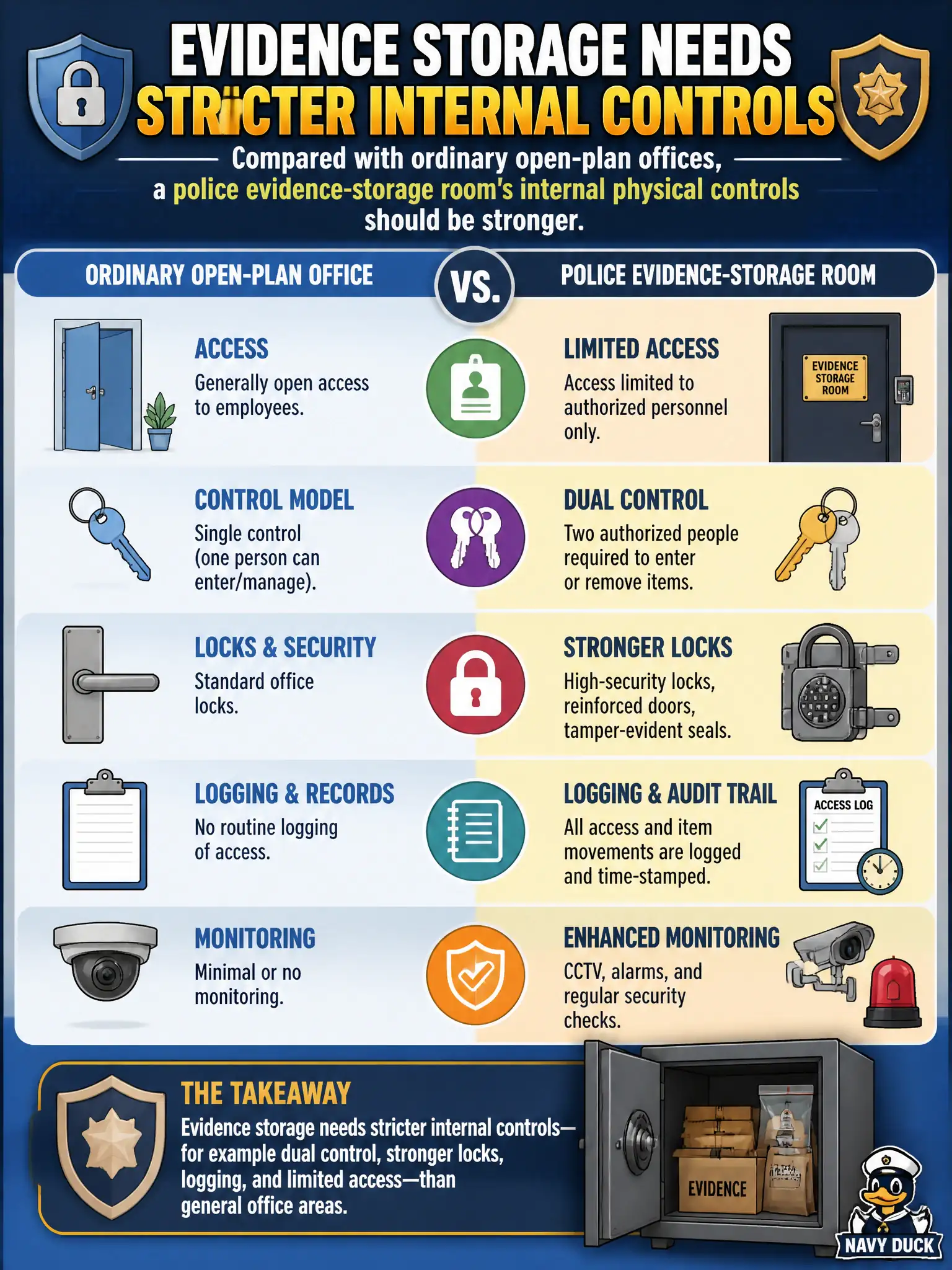
Evidence isn’t office snacks. That room gets tougher locks, fewer keys, dual control, and logs—way tighter than the cubicle floor—because chain of custody lives or dies on physical control.
Full Explanation
Internal physical controls should scale with asset sensitivity and legal risk. A police evidence-storage room supports chain of custody for investigations and prosecutions; therefore it needs stricter internal controls than ordinary open-plan offices—stronger locks, tightly limited access lists, entry logging, dual control or two-person rules where policy requires, sealed packaging standards, and monitored storage. Lobby or building-perimeter badges alone do not provide the accountability required once someone is already inside the facility.
Giving evidence rooms fewer controls because “fewer people visit” inverts risk logic: low traffic does not reduce consequence of tampering or theft. Assuming the same front-door badge model used for the whole building is always sufficient ignores zoning—public lobbies, general offices, and evidence vaults are different security domains. Leaving evidence on open hallway shelves because lobby cameras exist confuses distant observation with controlled custody; cameras without access restriction and logging fail chain-of-custody expectations.
Exam caveat: physical security grading and internal controls intensify for high-value or high-sensitivity assets (evidence, cash, keys, sensitive records). Dual control and logging are classic exam signals for custody-critical spaces. Perimeter controls and interior controls are complementary, not interchangeable.
Operational check: review evidence-room access lists quarterly, test door alarms and log review, confirm dual-control procedures for high-risk transfers, and ensure temporary evidence staging never relies on hallway storage even if cameras cover the corridor.