
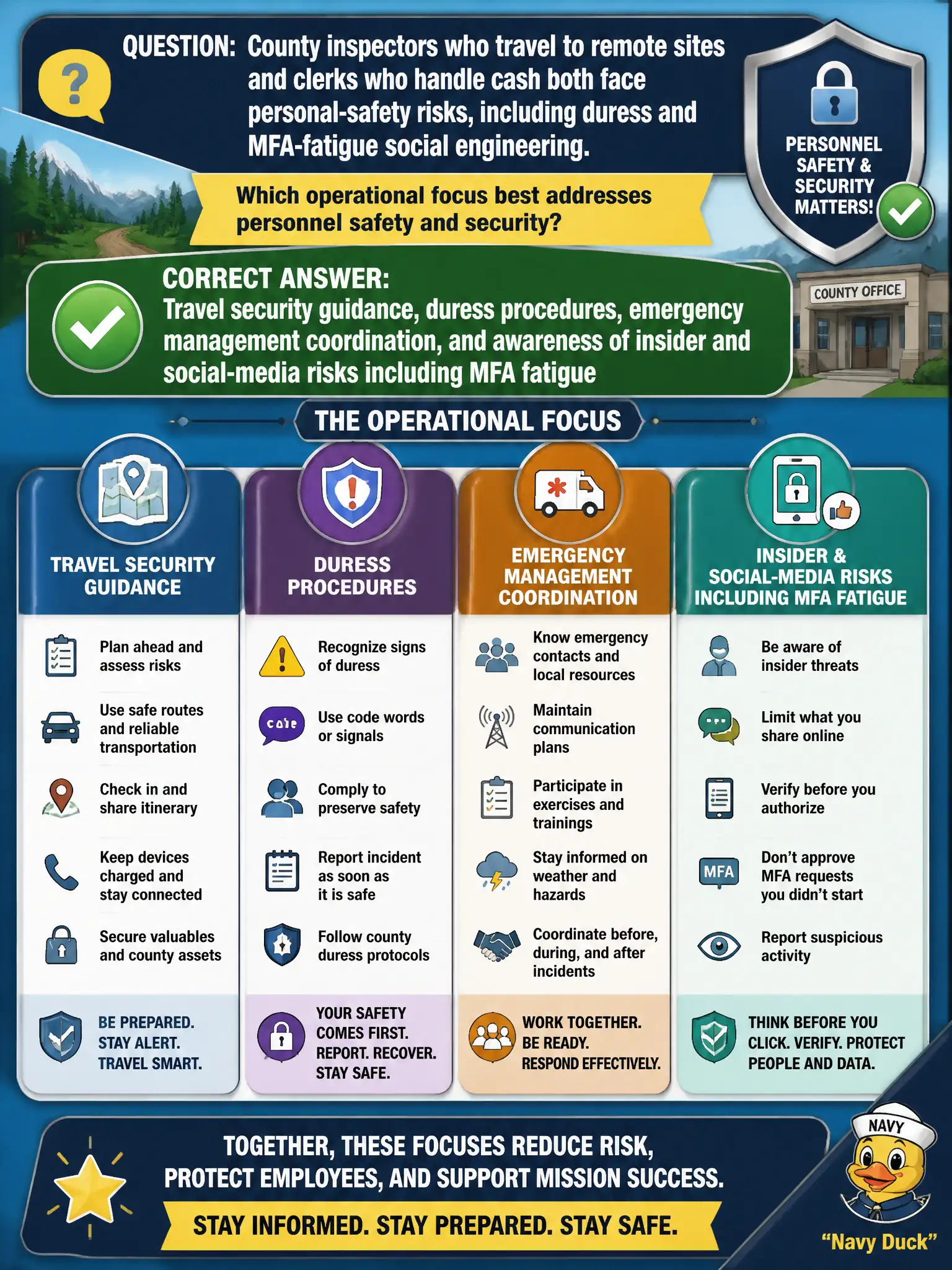
County inspectors who travel to remote sites and clerks who handle cash both face personal-safety risks, including duress and MFA-fatigue social engineering. Which operational focus best addresses personnel safety and security?
Select an answer to reveal the explanation.
Short Explanation
People need playbooks too: safe travel habits, a duress signal, who to call in an emergency, and training that covers insider chatter and “approve that push” MFA fatigue. Turning MFA off is not a safety plan.
Full Explanation
Personnel safety and security in municipal operations address both physical harm and social-engineering pathways that put people and credentials at risk. County inspectors traveling to remote sites need travel-security guidance—route awareness, check-in expectations, and safe meeting practices—while clerks handling cash need duress procedures that silently summon help without escalating a confrontational transaction. Emergency-management coordination ties those local signals into the city’s broader response structure. Awareness must also cover insider-threat behaviors and social-media OPSEC, including MFA-fatigue attacks that pressure staff to approve malicious push prompts. Together these measures treat people as assets to protect, not only as users of IT controls.
Disabling MFA for traveling staff removes a core authentication control and does not stop social engineering; attackers simply pivot to password theft or session abuse. Publishing inspectors’ exact daily routes on public social channels increases targeting risk under the guise of transparency. Treating duress alarms as optional because “physical safety is outside security’s remit” ignores that security operations routinely partner with facilities and emergency management on personnel protection for public-facing roles.
Exam caveat: personnel security topics on the exam span hiring/termination, training, and operational safety measures such as duress and travel security. MFA fatigue is a recognized social-engineering pattern; the remedy is better MFA design and awareness, not removing MFA. Physical and logical personnel risks often appear in the same scenario.
Operational check: confirm traveling field staff have written travel and check-in guidance, duress buttons or codes are tested at cash-handling counters, emergency contacts are current, and awareness modules explicitly cover MFA push bombing and oversharing on social platforms.