
Water-treatment OT controllers and office laptops share a vulnerability management program. How should patching be handled?
Select an answer to reveal the explanation.
Short Explanation
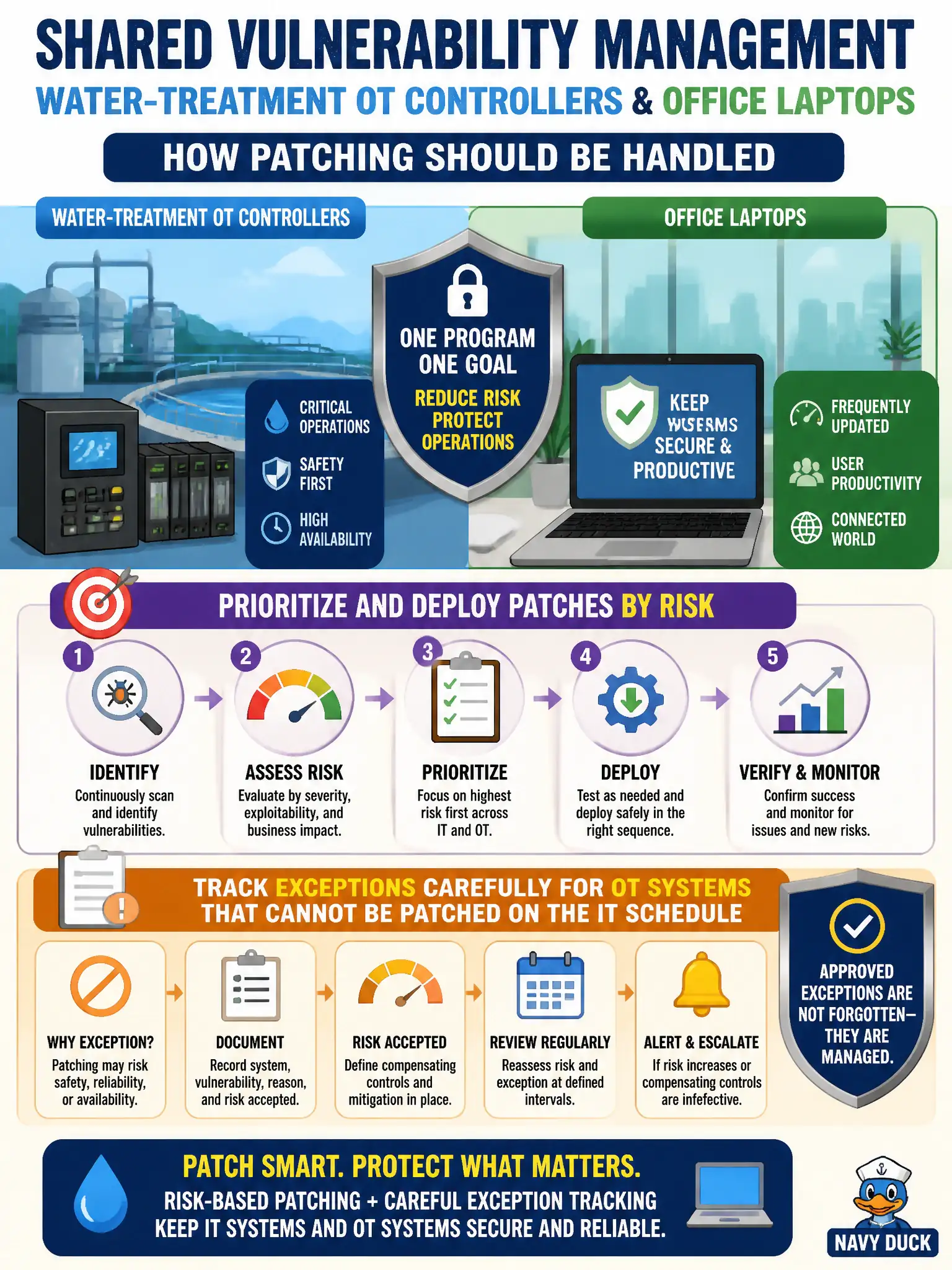
Laptops and pump controllers do not live on the same patch calendar. Prioritize by risk, push what you can, and formally track OT exceptions when you cannot move fast. Blind OT reboots at peak flow are how availability becomes the incident.
Full Explanation
Patch management across municipal IT and OT must prioritize by risk while recognizing that water, wastewater, or other OT controllers often cannot follow the same emergency reboot calendar as office laptops. Prioritize and deploy patches where impact and exploitability are high and change windows exist; for OT systems that cannot be patched on the IT schedule, track formal exceptions with compensating controls such as segmentation, monitoring, vendor-approved mitigations, and scheduled maintenance windows. That approach balances confidentiality and integrity needs against availability and safety for critical infrastructure. Vendor advisories still matter—they feed the risk prioritization even when immediate patching is deferred.
Forcing identical emergency reboots of OT controllers during peak pumping without change review can create public-safety and environmental incidents worse than the vulnerability being addressed. Never patching office laptops because OT risk is the only concern leaves an easy beachhead that attackers use to pivot toward industrial networks. Ignoring vendor advisories and waiting for full public exploitation everywhere maximizes exposure windows unnecessarily. Exam caveat: exception tracking is temporary risk acceptance with owners and dates—not permanent neglect. Operationally, maintain separate but linked IT/OT patch boards, require documented OT exceptions with compensations, and test patches in representative environments before production maintenance windows.