
A school-district SOC is choosing complementary host and deception controls beyond the firewall. Which mix is used appropriately?
Select an answer to reveal the explanation.
Short Explanation
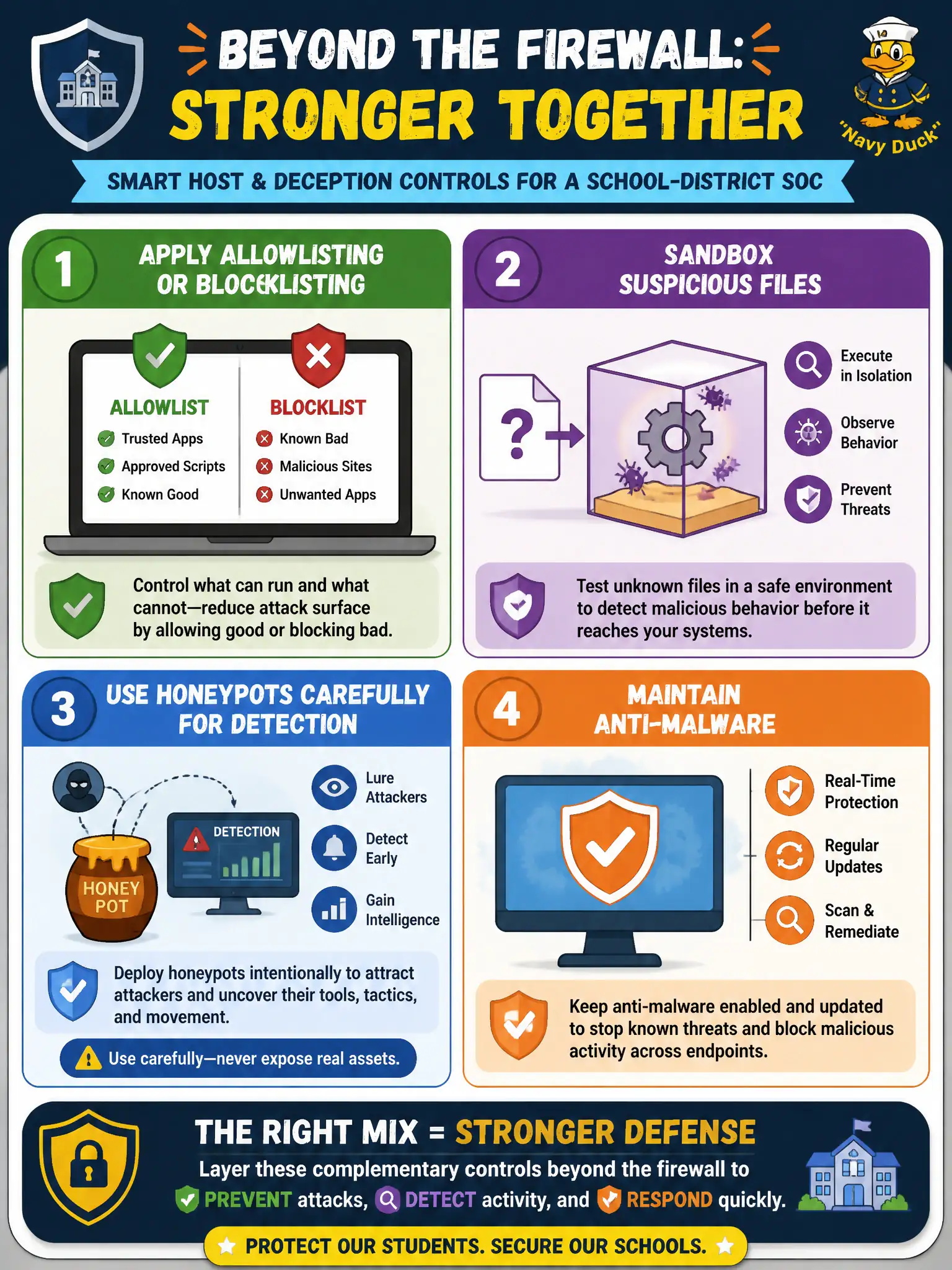
Think toolbox, not one magic gadget: allow or deny lists, sandbox the weird attachments, maybe a honeypot for early warning, and keep anti-malware on. Parking payroll in a honeynet or grabbing random freeware is the wrong complementary mix.
Full Explanation
Endpoint and file-borne threats against city workers require complementary controls rather than a single tool. Allowlisting or blocklisting constrains what can execute or enter the environment; sandboxing detonates suspicious files in isolation before they reach production mailboxes or shares; honeypots, used carefully, can provide early warning of internal reconnaissance without hosting real citizen data; and maintained anti-malware provides signature and behavior coverage for known families. Together these reduce reliance on any one detection method and address both opportunistic malware and targeted lures aimed at finance or records staff. Governance defines exceptions, update cadence, and who reviews sandbox verdicts.
Replacing all anti-malware with unrestricted freeware from unknown mirrors introduces supply-chain and integrity risk under the guise of savings. Running production payroll exclusively inside an internet-exposed honeynet places real high-value processing in an environment meant to attract attackers—an inversion of honeypot purpose. Disabling allowlisting because it might block a convenient shadow-IT tool prioritizes convenience over controlled execution and undermines the complementary model. Exam caveat: honeypots must be isolated and monitored—they are detection aids, not production platforms. Operationally, enforce allowlisting on high-risk roles where feasible, sandbox inbound attachments to finance, keep anti-malware current, and place any honeypot off trust paths that reach payroll or citizen databases.