
A city CISO contrasts an annual independent audit of payroll ITGCs with the SOC's weekly vulnerability scans. What distinction best explains their different purposes?
Select an answer to reveal the explanation.
Short Explanation
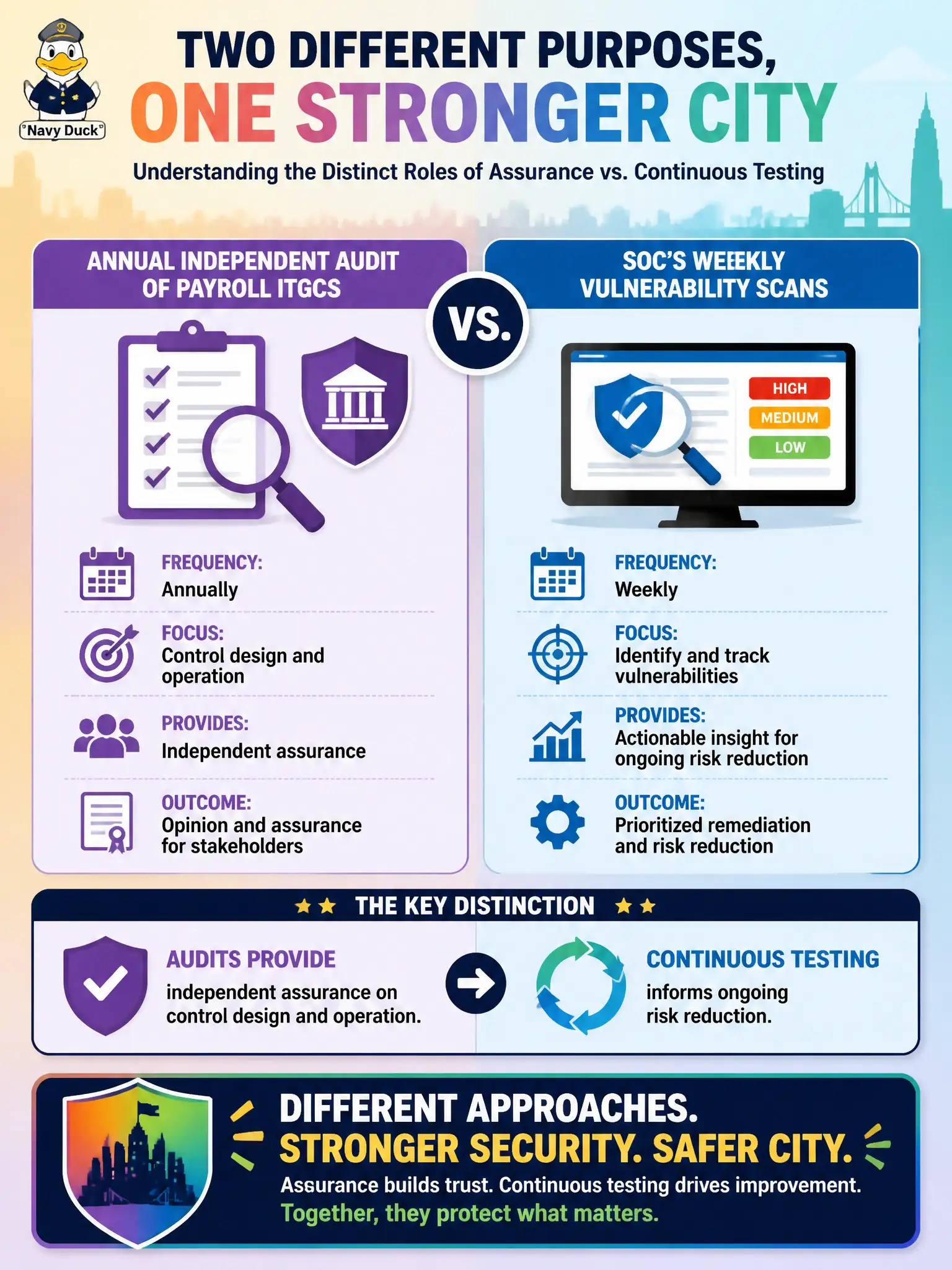
Audit is the formal report card for outsiders and leadership; weekly scans are the gym routine that keeps you sharp. One gives assurance on design and operation, the other feeds continuous fixing. They work together — they are not the same sport.
Full Explanation
Audits and continuous testing serve complementary but distinct purposes in a municipal security program. An audit—internal or external—provides independent assurance that selected controls are designed appropriately and operated effectively over a defined period, producing formal findings, opinions, or reports for leadership, councils, grantors, or external financial auditors. Continuous testing, including vulnerability scanning and automated control monitoring, supplies ongoing telemetry that drives risk reduction: patching, configuration hardening, and alert tuning between formal assurance cycles. Confusing the two leads cities either to treat weekly scans as a substitute for independent assurance or to treat annual audits as the only moment when weaknesses matter. Mature programs keep both: assurance for accountability, continuous testing for day-to-day improvement.
Claiming audits and continuous scans are identical with interchangeable reporting audiences erases independence, sampling methodology, and governance expectations that audits carry. Asserting that weekly scans replace independent assurance over control design ignores that scanners primarily find technical exposures—they do not, by themselves, conclude that access reviews or change approvals operated as designed. Framing audits as existing only to discover zero-days that scanners cannot find misstates audit objectives, which center on control design and operation rather than novel exploit research. Exam caveat: CISSP expects you to distinguish assurance activities from continuous monitoring while recognizing both support risk management. Operationally, map which stakeholders receive audit reports versus scan dashboards, and ensure remediation of continuous findings feeds the same risk register that audit issues enter.