
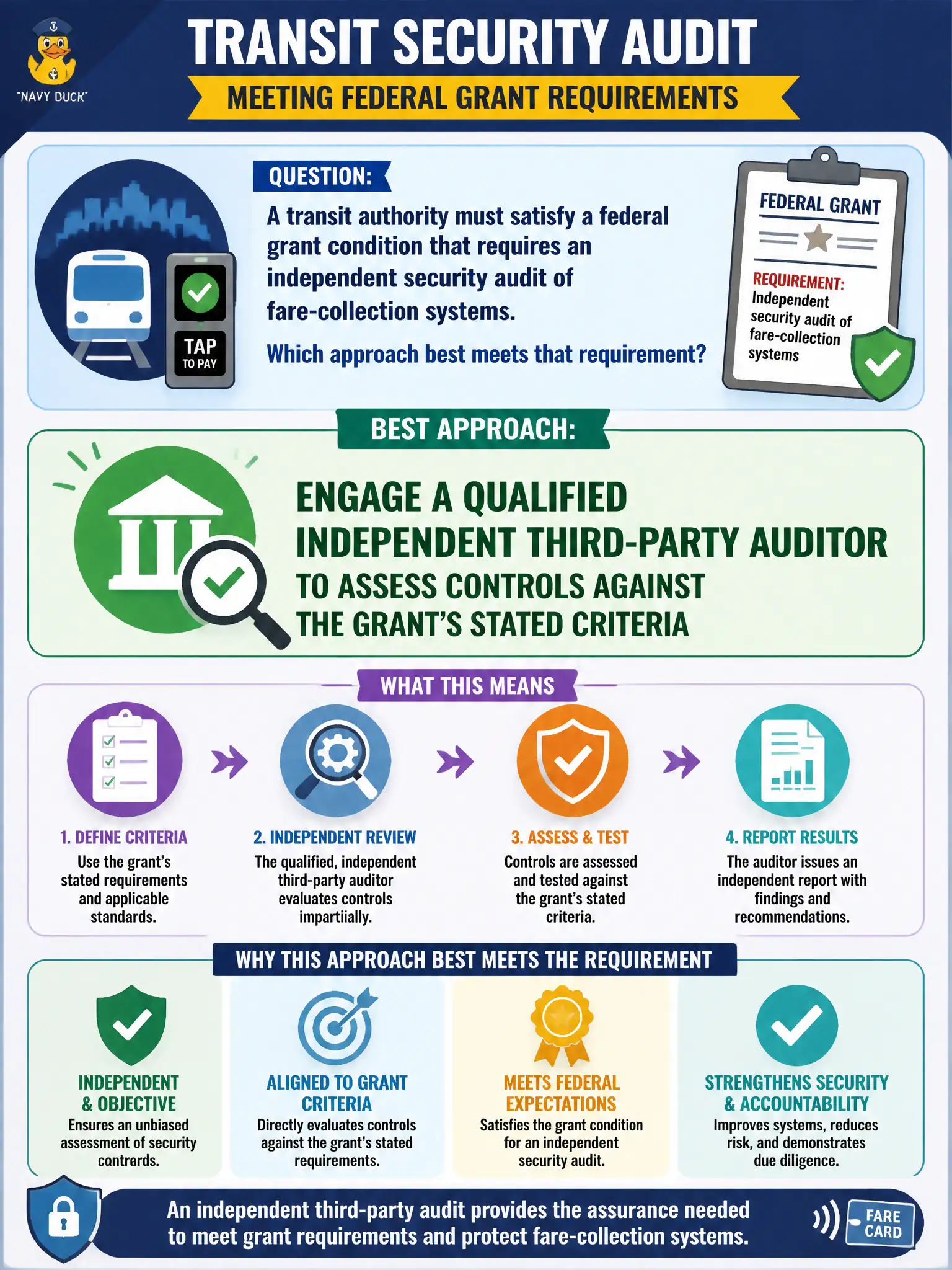
A transit authority must satisfy a federal grant condition that requires an independent security audit of fare-collection systems. Which approach best meets that requirement?
Select an answer to reveal the explanation.
Short Explanation
Grant language that says independent audit means someone outside the build team grades the homework. A third-party auditor against the grant criteria fits. Self-attestation by the coder, blogs, or help-desk pep talks do not count as independence.
Full Explanation
When grant language requires an independent audit of controls, independence and criteria alignment are non-negotiable. A qualified third-party auditor—organizationally separate from the team that built and operates the fare application—assesses design and operation against the grant’s stated control criteria, documents scope and exceptions, and issues an opinion or report that funding agencies can rely on. That separation protects objectivity: the assessor does not grade their own homework, and the city can demonstrate to grantors that assurance was obtained under professional standards appropriate to the funding instrument. Criteria may reference frameworks, grant-specific security requirements, or agreed-upon procedures; whatever the text says, the engagement must map findings to those criteria rather than to informal internal preferences.
A developer who coded the fare app signing a self-attestation checklist fails independence and typically lacks the structured evidence and methodology an external review provides. Publishing a marketing blog about cybersecurity culture may support awareness messaging but produces no control testing, no sampling, and no independent conclusion. Asking only the help desk to interview itself about password resets creates circular assurance and ignores broader application, identity, and operational controls the grant likely expects. Exam caveat: “independent” means free of management bias and self-review risk—not merely “someone else in the same squad who was free that afternoon.” Operationally, procure the auditor with a clear statement of work tied to grant clauses, preserve working papers and remediation evidence, and brief the grant administrator on scope limitations before fieldwork so surprises do not jeopardize funding.