
Assessment results for the emergency-dispatch network must inform both the city council and the engineering team. How should reports be tailored?
Select an answer to reveal the explanation.
Short Explanation
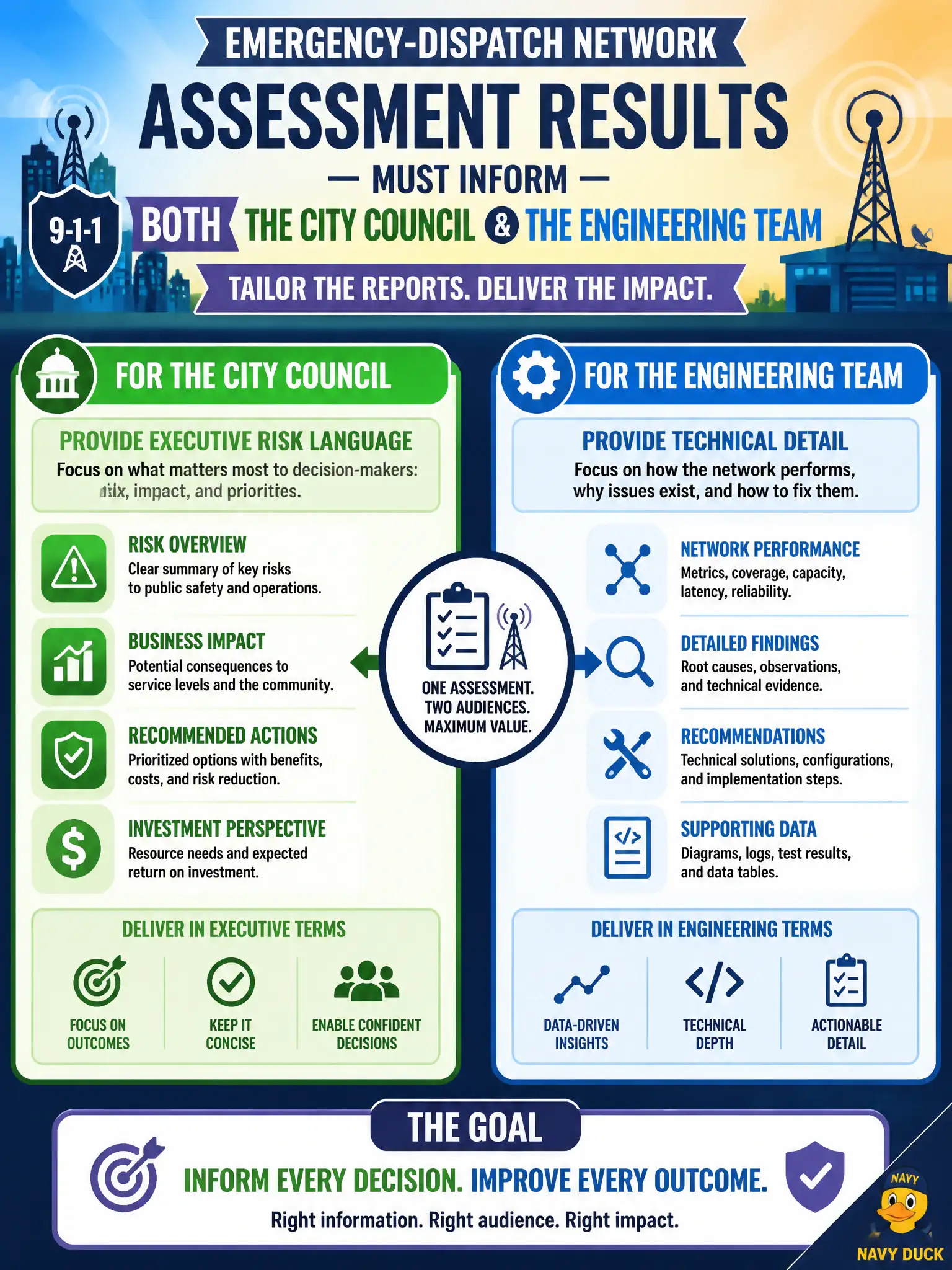
Council needs the weather report; engineers need the wiring diagram. Tailor the same assessment two ways. Dumping pcaps on council, handing raw exploits upstairs, or starving engineers of detail fails both audiences.
Full Explanation
Generating appropriate reports means matching content depth to audience decisions. Assessment results for an emergency-dispatch network must inform city council (risk, impact, funding, residual risk acceptance) and engineering (technical defects, reproduction steps, remediation guidance). Providing executive risk language for council and technical detail for engineers ensures each audience can act—policy and budget on one side, concrete fixes on the other—without drowning decision-makers in the wrong artifacts.
Sending identical deep packet traces to council and engineers alike overwhelms executives with low-level telemetry they cannot prioritize. Giving council only raw exploit scripts without risk context fails to explain business impact and urgency in governance terms. Withholding all technical detail from engineers to keep reports short blocks remediation and wastes the assessment.
Exam caveat: Domain 6 reporting emphasizes audience-appropriate content. Tailoring is not ‘hiding truth’; it is packaging the same underlying findings for different decisions.
Operational check: Produce a council brief with risk ratings, service impact on dispatch, and recommended decisions; produce an engineering annex with evidence, affected components, and fix verification criteria; version both from the same finding set so messages stay consistent.