
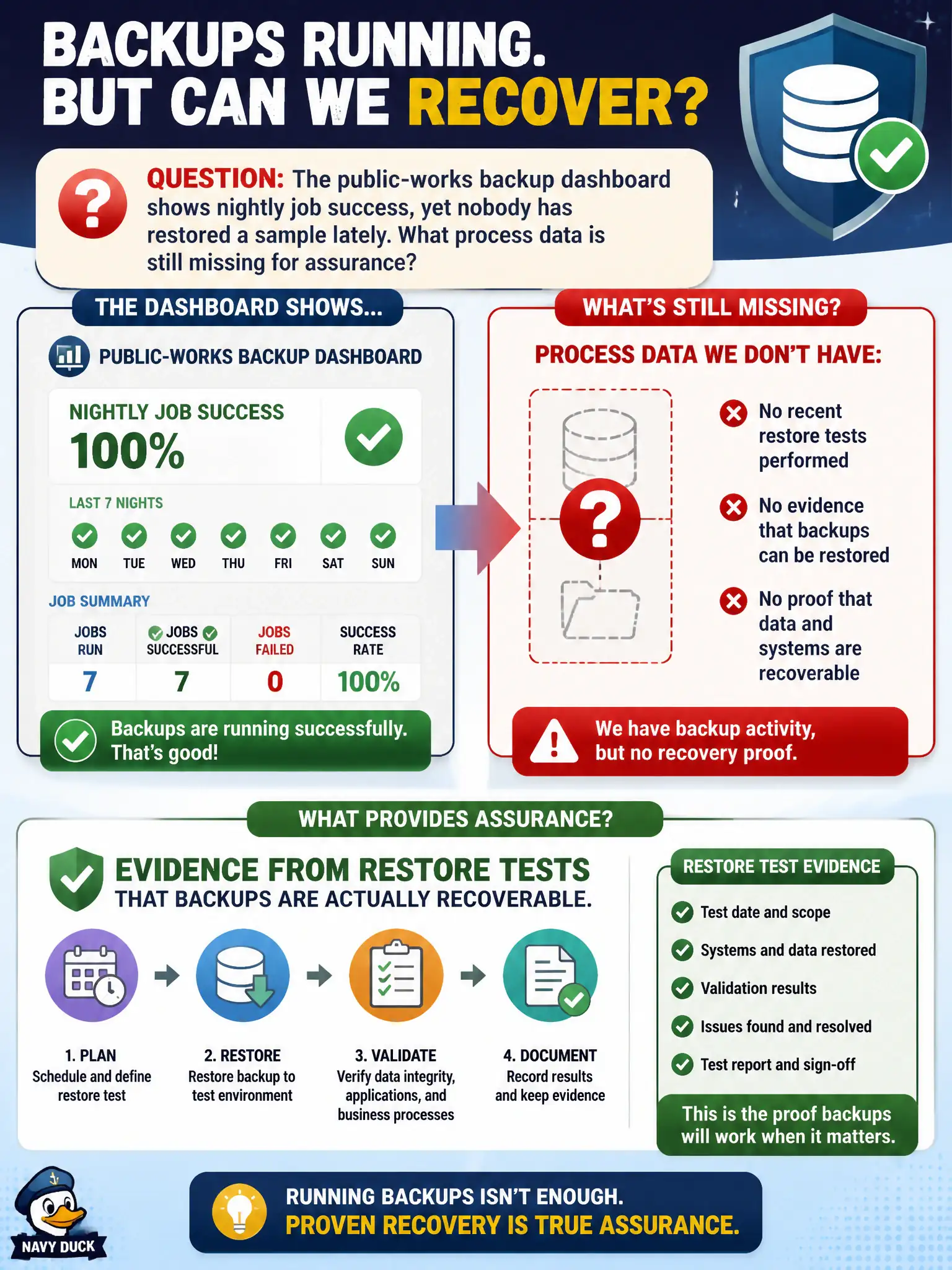
The public-works backup dashboard shows nightly job success, yet nobody has restored a sample lately. What process data is still missing for assurance?
Select an answer to reveal the explanation.
Short Explanation
Green backup lights can lie if you never try a restore—like a spare tire you have never inflated. Collect restore-test evidence. Extra checkmarks, shredding logs, or banning restores do not prove recoverability.
Full Explanation
Backup success indicators are incomplete without verification that data can be restored within required objectives. For public-works systems, nightly job-success checkmarks show that backup jobs ran—not that backups are readable, complete, or restorable inside RTO/RPO. Evidence from restore tests is the process data that validates recoverability and is still missing when nobody has restored a sample lately. Domain 6 process-data collection for backup/recovery expects that validation evidence, not dashboard green alone.
Collecting more green checkmarks without recovery validation amplifies false assurance. Deleting backup logs older than one day destroys forensic and operational history needed to investigate failures. A policy that forbids ever testing restores ‘in case they fail’ institutionalizes untested disaster readiness and is the opposite of assurance.
Exam caveat: ‘Backups succeeded’ ≠ ‘restores work.’ When stems contrast dashboards with missing restores, the correct missing data is restore-test evidence.
Operational check: Schedule periodic sample restores for critical public-works datasets, document time-to-recover against objectives, retain restore-test records for management review, and escalate when restores fail or exceed RTO even if nightly jobs were green.