
A county is fitting out a municipal server room. Which control set best reflects appropriate facility engineering for that space?
Select an answer to reveal the explanation.
Short Explanation
Server rooms need locked doors, fire smarts, cool air, and power that does not quit when the grid hiccups. Skipping those is how a quiet closet becomes an outage headline.
Full Explanation
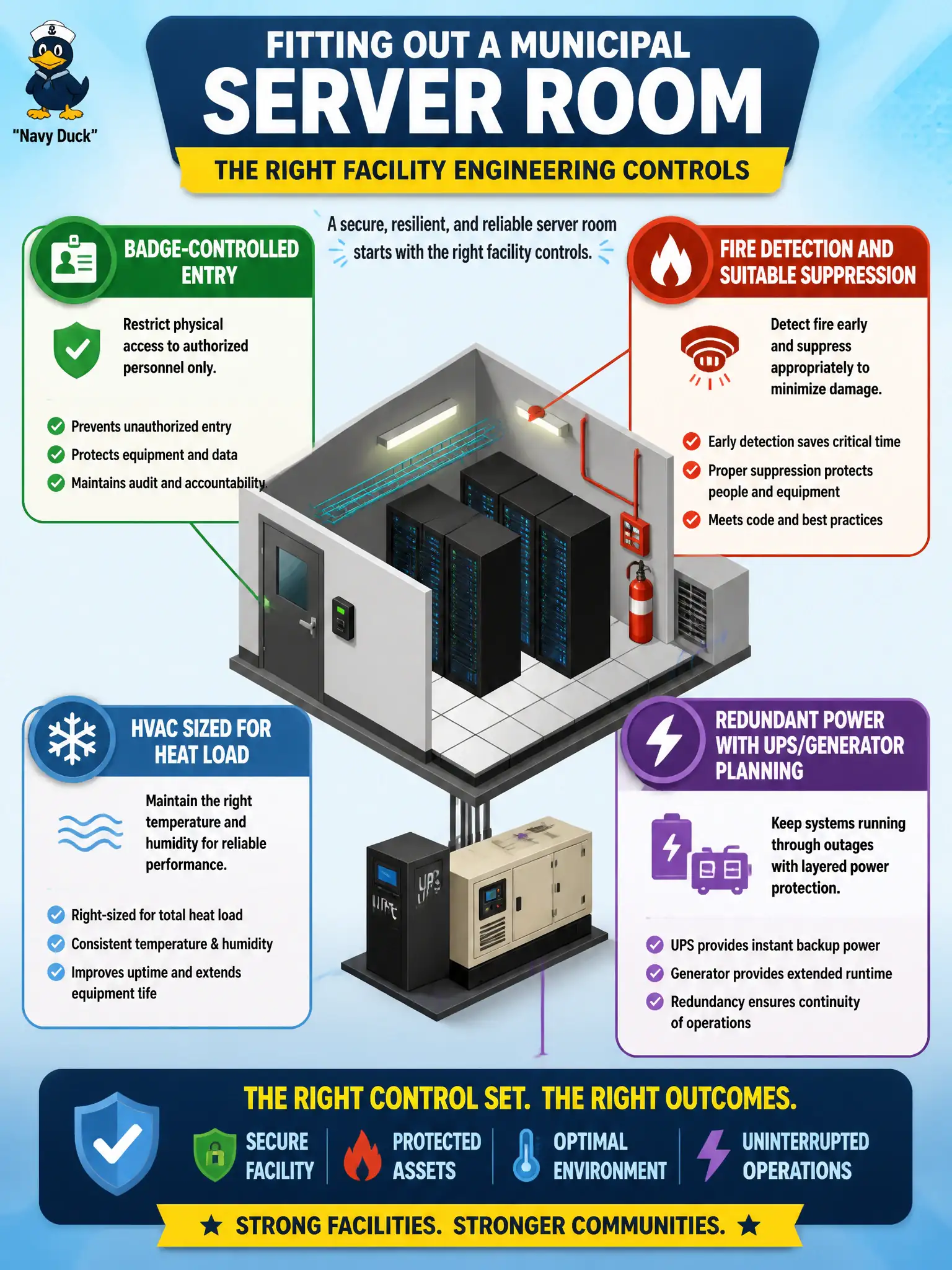
A municipal server room needs layered facility engineering: badge-controlled entry to limit physical access; fire detection and suppression suitable for IT spaces; HVAC sized for continuous heat load; and power resilience through UPS and generator planning with tested failover. Together these controls protect confidentiality (unauthorized entry), integrity (tampering and environmental damage), and availability (cooling and power continuity) for city systems concentrated in one room.
Unlocked glass doors, absent fire detection, and a shared non-redundant power strip with a break room create open access and single points of failure. Public tours without escort policy expose racks and console access. Smoke-only alarms without power and cooling design ignore the primary availability threats that take servers offline without flames.
Exam caveat: CISSP Domain 3 facility controls treat access, fire, environmental, and power systems as an integrated set for data centers and server rooms—not optional amenities.
Operational check: commission badge readers with logging; verify suppression agent compatibility and detection zoning; measure rack heat load against HVAC capacity; test UPS runtime and generator transfer under load; review physical access lists quarterly; seal cable penetrations and control visitor escort.