
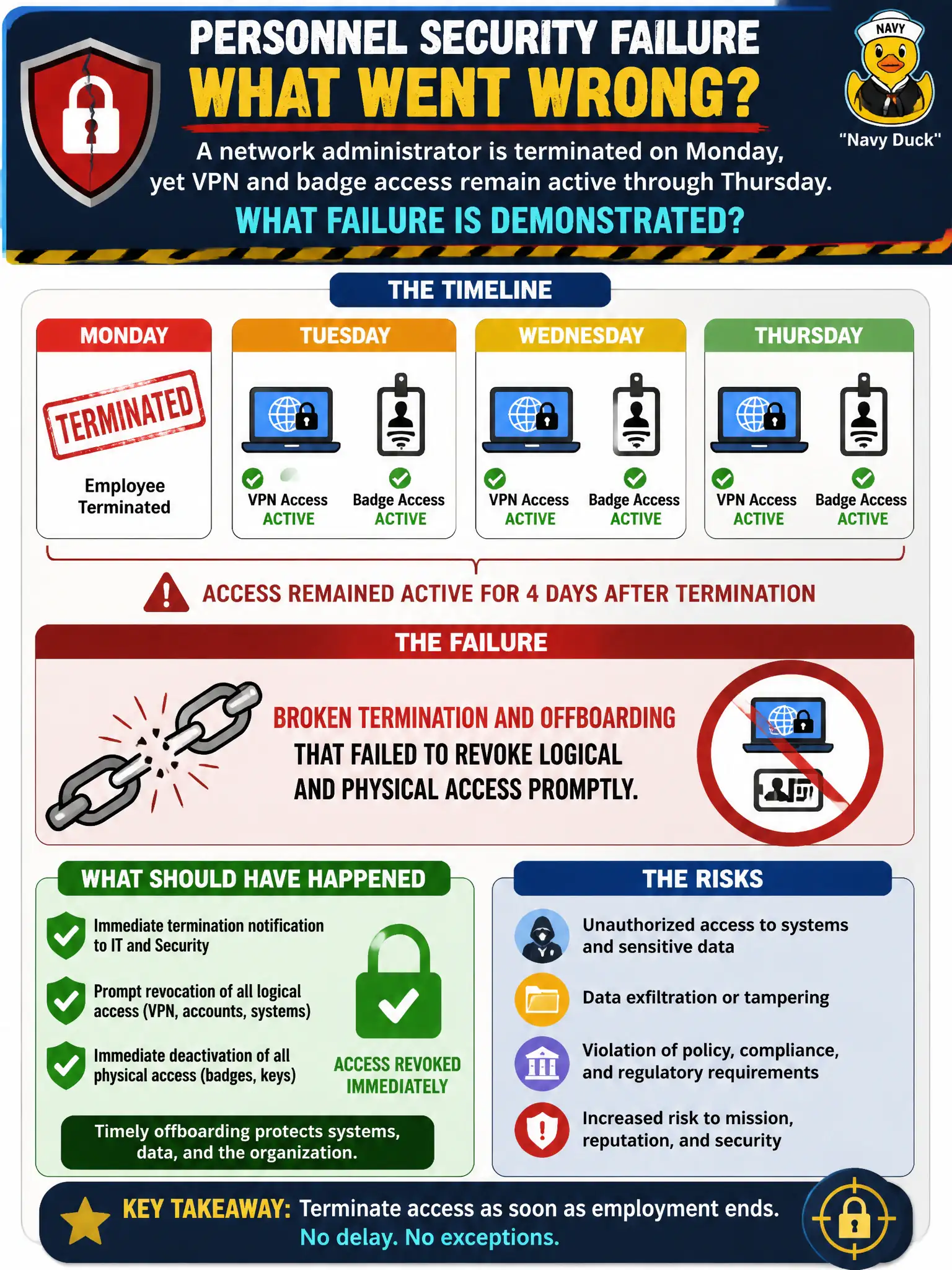
A network administrator is terminated on Monday, yet VPN and badge access remain active through Thursday. What personnel security failure is demonstrated?
Select an answer to reveal the explanation.
Short Explanation
Fired Monday, keys still work Thursday—that's an offboarding fire drill that never started. Termination has to yank VPN, badges, and accounts in lockstep, not on a leisurely cleanup schedule. Lingering access after separation is classic insider-risk theater.
Full Explanation
Termination and offboarding must promptly revoke logical and physical access when employment ends; leaving VPN and badge access active for days after termination is a classic personnel security failure. A network administrator retains privileged remote and facility access during that window, creating avoidable insider and account-abuse risk against municipal systems. Encryption key length does not explain delayed revocation—key management is unrelated to same-day disablement of accounts and badges. Mandatory vacation policies address fraud detection through absence, not a prohibition on disabling access mid-week after separation. Shared admin credentials remaining available is a separate failure mode and does not convert broken offboarding into successful job rotation. Exam caveat: CISSP emphasizes timely access revocation as part of personnel lifecycle controls; delayed disablement is treated as a serious control break regardless of backlog excuses. Operational check: use a termination checklist that simultaneously disables directory accounts, VPN, email, privileged groups, and badge access; require same-day execution with dual confirmation from HR and IT; and sample recently separated privileged users for residual entitlements. Automate identity lifecycle where possible and escalate any access that remains after the separation effective time.