
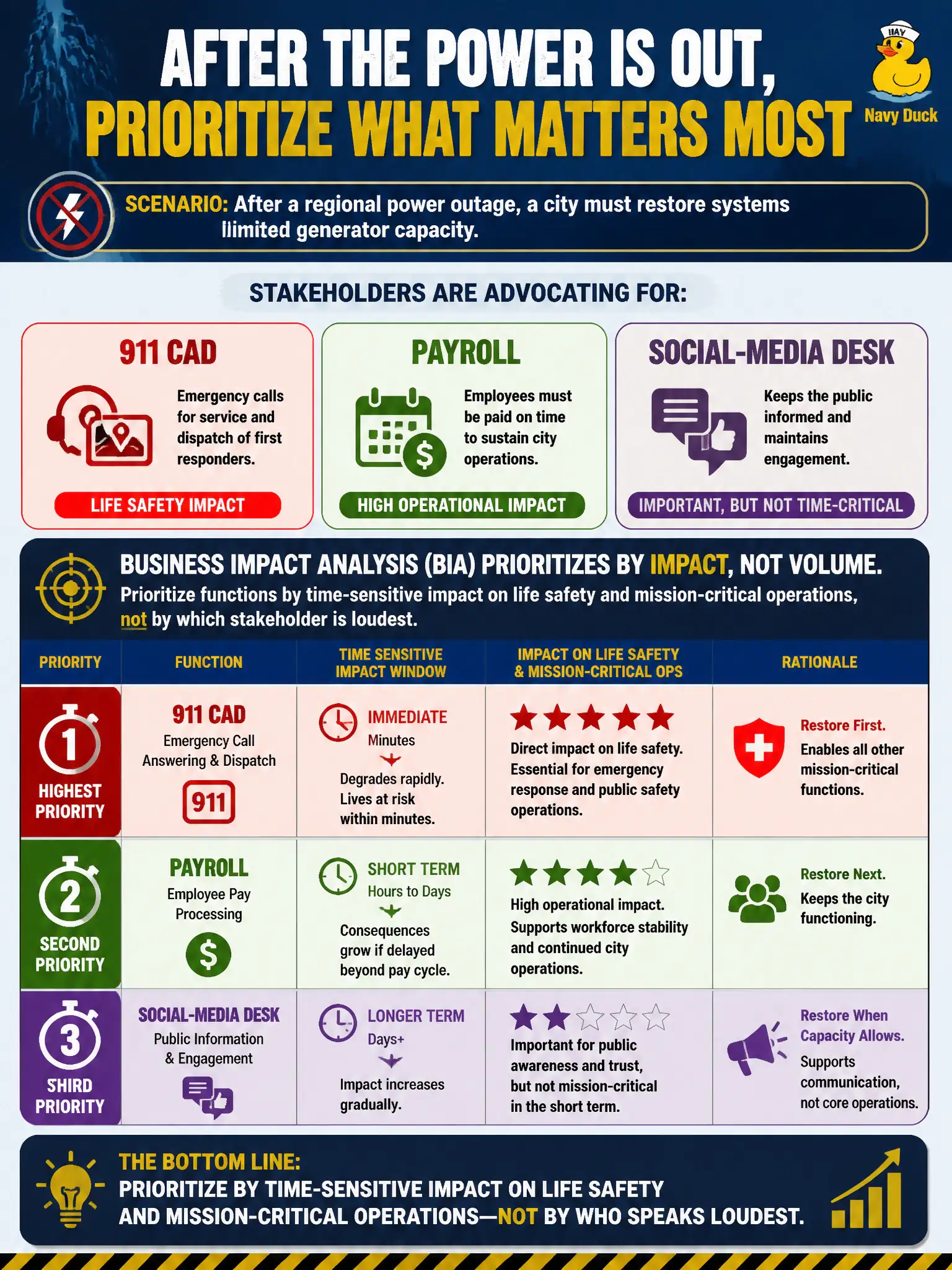
After a regional power outage, a city must restore systems under limited generator capacity. Stakeholders argue for 911 CAD, payroll, and the social-media desk. How should the business impact analysis prioritize restoration?
Select an answer to reveal the explanation.
Short Explanation
Think triage in an ER, not a shouting match in a hallway. A BIA ranks what hurts the mission hardest and fastest—911 CAD beats payroll and the tweet desk when generator fuel is scarce. Loud stakeholders are data points; impact over time is the scorecard.
Full Explanation
Business impact analysis prioritizes restoration by how quickly and severely downtime harms life safety and mission delivery, not by who argues loudest in the recovery war room. Under constrained generator capacity after a regional outage, computer-aided dispatch for 911 typically shows a steep impact curve within minutes: delayed emergency response can cost lives and violate the municipality's core public-safety duty. Payroll and social-media operations matter, yet their maximum tolerable downtime is usually measured in hours or days rather than minutes; unpaid staff create political and morale pressure, and public messaging supports confidence, but neither replaces immediate emergency dispatch. Selecting restoration based on stakeholder volume or optics substitutes influence for impact analysis and can starve the functions whose outage produces irreversible harm first. Equal or alphabetical restoration likewise ignores differential criticality and wastes scarce fuel and technician time on systems that can wait. Exam caveat: CISSP expects BIA-driven, time-sensitive prioritization—political sensitivity alone does not equal mission criticality unless the BIA documents comparable downtime consequences. Operational check: maintain BIA impact curves and RTO/MTD tables that name life-safety and critical infrastructure ahead of administrative and communications support; when fuel is limited, restore in documented impact order and brief executives with evidence rather than hallway consensus. Document who owns each restoration decision, rehearse constrained-capacity scenarios in exercises, and update priorities when services or dependencies change so the next outage still follows impact, not volume.