
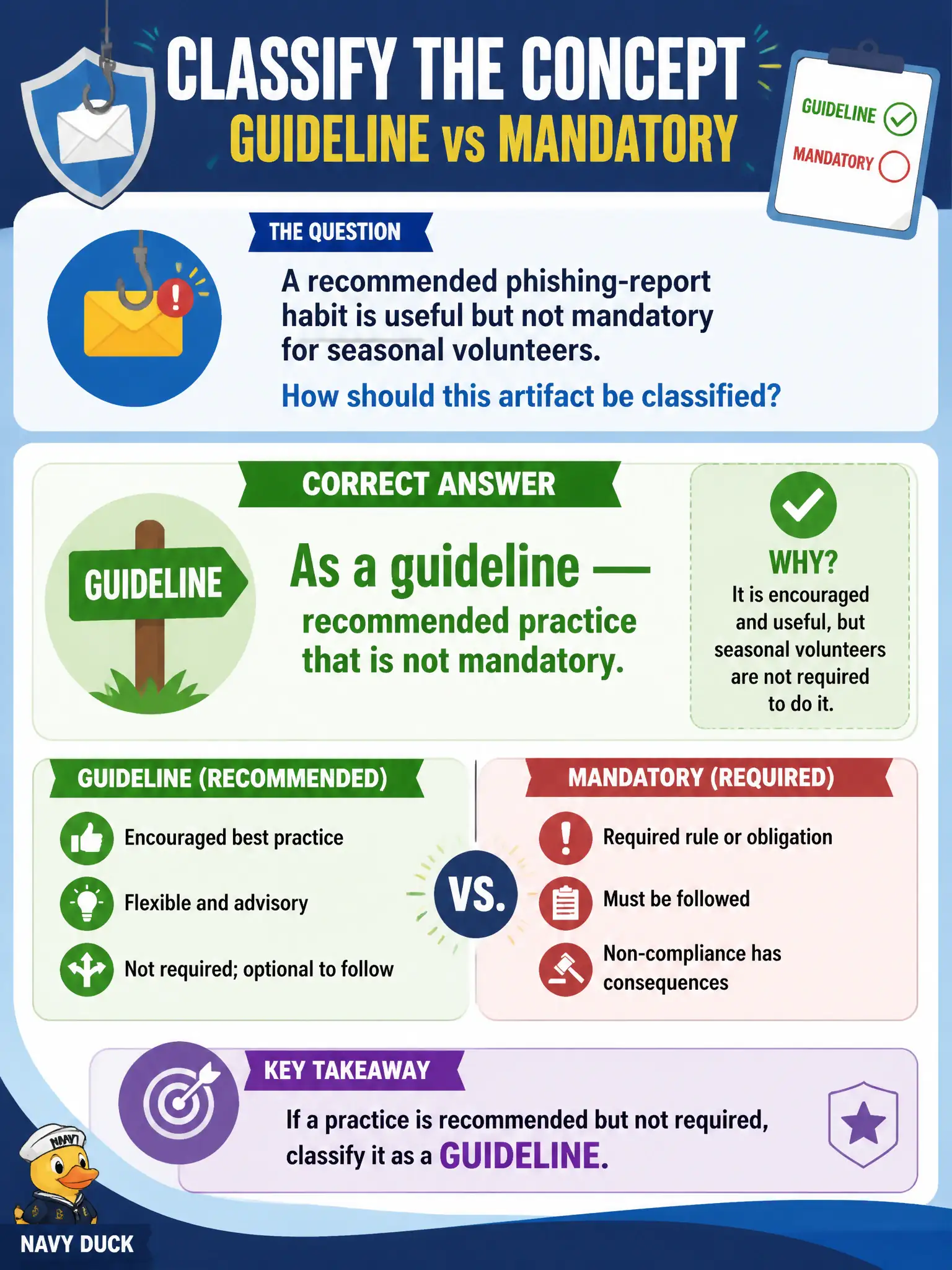
A recommended phishing-report habit is useful but not mandatory for seasonal volunteers. How should this artifact be classified?
Select an answer to reveal the explanation.
Short Explanation
If it is helpful advice but nobody gets written up for skipping it, you are looking at a guideline. Standards and policies carry must-do weight; guidelines say 'here's a smart habit.' Seasonal volunteers often get the recommended version first.
Full Explanation
Guidelines are recommended practices that are not mandatory. A phishing-report habit that is useful for seasonal volunteers but explicitly not mandatory should be classified as a guideline: it encourages good behavior without creating a must-do standard or policy obligation for that population. Clear labeling prevents volunteer programs from being held to unenforceable 'mandatory' language while still promoting reporting culture.
Calling it a standard implies mandatory criteria with no exceptions, which contradicts the non-mandatory framing. Treating it as a law enforceable by criminal prosecution for every missed report wildly overstates both authority and consequence. Labeling it a baseline configuration image for municipal laptops confuses a behavioral recommendation with a technical build artifact.
Exam caveat: If the stem says recommended/not mandatory, the artifact is a guideline. Standards and policies carry obligatory weight; baselines are configuration sets.
Operational check: Publish the phishing-reporting tip under guidelines for volunteers, keep mandatory reporting language in employee policy/standards where appropriate, train seasonal staff on the recommendation, and measure report rates without treating misses as policy violations for that cohort.