
After a municipal merger, nobody owns security decisions across former city and county IT. What should leadership establish first to restore oversight?
Select an answer to reveal the explanation.
Short Explanation
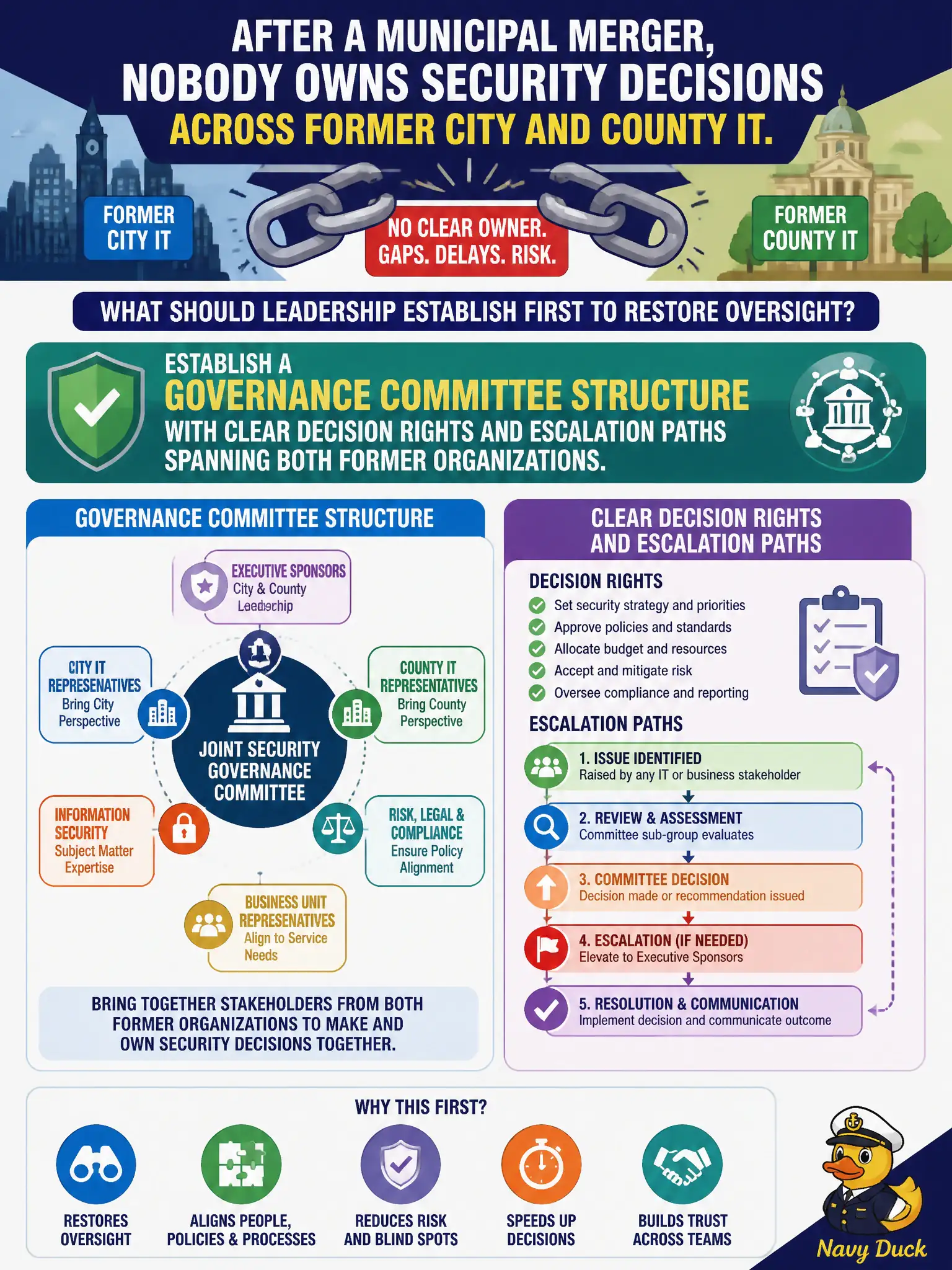
Mergers without decision owners are like two fire departments sharing one truck and arguing over who drives. A real governance committee with clear rights and escalations puts someone in the driver's seat. Chat polls and shared SSIDs do not fix ownership.
Full Explanation
After a municipal merger, fragmented authority is a governance failure: security decisions need clear decision rights, escalation paths, and cross-organization coverage. Establishing a governance committee structure that spans both former city and county IT restores oversight by defining who decides, who advises, and how conflicts escalate. Without that structure, exceptions proliferate and accountability dissolves across legacy teams.
A single shared Wi-Fi SSID creates a cosmetic sense of unity without assigning decision ownership and may even expand risk if trust boundaries are blurred. An informal chat channel where engineers vote on exceptions daily substitutes popularity for authority and produces inconsistent, unauditable exceptions. Freezing all security work until a new mayor is elected leaves the merged environment unmanaged during a high-risk transition and confuses political calendars with control ownership.
Exam caveat: Merger and acquisition stems usually want governance and accountability first, not tactical network merges or work stoppages.
Operational check: Charter a joint security governance committee, publish a RACI for policy exceptions and architecture decisions, set escalation SLAs, and inventory overlapping tools and identities before normalizing them under the new decision rights.