
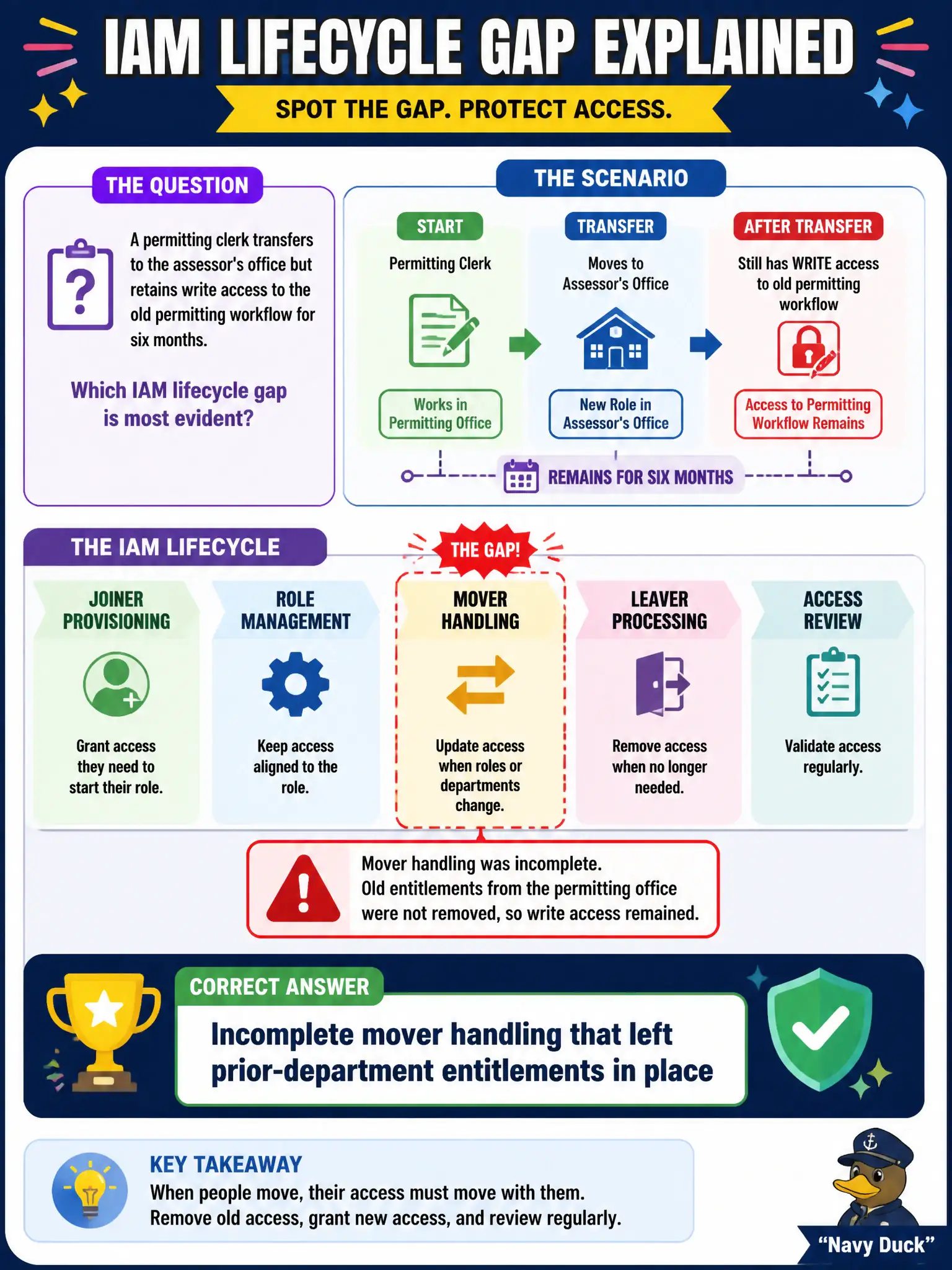
A permitting clerk transfers to the assessor's office but retains write access to the old permitting workflow for six months. Which IAM lifecycle gap is most evident?
Select an answer to reveal the explanation.
Short Explanation
New desk, old keys still on the ring—classic mover mess. Joiner, mover, leaver is not only hire and fire; transfers need entitlements swapped, not stacked.
Full Explanation
Identity lifecycle must treat movers—transfers and role changes—as first-class events, not only joiners and leavers. When a permitting clerk moves to the assessor’s office yet retains write access to the old permitting workflow for months, prior-department entitlements were never swapped or removed. That incomplete mover handling creates privilege accumulation, blurs segregation of duties between permitting and assessment functions, and expands the blast radius if the account is later abused.
Issuing a longer password for the new department strengthens a secret at best; it does not remove stale write rights on the prior workflow. A hardware token unique to building badges addresses facility access, not application entitlement cleanup. Overuse of MAC labels on low-sensitivity forms is unrelated to the transfer gap; labeling theater does not substitute for role change workflows and recertification.
Exam caveat: JML questions often hide the failure in the mover path while distractors talk about passwords or tokens—focus on entitlement add/remove relative to the new job. Operational check: trigger mover playbooks from HRIS department-change events, default to remove-then-add or carefully timed cutover, require manager attestation of both new and retired access, and sample transferred staff quarterly for residual prior-department rights.