
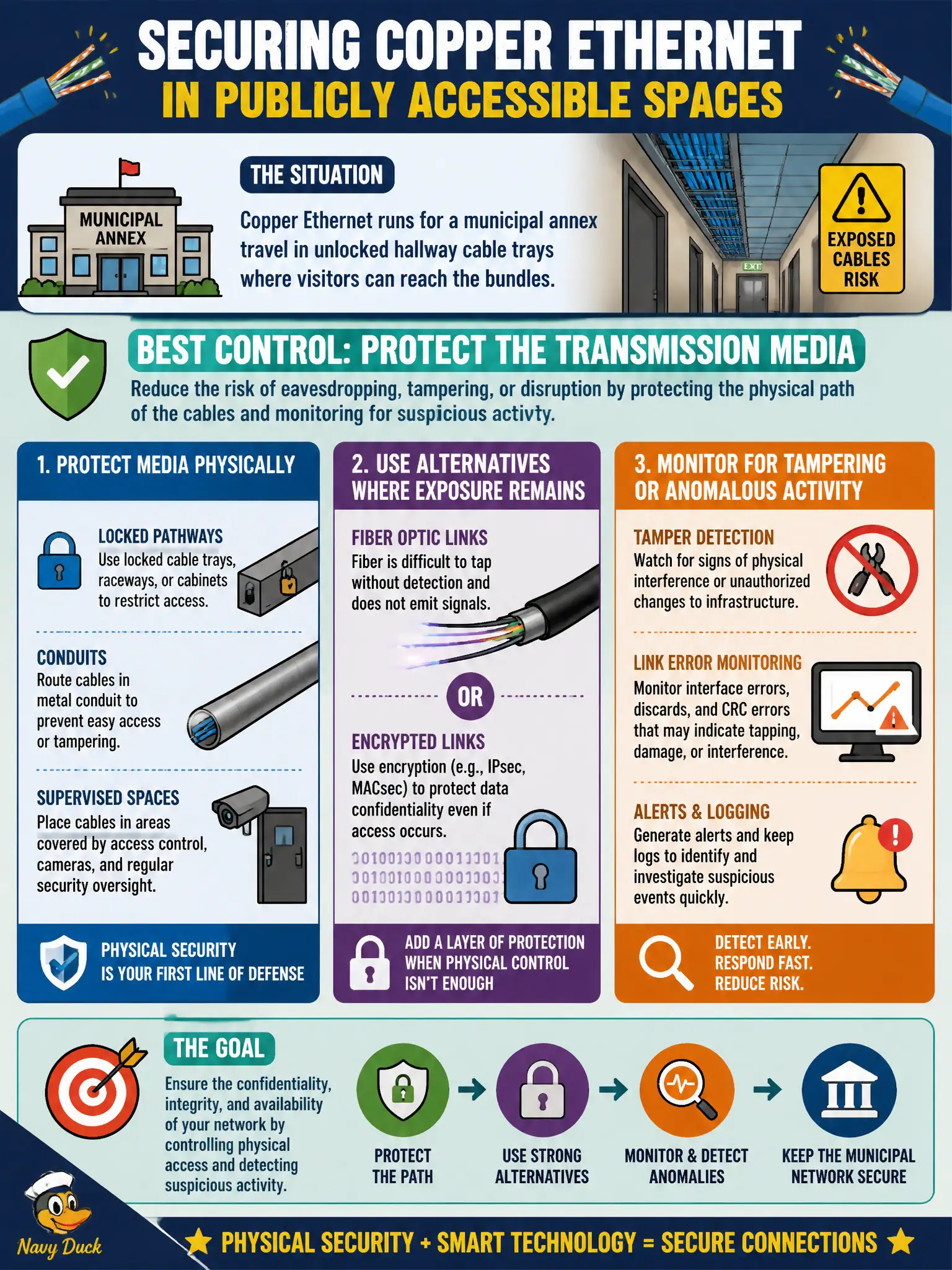
Copper Ethernet runs for a municipal annex travel in unlocked hallway cable trays where visitors can reach the bundles. Which control best addresses transmission-media risk?
Select an answer to reveal the explanation.
Short Explanation
Unlocked hallway copper is a gift-wrapped tap kit. Lock the path, prefer media that’s harder to silently abuse, and watch for weird link errors—physical access beats a lot of fancy firewalls if the wire is sitting in the open.
Full Explanation
Unlocked hallway cable trays give visitors physical reach to municipal Ethernet bundles—enough access for taps, cuts, or insertion of unauthorized devices. Protecting transmission media physically with locked pathways, conduits, or supervised spaces raises the cost of tampering. Where exposure cannot be fully eliminated, prefer fiber that is harder to tap silently without detection, or encrypt links so compromised media yields ciphertext. Monitoring for tampering and anomalous link errors provides detection when physical controls alone are imperfect. Physical access to copper often bypasses years of logical firewall work.
Labeling every cable with VLAN IDs and subnet maps makes reconnaissance easier for an attacker who already reaches the tray; documentation is not a substitute for locks. Switching exclusively to infrared free-space links through public corridors without monitoring trades one exposed medium for another line-of-sight path that still needs protection and detection. Leaving trays unlocked but doubling cable counts so tapping any one pair seems statistically unlikely is superstition, not control—attackers choose valuable pairs deliberately.
Exam caveat: CISSP physical and network transmission security emphasizes protecting the medium and detecting interference. Obscurity via extra cables or helpful labeling of sensitive topology does not remediate open trays.
Operational check: lock or enclose annex trays in public corridors; restrict keys and log access; evaluate fiber or link encryption for remaining exposed runs; baseline optical/electrical error counters; and investigate sudden CRC/link flaps as potential tampering indicators.