
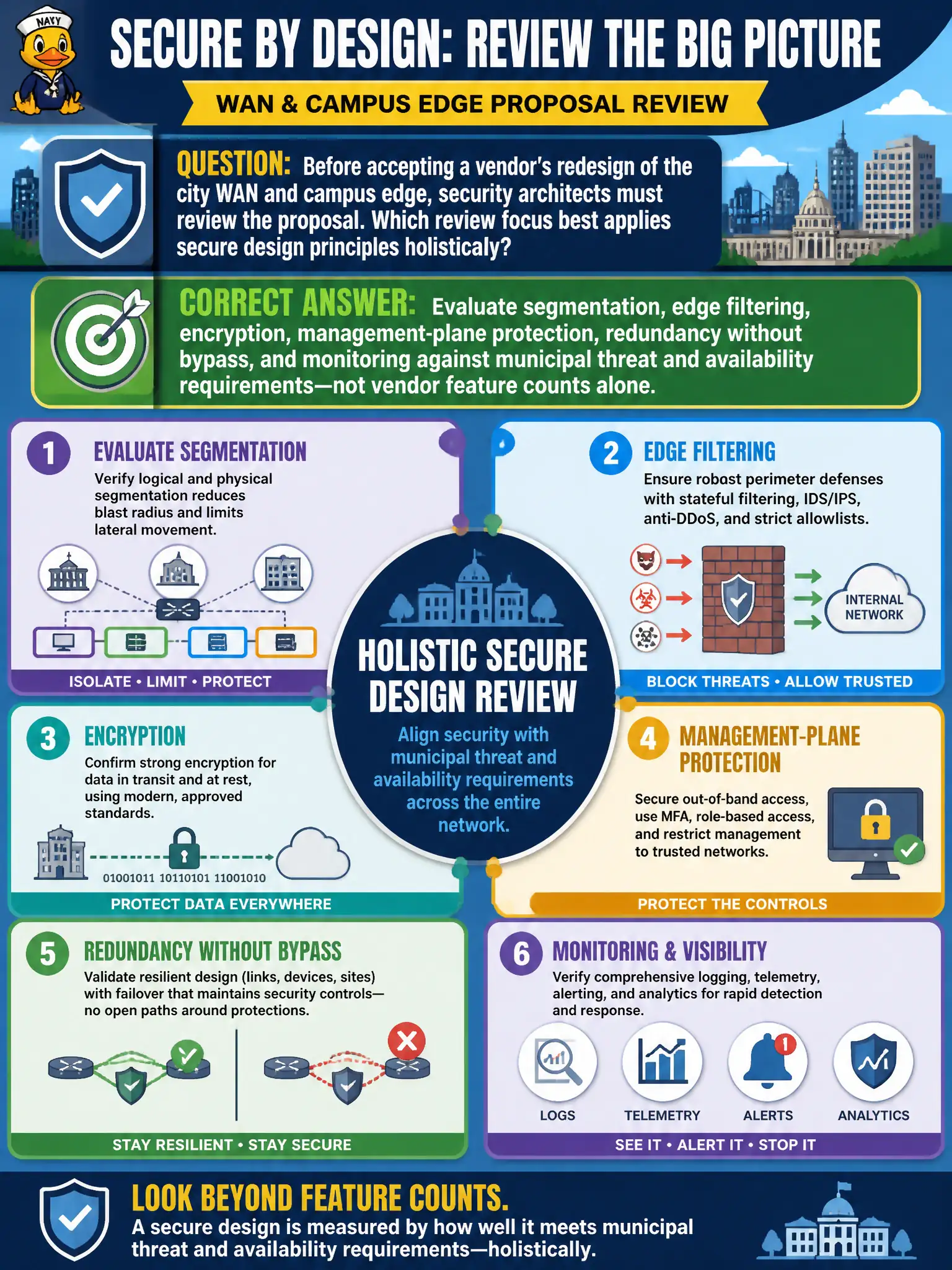
Before accepting a vendor’s redesign of the city WAN and campus edge, security architects must review the proposal. Which review focus best applies secure design principles holistically?
Select an answer to reveal the explanation.
Short Explanation
A redesign isn’t 'secure' because the vendor drew more boxes. Check the real stuff: zones, edge filters, crypto, who can manage devices, whether failover cheats the firewall, and whether you’ll even see attacks. Principles beat product checklists.
Full Explanation
Before accepting a vendor redesign of the city WAN and campus edge, architects must judge the design against security principles—not against how many product logos appear on a slide. Holistic review examines segmentation between trust zones, edge filtering of inbound and outbound traffic, encryption of sensitive paths, protection of the management plane, redundancy that does not bypass inspection, and monitoring adequate for municipal threats and availability needs. Feature counts without policy depth, logging, or verified isolation can look impressive while leaving guest-to-finance shortcuts, unmonitored admin paths, or failover holes that undo the stated architecture.
Approving a proposal merely because it lists more firewalls than the current design confuses quantity with quality and ignores policy, monitoring, and placement gaps. Accepting designs that reuse default passwords to speed cutover trades short-term convenience for trivial compromise of new gear. Limiting review to rack-elevation aesthetics while skipping logical trust boundaries audits furniture, not security architecture.
Exam caveat: CISSP secure design principles prioritize defense in depth, least privilege, secure defaults, and fail-secure behavior over vendor checklists. Always ask whether redundancy preserves the same controls as the primary path.
Operational check: map the proposal’s zones and flows against municipal data classifications; require evidence of management-plane isolation and MFA; demand that failover paths include equivalent firewalling and IDS; review logging/SIEM coverage; and reject cutover plans that retain default credentials past commissioning.