
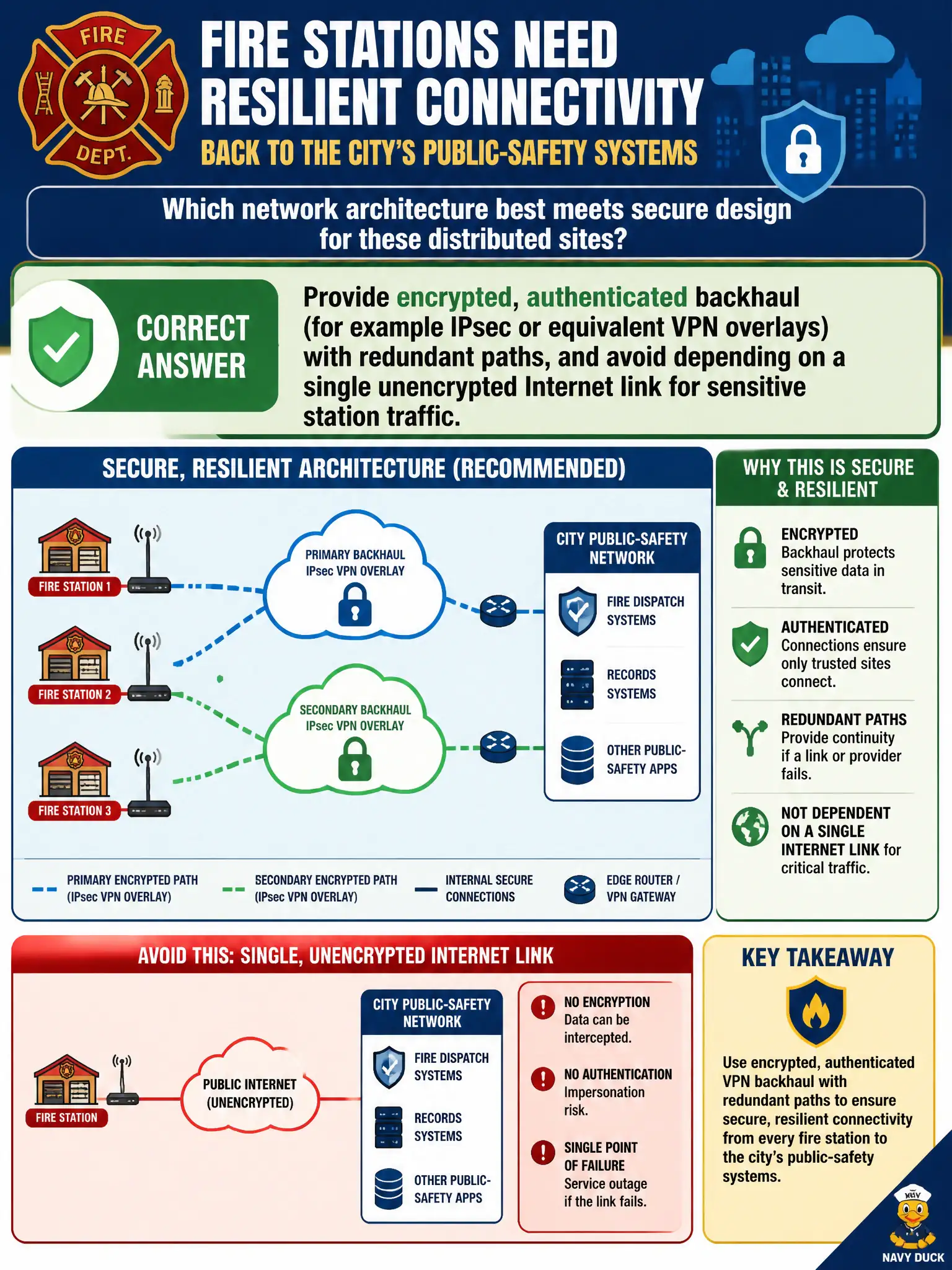
Fire stations need resilient connectivity back to the city’s public-safety systems. Which network architecture best meets secure design for these distributed sites?
Select an answer to reveal the explanation.
Short Explanation
A firehouse isn’t a coffee shop—its link back to dispatch and records needs crypto and a backup path. Encrypt the backhaul, authenticate the peers, and don’t bet the station on one naked Internet pipe.
Full Explanation
Fire stations exchanging traffic with public-safety systems need confidentiality, integrity, and availability on the backhaul—not a coffee-shop grade Internet pipe. Encrypted, authenticated overlays such as IPsec (or equivalent VPN technology) protect station traffic across potentially untrusted access circuits, while redundant paths keep dispatch and records reachable when a single ISP or DSL link fails. Avoiding dependence on one unencrypted Internet link prevents both eavesdropping on sensitive station communications and single points of failure that take a house offline during incidents.
Bridging each station LAN directly onto the Internet without NAT so mutual aid partners can scan freely exposes station networks to the entire Internet and confuses interoperability with openness. Using a single DSL circuit with no failover because stations seem low bandwidth ignores that emergency operations still require resilient reachability when that one circuit dies. Sharing one preshared key across every station and vendor simplifies swaps while guaranteeing that compromise or loss of one appliance or technician credential threatens the entire fleet.
Exam caveat: CISSP remote-site and VPN design favors authenticated encryption plus redundancy. Shared static keys and intentional Internet exposure of station LANs contradict least privilege and key management hygiene.
Operational check: verify station tunnels authenticate peers and use modern crypto profiles; test failover to secondary circuits under maintenance windows; ensure station LANs are not directly bridged to the Internet; and issue per-site or per-device secrets with rotation rather than one citywide PSK.