
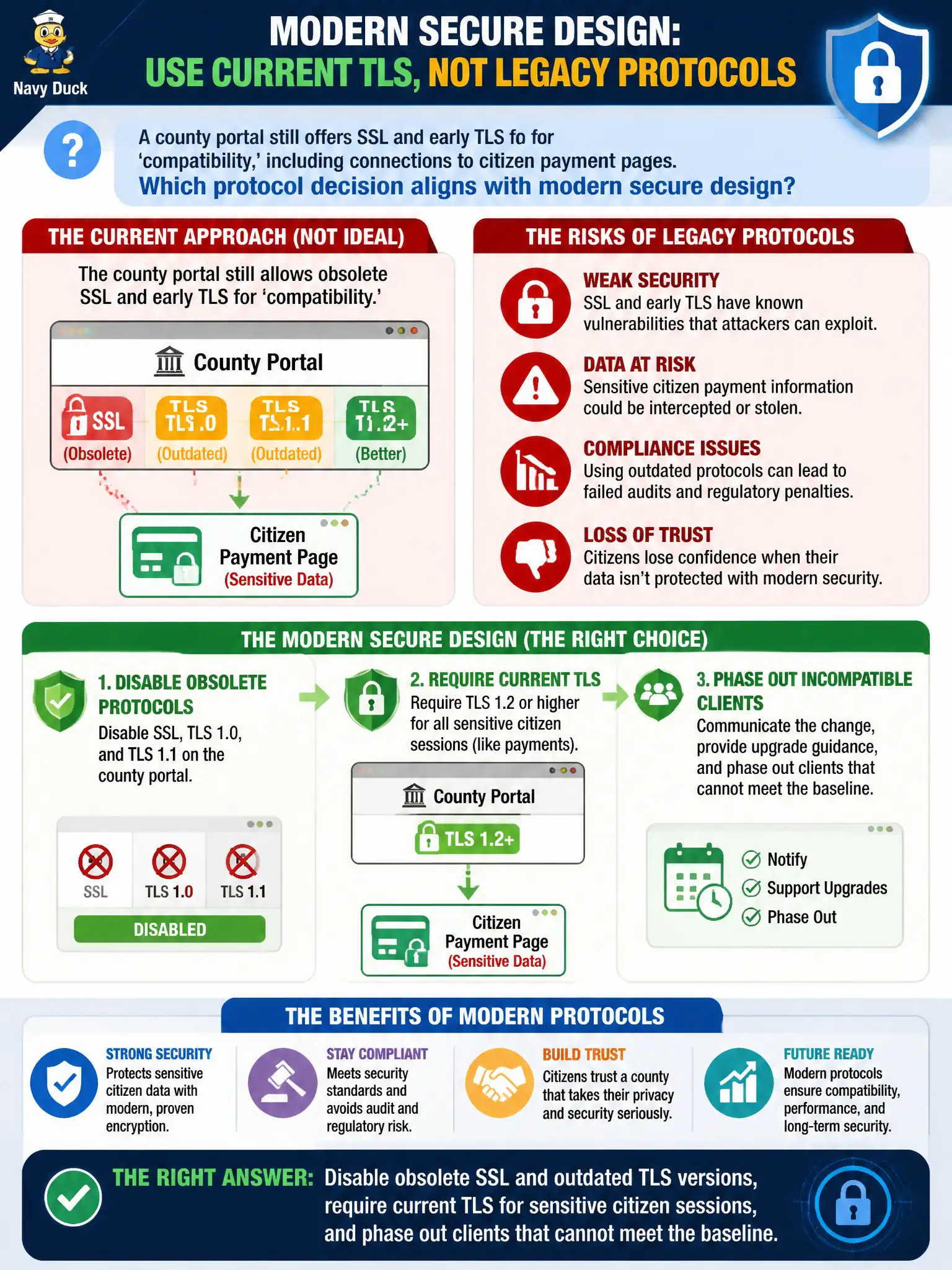
A county portal still offers SSL and early TLS for 'compatibility,' including connections to citizen payment pages. Which protocol decision aligns with modern secure design?
Select an answer to reveal the explanation.
Short Explanation
SSL is the VHS tape of encryption—nostalgic and unsafe. For payments and citizen portals, turn off the museum protocols and insist on current TLS. Compatibility isn’t worth handing attackers a weak handshake.
Full Explanation
Citizen payment portals and other sensitive county sessions require contemporary TLS. Obsolete SSL and early TLS versions carry known protocol weaknesses, weak cipher negotiation, and downgrade attack history that modern baselines reject. Disabling those museum protocols, requiring current TLS for sensitive sessions, and phasing out clients that cannot meet the bar aligns cryptographic transport with the confidentiality and integrity expectations of municipal finance and identity traffic. Compatibility that preserves broken handshakes is not a security control.
Keeping SSLv3 enabled beside TLS 1.3 so legacy kiosks never fail invites attackers to force weak negotiation paths and undermines the stronger stack. Preferring TLS 1.0 only because newer versions seem unnecessary for HTTP content ignores both known TLS 1.0 weaknesses and the sensitivity of payment pages. Terminating crypto at a reverse proxy that then speaks uncontrolled cleartext to the application may still leave a plaintext segment where attackers or insiders can observe sessions unless compensating controls fully protect that backend path—blind cleartext backends are a common false sense of security.
Exam caveat: CISSP secure protocol selection emphasizes current TLS and retirement of SSL/early TLS for sensitive data. Backward-compatibility distractors that keep obsolete versions enabled are frequently wrong.
Operational check: scan the portal for offered protocol versions and ciphers; disable SSL and TLS 1.0/1.1 on payment virtual hosts; inventory kiosks and plan replacement or TLS-capable upgrades; confirm backend segments after TLS termination are segmented and monitored; and retest citizen payment flows after the baseline change.