
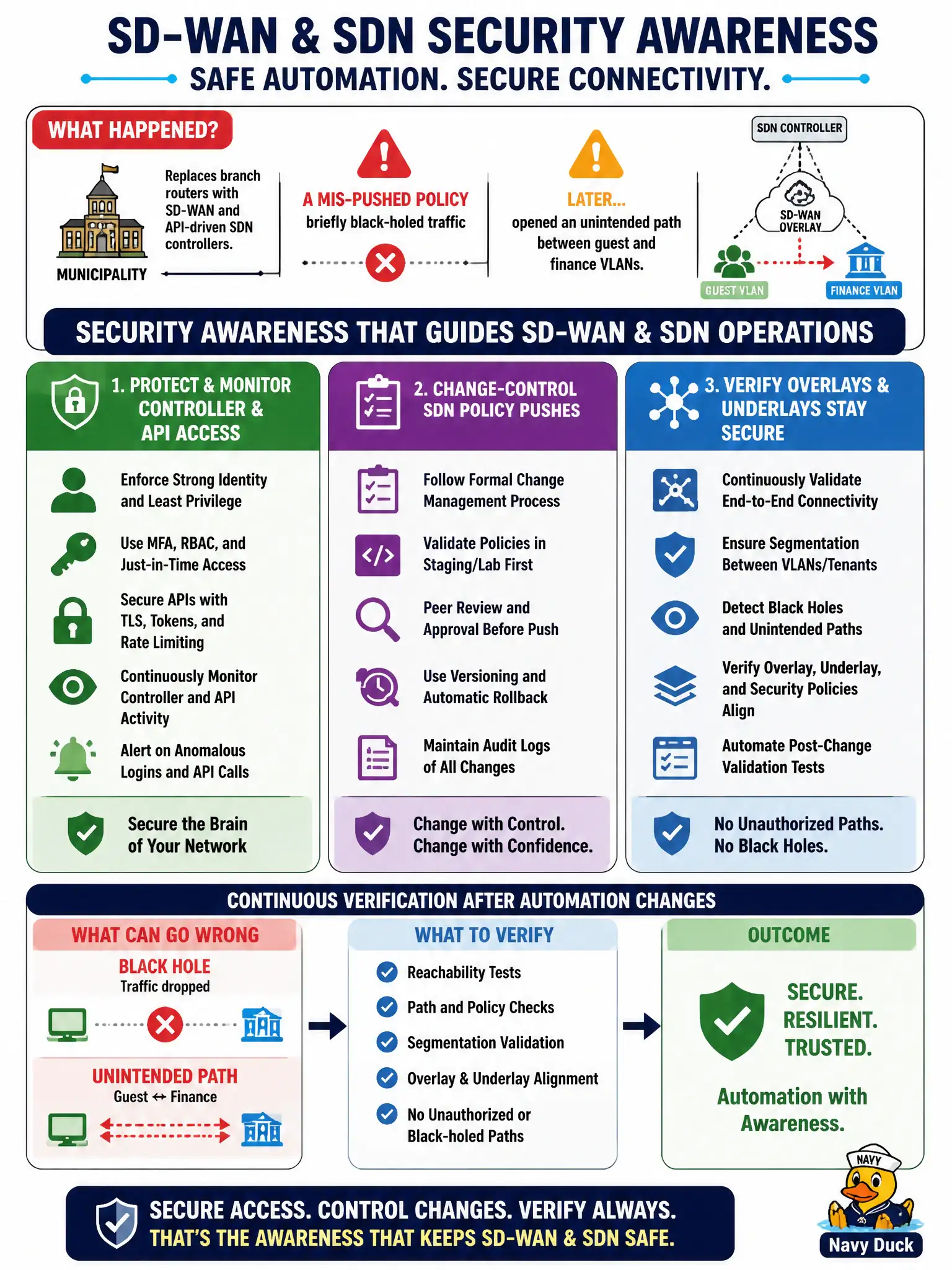
A municipality replaces branch routers with SD-WAN and API-driven SDN controllers. A mis-pushed policy briefly black-holed traffic and later opened an unintended path between guest and finance VLANs. Which security awareness should guide ongoing SD-WAN and SDN operations?
Select an answer to reveal the explanation.
Short Explanation
SD-WAN can rewire the whole city with one bad API call—like flipping every traffic light from one console. Guard who can push policy, watch the controller, and double-check that automation didn’t open a sneak path or drop a neighborhood offline.
Full Explanation
SD-WAN and SDN concentrate network change into controllers and APIs: one mis-pushed policy can black-hole neighborhoods or open unintended paths between guest and finance segments. Secure operations therefore treat the controller and its APIs as crown-jewel management planes—strong authentication, least privilege, monitoring, and change control on every policy push. After automation runs, verification must confirm that overlays and underlays still enforce intended isolation and that no unauthorized or black-holed path appeared. Automation without guardrails is not agility; it is amplified misconfiguration risk across the municipal fabric.
Treating controller APIs as low-risk because overlays supposedly enforce least privilege without review ignores how policy itself defines those overlays—compromised or careless API use rewrites the trust model. Preferring only manual CLI on every edge and abandoning centralized policy avoids one class of API outage but reintroduces drift, slow response, and inconsistent security at scale; the remedy is controlled automation, not abandoning orchestration. Sharing orchestration tokens across vendors so failover scripts never fail authentication collapses accountability and turns any leaked token into a multi-vendor master key.
Exam caveat: CISSP emphasizes secure management of programmable infrastructure—protect the control channel, change-control high-impact pushes, and validate outcomes. Centralization is acceptable when hardened; convenience tokens and unreviewed automation are not.
Operational check: place controllers on management networks with MFA and role-based API keys; log and alert on policy pushes; require peer review or staged rollout for guest-to-finance path changes; run post-change reachability and micro-segmentation tests; and rotate orchestration credentials per vendor integration rather than sharing one eternal token.