
A county publishes emergency-alert pages through a content delivery network. Architects worry that the origin is reachable directly and that poisoned cache objects could mislead the public. Which CDN design practice best addresses those concerns?
Select an answer to reveal the explanation.
Short Explanation
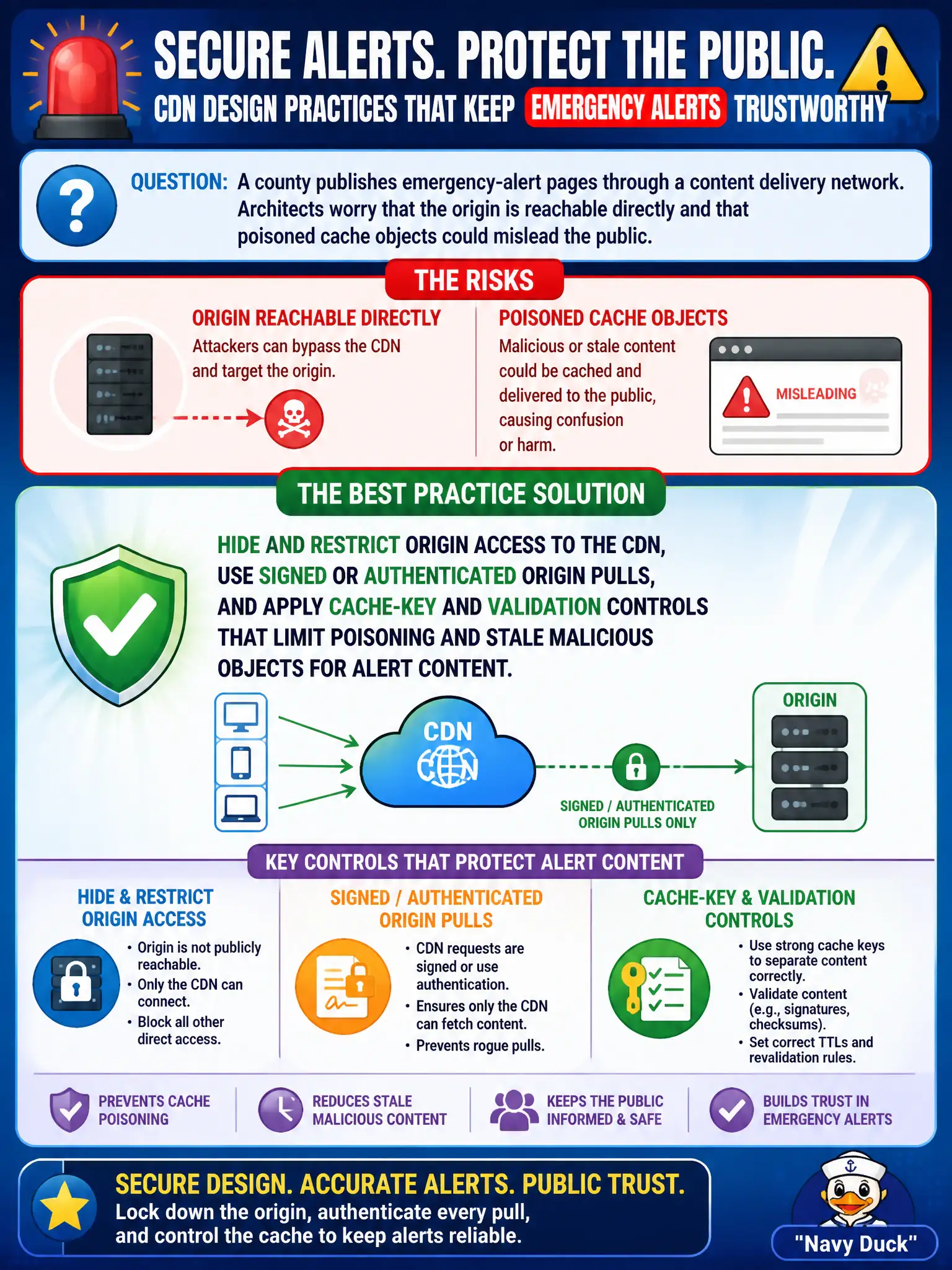
A CDN is a helpful megaphone—until someone talks to the stage door or slips a fake flyer into the stack. Lock the origin so only the CDN can fetch, and make sure cached alert pages can’t be quietly swapped for junk.
Full Explanation
Emergency-alert content on a CDN must remain authentic and available under crisis load. If the origin is reachable by anyone, attackers can abuse it directly, bypass edge protections, or poison what edges cache. Restricting origin access so only the CDN can pull—via allowlists, authenticated pulls, or signed requests—closes the stage door. Cache-key discipline and validation controls reduce the chance that a malicious or stale object persists at the edge and misleads the public during an alert window. The design goal is a trustworthy megaphone: edges amplify only what the county intentionally publishes.
Pointing the CDN at an unauthenticated origin so any edge refreshes faster invites unauthorized refresh and content substitution precisely when citizens rely on alerts. Disabling caching on every edge so the CDN is merely a DNS redirector throws away resilience and capacity that crises need and does not fix origin exposure or authenticity. Publishing origin IP addresses widely so citizens can bypass failed edges advertises a bypass path attackers will use and undermines the controlled delivery path the CDN was meant to provide.
Exam caveat: CISSP content-delivery and availability discussions expect origin hardening and integrity of cached objects, not elimination of caching or public disclosure of origin addressing. Speed-of-crisis arguments that remove authentication are distractors.
Operational check: confirm origin firewall or cloud ACLs accept only CDN egress ranges or mutual TLS; enable signed URLs or authenticated origin pulls; review cache keys for alert pages so query-string tricks cannot fragment or poison content; set short TTLs with revalidation for critical alerts; and periodically test that direct origin access from the public Internet fails while CDN delivery succeeds.