
A parks department still runs city Wi-Fi with outdated cipher suites, while field crews also deploy Bluetooth beacons and Zigbee sensors for irrigation telemetry. Which approach best strengthens wireless security across these municipal links?
Select an answer to reveal the explanation.
Short Explanation
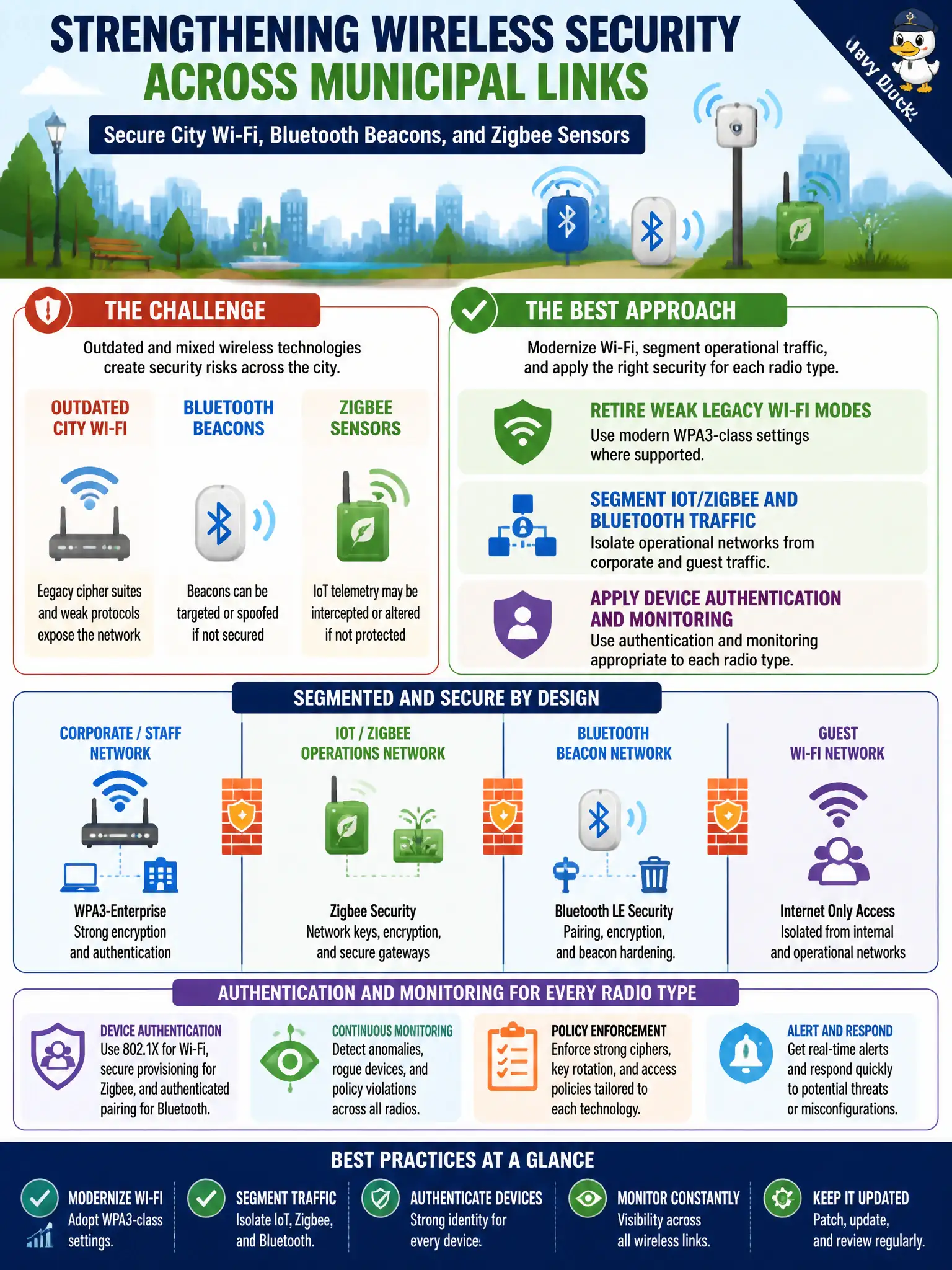
Old Wi-Fi ciphers are like leaving the padlock on a rusty hasp—it looks locked until someone tugs. Bluetooth beacons and Zigbee gear are their own little radios, so they need their own segmentation and auth story, not a free ride on staff Wi-Fi.
Full Explanation
Municipal wireless security must cover every radio the city actually uses—not only the familiar enterprise SSID. Legacy Wi-Fi cipher suites enable downgrade and offline-attack paths that modern WPA3-class configurations were designed to close; retiring weak modes where supported raises the baseline for staff and guest associations. Bluetooth beacons and Zigbee irrigation sensors are separate physical and logical channels with different pairing, keying, and monitoring needs. Segmenting IoT and operational radio traffic away from staff laptop SSIDs limits lateral movement if a low-assurance sensor is compromised, while device authentication and radio-appropriate monitoring give operations visibility into spoofed beacons, rogue coordinators, and unusual join patterns.
Keeping legacy Wi-Fi modes for compatibility while relying on MAC filtering alone leaves known-weak cryptography in place and treats easily spoofed addresses as identity—neither stops determined wireless abuse of parks networks. Collapsing Zigbee onto the staff laptop SSID mixes low-assurance field telemetry with higher-trust endpoints and simplifies an attacker’s path after any single radio compromise. Disabling encryption on guest Wi-Fi so other radios can bridge removes confidentiality for patrons and staff-adjacent traffic and does not securely integrate Bluetooth or Zigbee; it trades key management for open air exposure.
Exam caveat: CISSP wireless questions emphasize current cryptographic modes, separation of trust zones by device class, and controls matched to the medium—not a single SSID or MAC list for every radio type. Compatibility arguments that preserve obsolete ciphers are classic distractors.
Operational check: inventory SSIDs and cipher suites on parks APs and disable obsolete Wi-Fi modes where clients allow; place Zigbee/Bluetooth gateways on isolated VLANs with deny-by-default to staff networks; require device onboarding or join keys per radio class; and alert on rogue APs, unexpected coordinators, and anomalous association rates near irrigation controllers.