
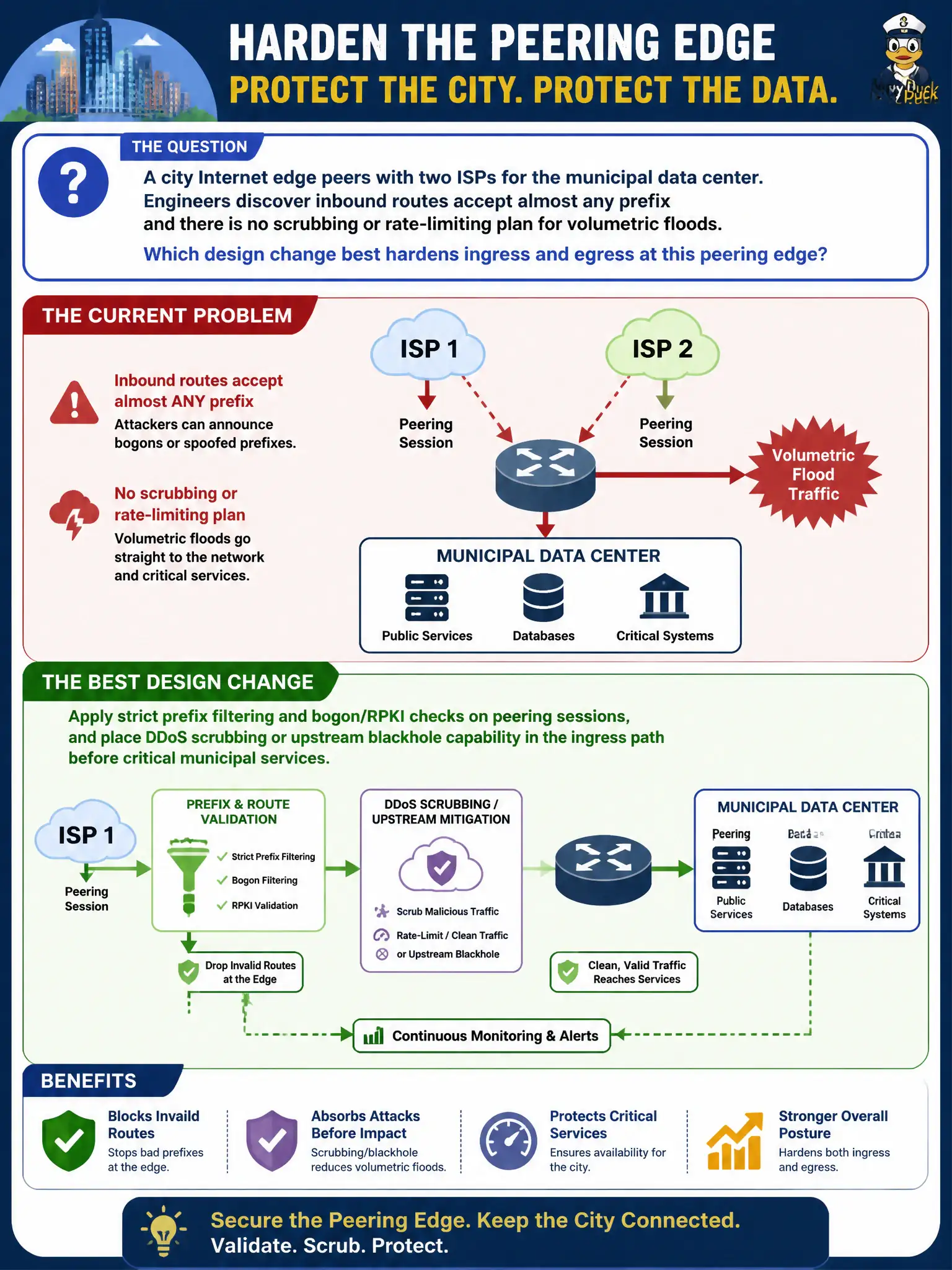
A city Internet edge peers with two ISPs for the municipal data center. Engineers discover inbound routes accept almost any prefix and there is no scrubbing or rate-limiting plan for volumetric floods. Which design change best hardens ingress and egress at this peering edge?
Select an answer to reveal the explanation.
Short Explanation
Picture the city’s front door with no bouncer and no flood plan. Peering that trusts every prefix and has no scrubbing is an open invitation. Filter what you accept, prove routes are legitimate, and put DDoS readiness in front of the things that keep city services online.
Full Explanation
Municipal Internet peering is a high-value control point: whatever prefixes and floods the edge accepts can starve citizen portals, payment systems, and public-safety backhaul. Hardening that edge means validating routes before they enter the forwarding table and placing volumetric defenses ahead of critical services. Strict prefix filtering, bogon rejection, and RPKI or equivalent origin validation reduce acceptance of hijacked or unallocated space that attackers use to attract or inject traffic. Pair that with DDoS scrubbing or coordinated upstream blackhole capability so floods are absorbed or diverted before they saturate municipal links and servers. Together, route hygiene and flood readiness address both the control-plane lie and the data-plane deluge that peering without policy invites.
Advertising every internal RFC1918 prefix to ISP peers does not hide public space; it leaks private topology, invites misrouting, and violates common peering norms without stopping prefix injection or volumetric attack. Replacing BGP with static defaults removes multi-homing agility and still leaves the edge exposed to floods unless scrubbing and filtering remain; it treats routing protocol choice as a substitute for edge security policy. Disabling egress ACLs so return traffic flows freely weakens anti-spoofing and abuse containment and does not protect ingress from malicious prefixes or inbound floods—asymmetric-routing convenience is not a substitute for controlled egress.
Exam caveat: CISSP expects layered edge design—authentication and validation of routing information plus availability controls for DDoS—not elimination of peering or reckless advertisement of private space. Multihoming without policy is still weak; policy without a flood plan still fails under volumetric attack.
Operational check: review ISP peer filter lists and RPKI/ROA coverage for announced and accepted prefixes; confirm bogons are dropped; exercise scrubbing or blackhole playbooks against a test flood; verify critical municipal services sit behind the scrubbing path; and ensure egress anti-spoofing ACLs remain enforced even when traffic engineering pressure rises.