
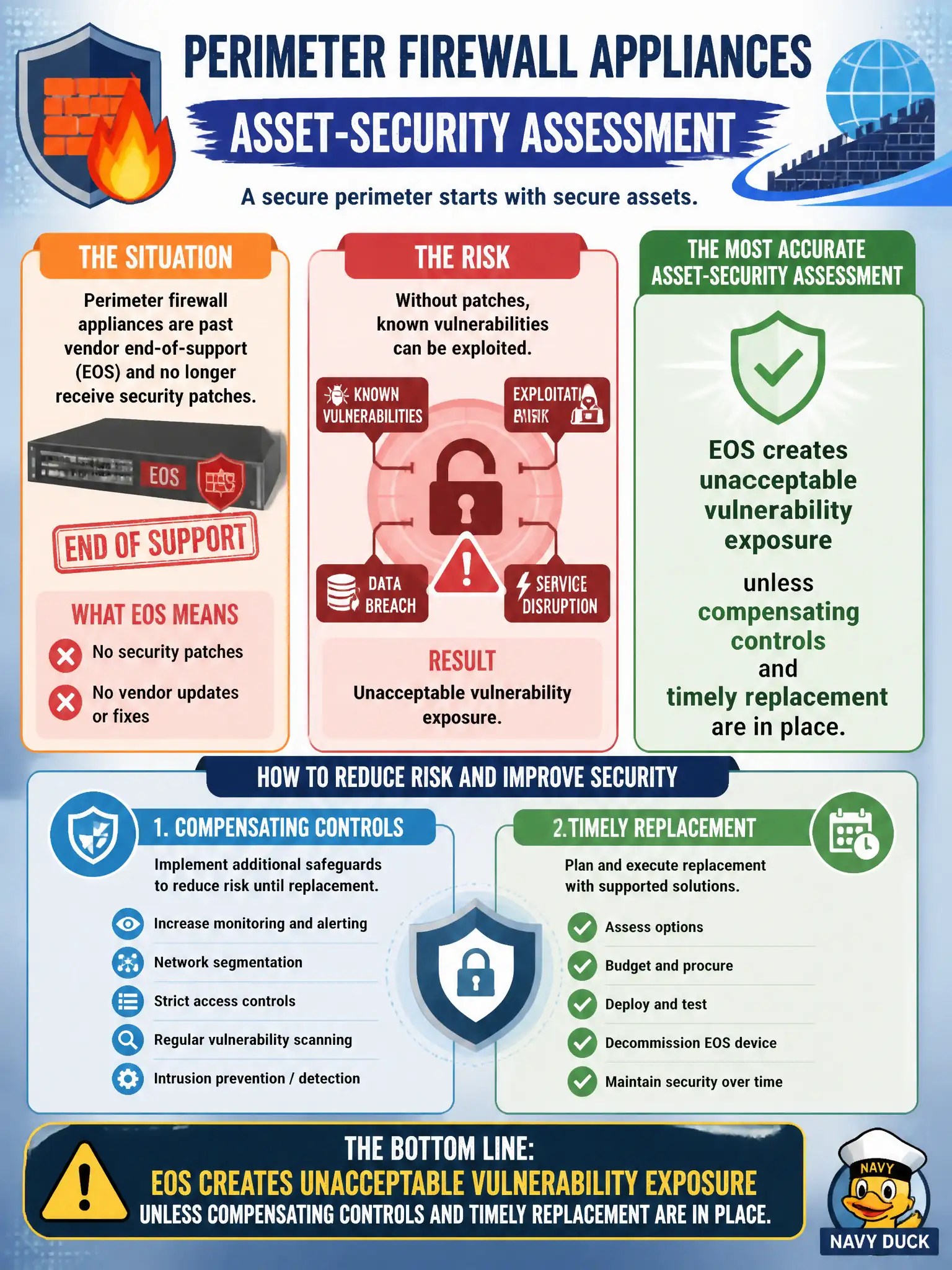
Perimeter firewall appliances are past vendor end-of-support and no longer receive security patches. What is the most accurate asset-security assessment?
Select an answer to reveal the explanation.
Short Explanation
A castle gate that never gets repaired is just decorative iron. Firewalls past end-of-support stop getting patches while new exploits keep shipping. Replace them, isolate them hard, or write down that you are knowingly flying without a net—do not pretend "it still boots" equals secure.
Full Explanation
Perimeter firewalls past vendor end-of-support that no longer receive security patches create unacceptable vulnerability exposure unless compensating controls and timely replacement are in place. "It still boots" is not a security posture: new exploits continue while patches stop. Asset security treats EOS network appliances as aging critical controls that must be replaced, tightly isolated with monitoring, or formally accepted as known risk—not ignored.
Claiming EOS is acceptable indefinitely because of a lifetime warranty sticker fails by concept: warranty for hardware failure is not vulnerability patching. Asserting EOS only matters for workstations and never for network appliances fails because perimeter devices are high-value attack targets that require updates. Claiming EOS automatically upgrades classification from Internal to Public fails as nonsense—support status does not rewrite data classification labels.
Exam caveat: unsupported critical infrastructure is a standard CISSP risk theme; compensating controls buy time, they do not erase the need to replace. Operational check: inventory EOS firewalls, prioritize replacement, apply network segmentation and enhanced monitoring as interim controls, and track residual risk to closure.