
Two online PLCs share a similar firmware weakness and both are reachable from the same engineering VLAN. One can trip a refinery reactor. The other only counts bottles. Which risk reading is sound?
Select an answer to reveal the explanation.
Short Explanation
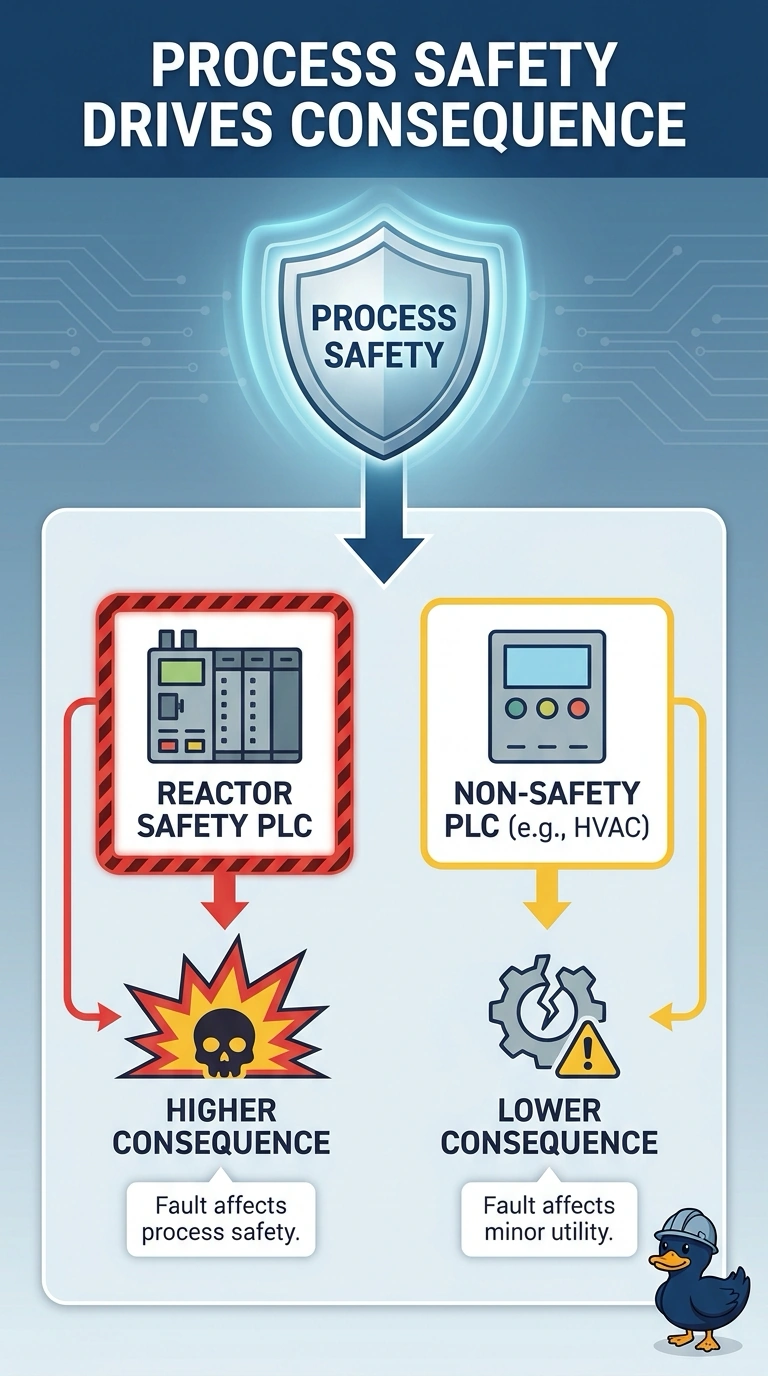
Two similar cracks are not equal when one vessel can trip a reactor and the other counts bottles. You rank the safety PLC higher because the consequence reaches process safety. A matching weakness on the same VLAN does not make those outcomes the same.
Full Explanation
When exposure is similar, consequence still changes the rank. Both PLCs are online and reachable from the same engineering VLAN, and the firmware weakness is similar. The reactor PLC can trip a safety function. A fault there affects process safety, so it is the higher consequence. The bottle counter only counts bottles. Packaging speed matters to production, and it does not outweigh a reactor trip. Giving both PLCs one risk level because the weakness and the VLAN match ignores the safety role, which is the difference the stem provides. Waiting for an exploit packet on the VLAN confuses a risk ranking with an incident that has already started. The rank is how the plant chooses what to treat first. Exam caveat: this comparison holds for the roles in the stem. If a different line's counter were itself a safety interlock, the consequence would be reassessed from that role. Here the counter only counts bottles. Shared reachability makes the safety role the difference that sets the order. Operational check: confirm both PLCs are reachable from the engineering VLAN as the stem says, and put the reactor safety PLC ahead of the counter on the work list.