
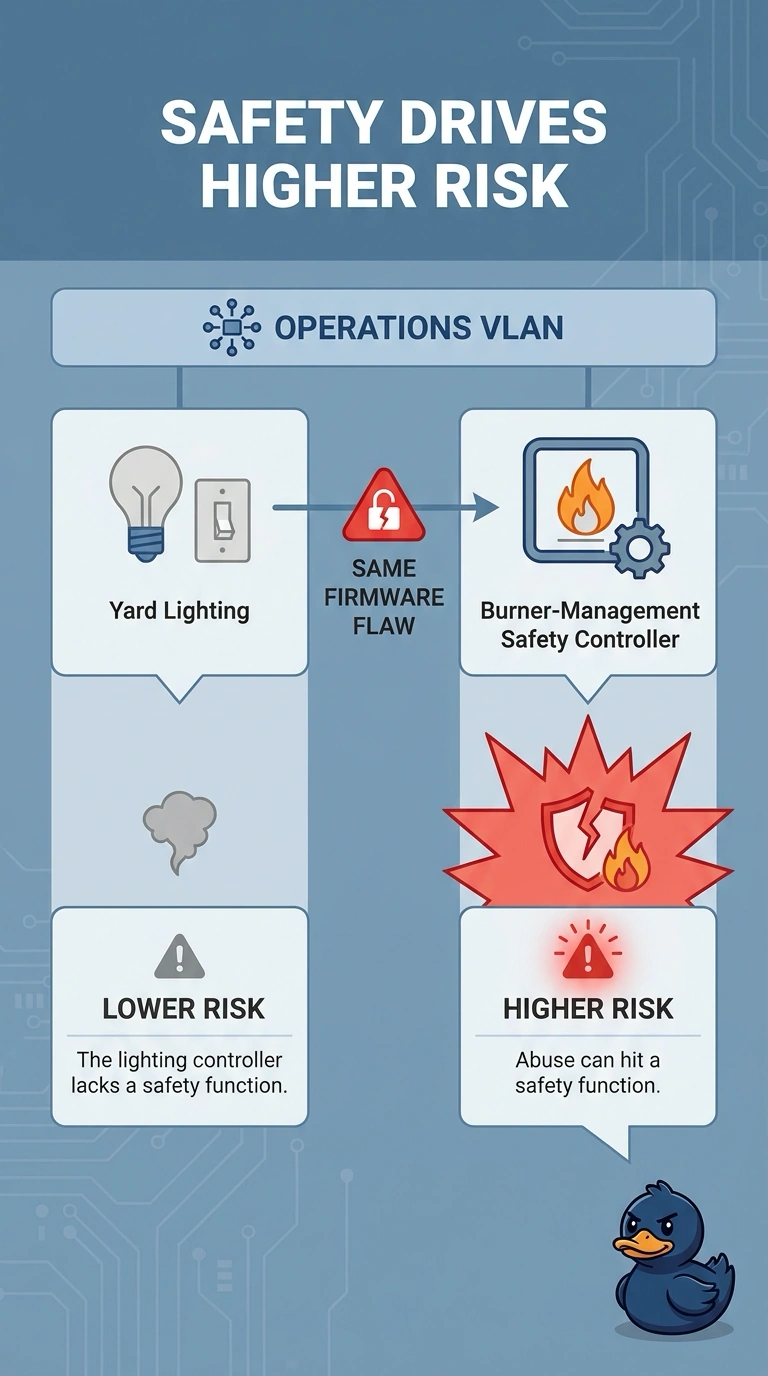
A refinery has the same firmware flaw on two controllers that are equally reachable from the operations VLAN. One is the burner-management safety controller. The other runs only yard lighting. Which risk reading is sound?
Select an answer to reveal the explanation.
Short Explanation
A crack in a brake line is not the same event as a crack in a fence light, even when both cracks look identical. You rank the burner-management controller higher because the consequence is a safety function. The matching flaw name is the trap.
Full Explanation
Both controllers are equally reachable and share one firmware flaw, so exposure does not separate them. Consequence does. The burner-management controller performs a safety function. Abuse there can affect firing and shutdown logic. The yard-lighting controller does not. The safety controller is the higher risk even though the advisory name matches. Equal flaw identifiers are the start of the comparison, not the end. How easy the lights are to see from the fence is physical visibility of a lamp, not a higher cyber consequence than burner management. Reachability does not cancel risk. The stem already says both can be reached. That shared path is why the safety role is the remaining difference, not a reason to score both at zero. Exam caveat: ranking the safety controller first does not delete the lighting flaw from the work list. It sets order. If the lighting controller is later moved onto the safety network, the exposure comparison has to be redone. Operational check: confirm the two paths from the operations VLAN are as equal as the stem says, then place the burner-management controller ahead of yard lighting in the remediation queue.