
A brewery will add a deny-by-default firewall rule between the cellar and the site historian, but nobody has a current map of which hosts actually talk. Which step should come first?
Select an answer to reveal the explanation.
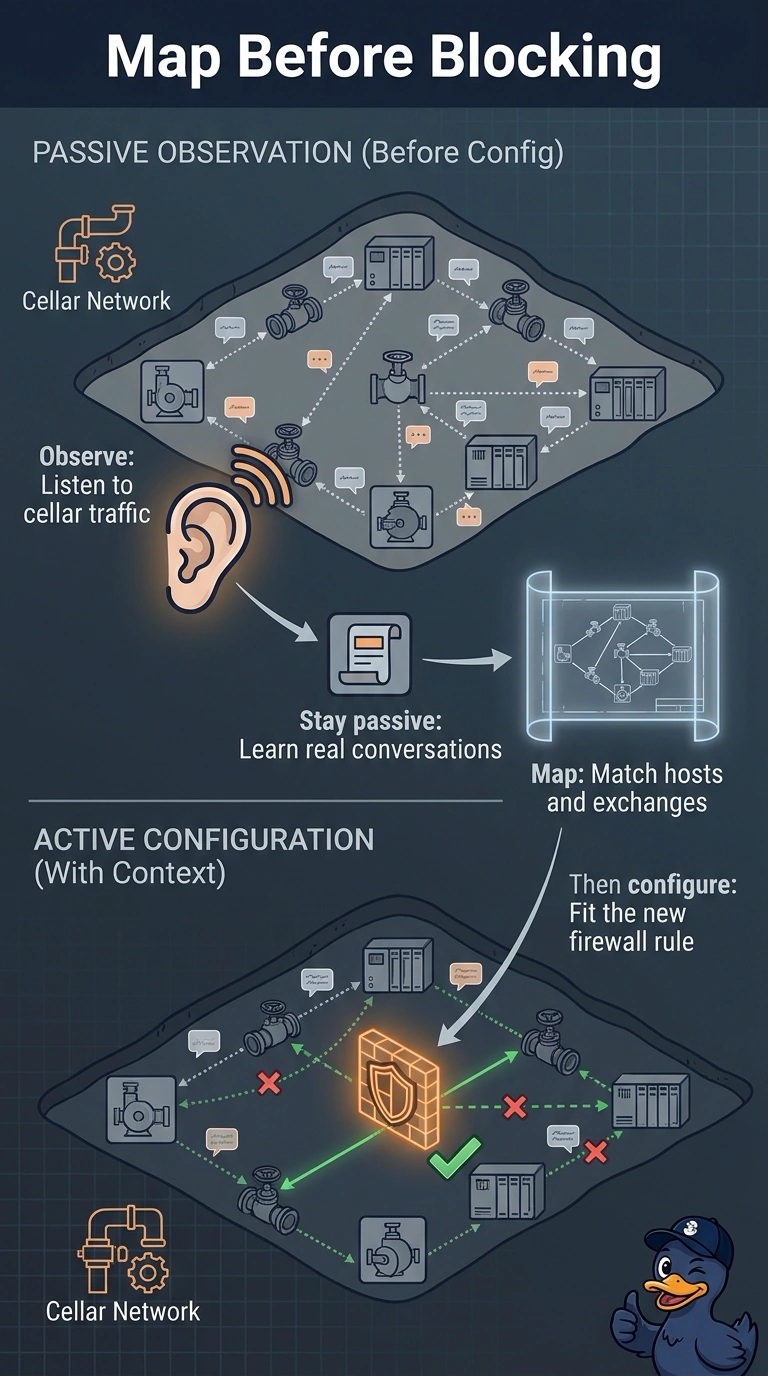
Short Explanation
Locking the door before you have seen who carries boxes through it will trap a cellar flow you did not know existed. You watch the real conversations first, from a copy of traffic, and then you write the firewall rule. The trap is borrowing an office rule or waiting until a stopped transfer tells you what you cut.
Full Explanation
A deny-by-default rule will block whatever it does not explicitly permit. Without a current map, the brewery does not know which historian queries, which HMI sessions, or which other cellar flows are legitimate. The step that comes first is a passive look at the conversations already on the wire. Validate observed flows with asset owners and required operations, then permit only authorized necessary flows. Observation alone does not authorize a flow, and infrequent legitimate flows may be absent from a capture. Applying the tightest deny immediately uses production as the discovery tool. Operators notice when the cellar stops, which is a poor way to learn a baseline and a good way to interrupt a batch. An office-user rule assumes the cellar speaks the same protocols as the business LAN. Industrial flows will not match that assumption, so the copied rule will either break the cellar or permit the wrong things. Windows workstation logs show what those PCs recorded. They do not display Modbus, OPC, or drive traffic between controllers and a historian, so they are not the map. Exam caveat: deny-by-default can still be the end state. Validate observed flows with asset owners and required operations, then permit only authorized necessary flows. Observation alone does not authorize a flow, and infrequent legitimate flows may be absent from a capture, which is why the watch comes first. Operational check: capture the cellar-to-historian flows on a span or a tap, list the hosts and ports, and only then install the rule and confirm the historian still updates.