
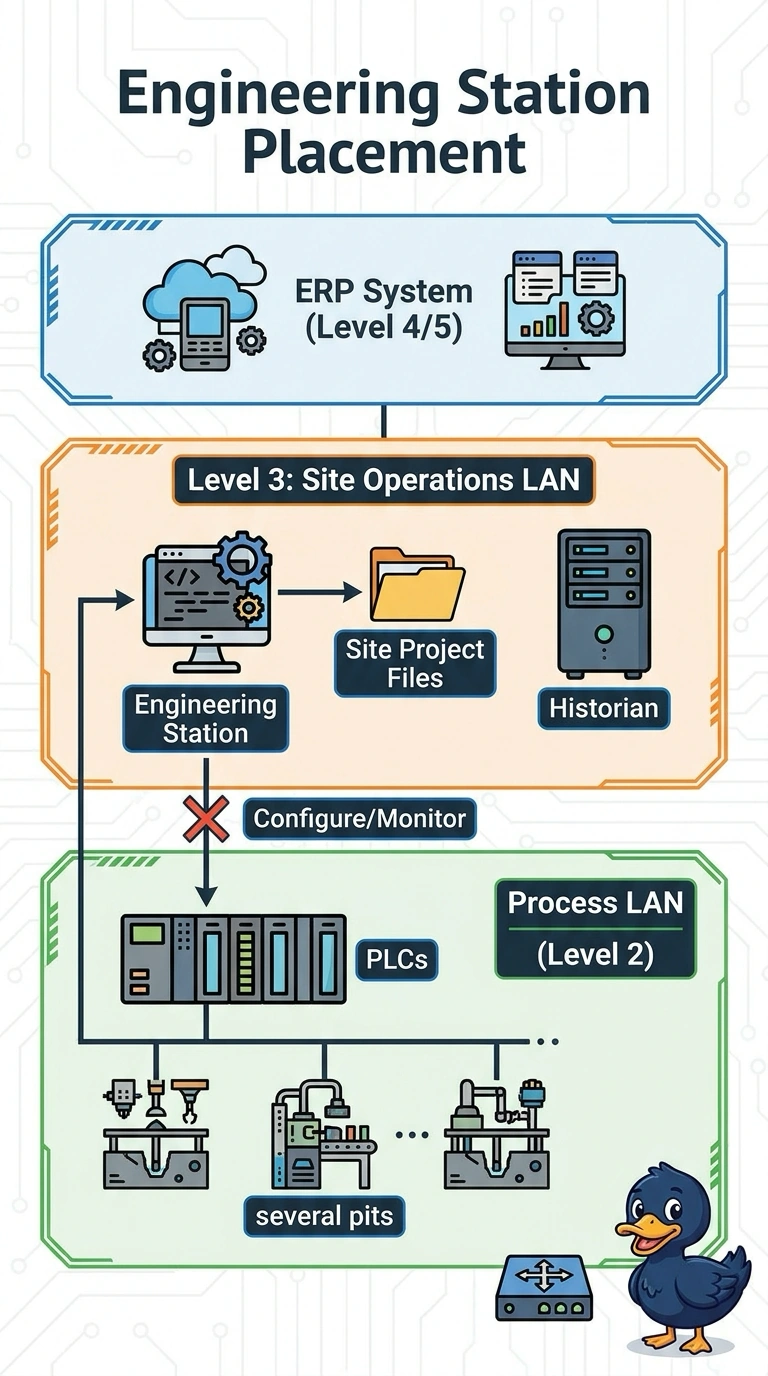
A mining company uses one permanent engineering station to maintain PLCs across several pits and to store the site project files. Where does that station belong in the Purdue model?
Select an answer to reveal the explanation.
Short Explanation
Think of the permanent engineering station as the workshop for every pit, not a sensor in the dirt or the purchasing office. You place it at Level 3 with site operations systems. Storing project files does not make it an ERP server.
Full Explanation
A permanent engineering station that maintains PLCs across several pits and holds the site project files is a site operations system. In the Purdue model, it belongs at Level 3, the same layer as the site historian, above the pit controllers and below the enterprise. It does not belong on the process LAN or with ERP. Level 0 is where the pit sensors and equipment sit; project files describing those sensors do not place the workstation beside them. Level 4 is the enterprise layer, where business systems such as ERP live. Storing project files is not the same job as planning orders, so that file storage does not put the station on the ERP VLAN. The industrial DMZ is a buffer for services that must be shared with the enterprise, such as a remote-access broker or data replica. The site engineering station is not required to live in that buffer, and not every workstation sits between IT and OT. Classify the station by its site-wide engineering function and the approved architecture. A cell-local engineering workstation can have a different functional placement. Permanent versus temporary attachment alone does not determine its Purdue level. Practical check: the architecture drawing should show the workstation with Level 3 site systems, on a controlled path down to the pits, and not on the ERP VLAN.