
A filler PLC talks to a local drive over a serial Modbus bus. An IP access list on the cell switch permits only TCP 502 from the HMI. Which statement about that serial bus is accurate?
Select an answer to reveal the explanation.
Short Explanation
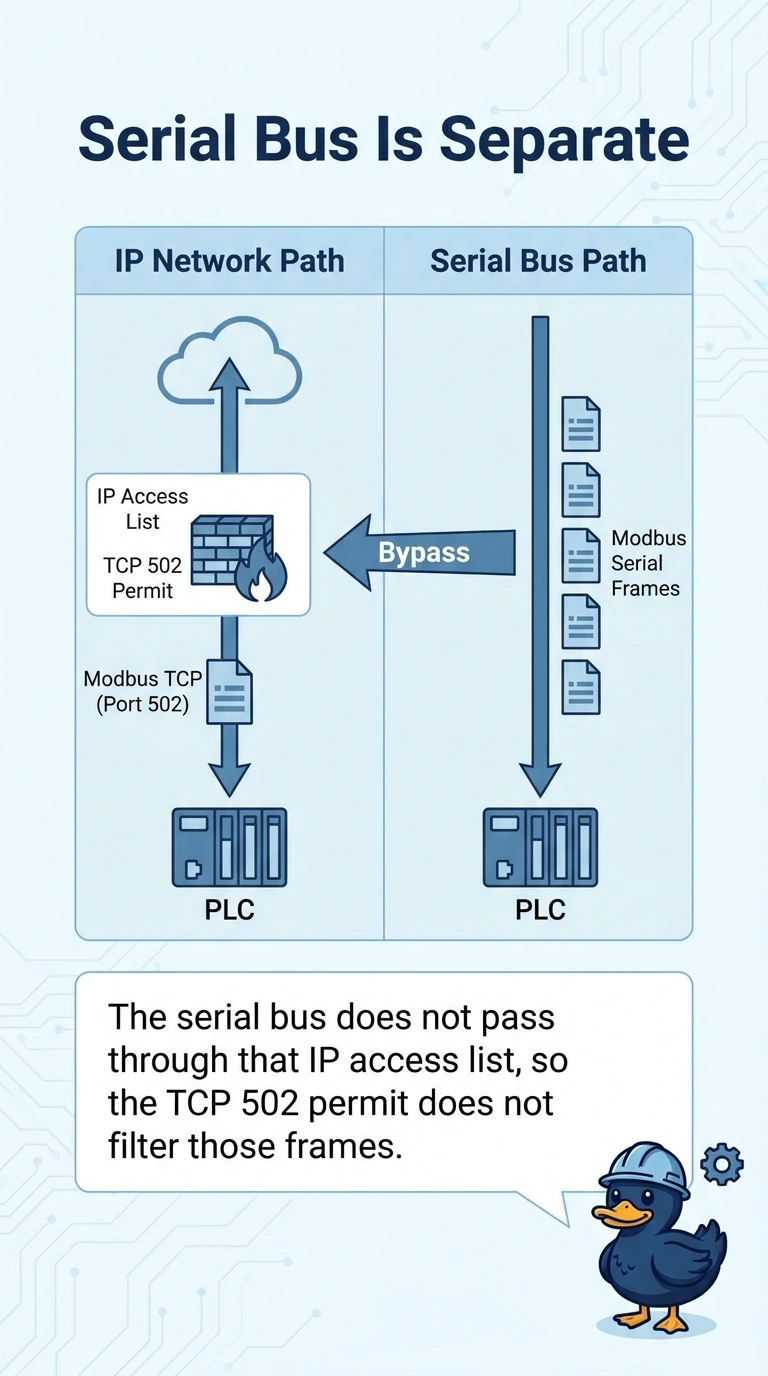
A serial cable does not walk through an IP access list on its way to the drive. You treat that bus as outside the TCP 502 rule. The trap is picturing every Modbus frame as a packet the switch can permit or deny.
Full Explanation
Classic serial Modbus is a bus between the controller and the device, not an IP flow. An ACL on the cell switch examines IP packets, including Modbus TCP on port 502 from the HMI. It never sees the serial frames, so the permit line neither allows nor blocks them, and it certainly does not authenticate the drive. Authentication is not something that ACL adds to serial Modbus. Shutting TCP 502 would affect the HMI's IP session and would leave the serial bus running, because they are different media. Landing the serial cable on an enterprise firewall is not how serial works, and the firewall's TCP 502 rule would still not be on that bus. The caveat is that a serial-to-Ethernet gateway does put a TCP 502 session on the network, and that gateway session is what the ACL can see. The check is the path: if the drive is on screw terminals or a serial plug into the PLC, the switch ACL is the wrong control for that hop. If a gateway is later added, revisit the ACL, because only the gateway's TCP 502 session will show up on the switch. The screw-terminal bus still will not.