
A cement plant needs a server that stores tested Windows patches for the kiln HMIs, and that server must not sit on the controller VLAN. Which location fits a Purdue-style design?
Select an answer to reveal the explanation.
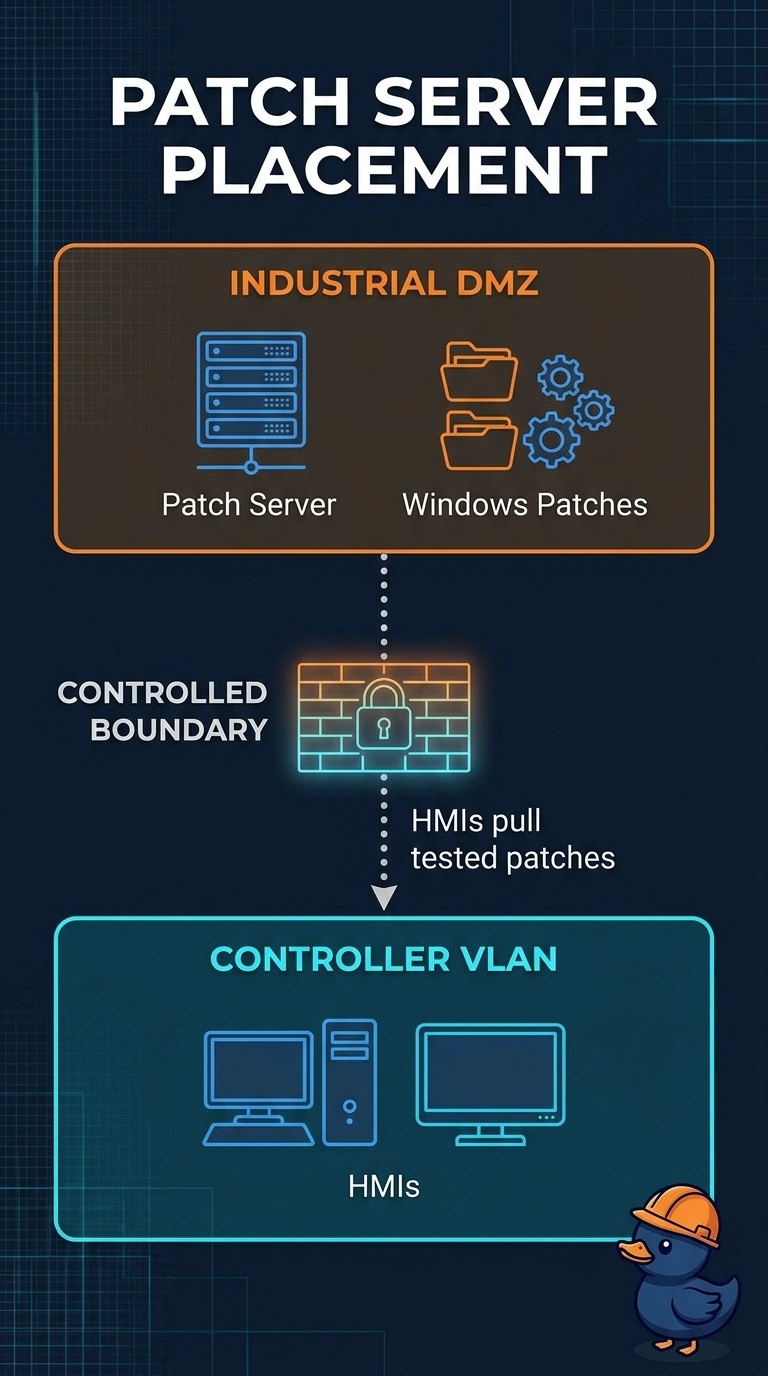
Short Explanation
The patch server is a supply shed for the HMIs, and you do not park that shed on the kiln floor or out on the public road. Your Purdue-style place for it is the industrial DMZ, across a controlled boundary and off the controller VLAN. A temperature sensor and the PLC VLAN itself are the wrong shelves.
Full Explanation
Tested Windows patches for HMIs are a shared service, not part of the kiln control loop. In a Purdue-style plant the industrial DMZ is the buffer where that service sits, so HMIs can retrieve patches across a controlled boundary while the server stays off the controller VLAN. Level 0 is the process itself, sensors and actuators. A temperature sensor does not store a patch repository, and putting files there does not create a distribution point the HMIs should use. Level 1 is basic control. Placing the patch server on the kiln PLC VLAN drops that service into the controller broadcast domain, which the stem rules out. A public internet file host that every HMI reaches directly gives the kiln HMIs a path onto the internet and no boundary where the plant can allow only the tested packages. Exam caveat: the DMZ server in this stem holds patches for the HMIs. It is not a place where kiln control logic runs, and the controllers do not need to share its subnet. Operational check: confirm the server address is in the DMZ, an HMI can retrieve a test package from it, and that address is not on the kiln controller VLAN.