
A GIS mapping unit wants exploratory SQL for an open-data mashup prototype. How should AI code generation be used?
Select an answer to reveal the explanation.
Short Explanation
Exploratory mashups love a draft SQL assist—point it at open or sample data, check the results, and keep DROP TABLE fantasies far away from production schemas.
Full Explanation
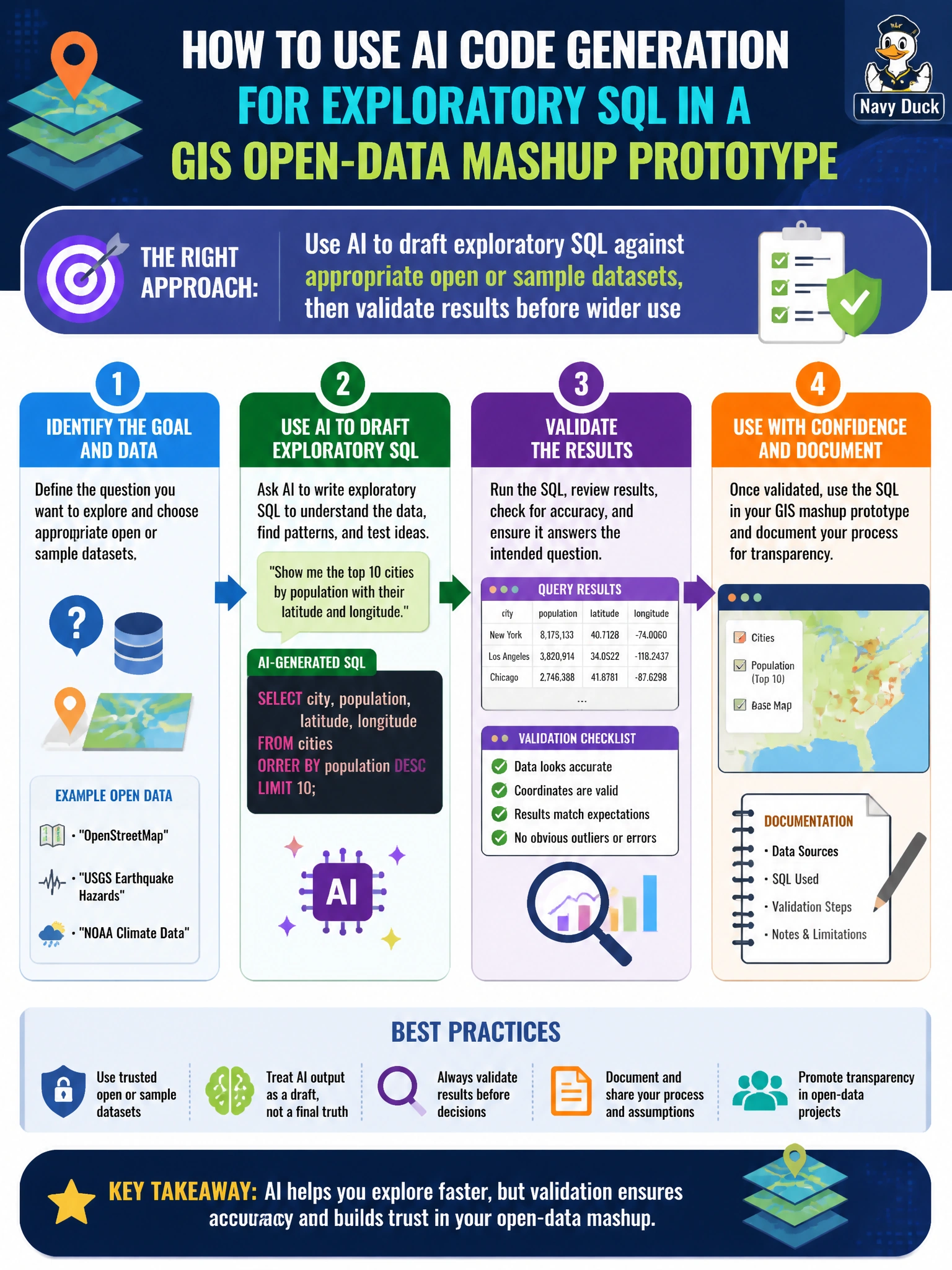
A GIS mapping unit should use AI to draft exploratory SQL against appropriate open or sample datasets and validate results before wider use. Exploratory mashup prototypes benefit from generative SQL for joins, filters, and aggregations, provided the workspace is non-destructive and outputs are checked for correctness. The correct practice keeps DROP/DELETE fantasies away from enterprise schemas and treats generated SQL as untrusted until validated.
Executing AI-written SQL that drops production tables to “clean” the mashup fails because destructive production statements are not exploratory analysis—they are outages and data-loss events. Granting the prototype role unrestricted DELETE on all enterprise GIS schemas fails by concept: least privilege is mandatory; prototypes get constrained roles on sample or open data. Skipping result validation because generated SQL is always optimal fails because models invent joins, mis-group geometries, and hallucinate functions—validation is the point of exploratory care.
Exam caveat: even SELECT-only generated SQL can leak sensitive attributes if the “open” extract was poorly redacted or if connected views expose restricted layers. Validate both query logic and data classification of the result set.
Operational check: point AI drafting at open/sample datasets only, use a read-limited prototype role, run EXPLAIN/row-count sanity checks, compare sample results to known baselines, and promote queries to wider use only after human validation.