
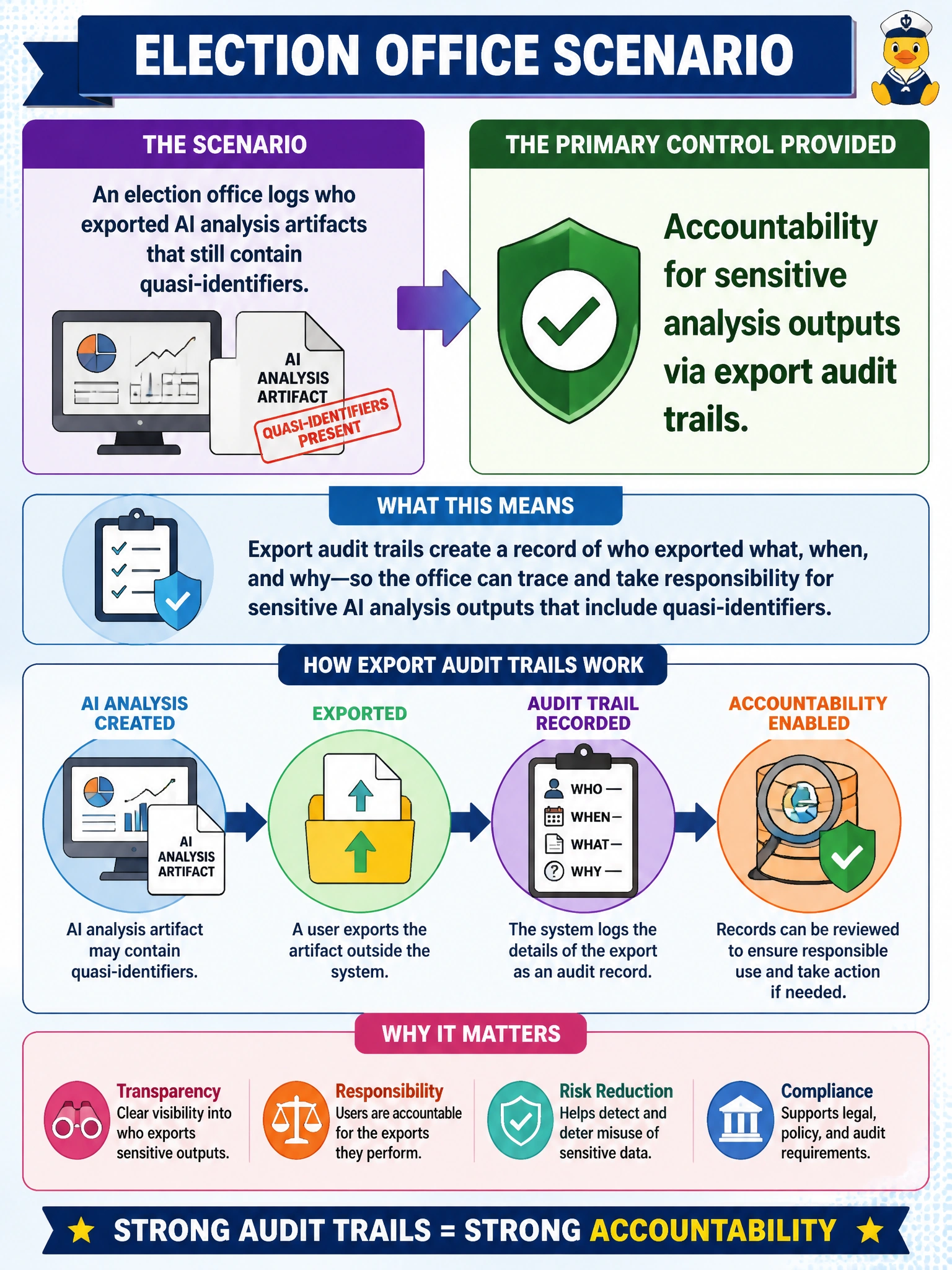
An election office logs who exported AI analysis artifacts that still contain quasi-identifiers. What control does this primarily provide?
Select an answer to reveal the explanation.
Short Explanation
If a spreadsheet with quasi-identifiers walks out the door, you need to know whose badge waved it through. Export logs give accountability when AI analysis artifacts are sensitive. Logs do not make quasi-identifiers harmless—and they are not an excuse to skip access reviews.
Full Explanation
Logging who exported AI analysis artifacts that still contain quasi-identifiers provides accountability: election offices gain an audit trail to investigate leaks, misuse, or policy violations when sensitive analytical outputs leave the controlled environment. Export logging complements minimization—it does not claim quasi-identifiers are harmless. Civic election data practices increasingly expect traceability around AI-assisted workflows.
Faster model inference through longer prompts fails as an explanation—export logs do not accelerate inference. Proof that quasi-identifiers can never identify anyone fails by concept: quasi-identifiers can re-identify, which is why export accountability matters. Disabling all access reviews after the election fails because post-election periods still require records controls and often heightened scrutiny.
Exam caveat: Logs must themselves be protected and retained per records policy; logging is not consent for broader distribution. Quasi-identifier risk rises when AI artifacts include rare precinct-level combinations or free text.
Operational check: Enable export audit trails on workspaces holding AI artifacts with quasi-identifiers, alert on bulk exports, review access periodically (including after election day), and pair logs with minimization so fewer sensitive artifacts exist to export. Test that investigations can answer who/when/what for a sample export.