
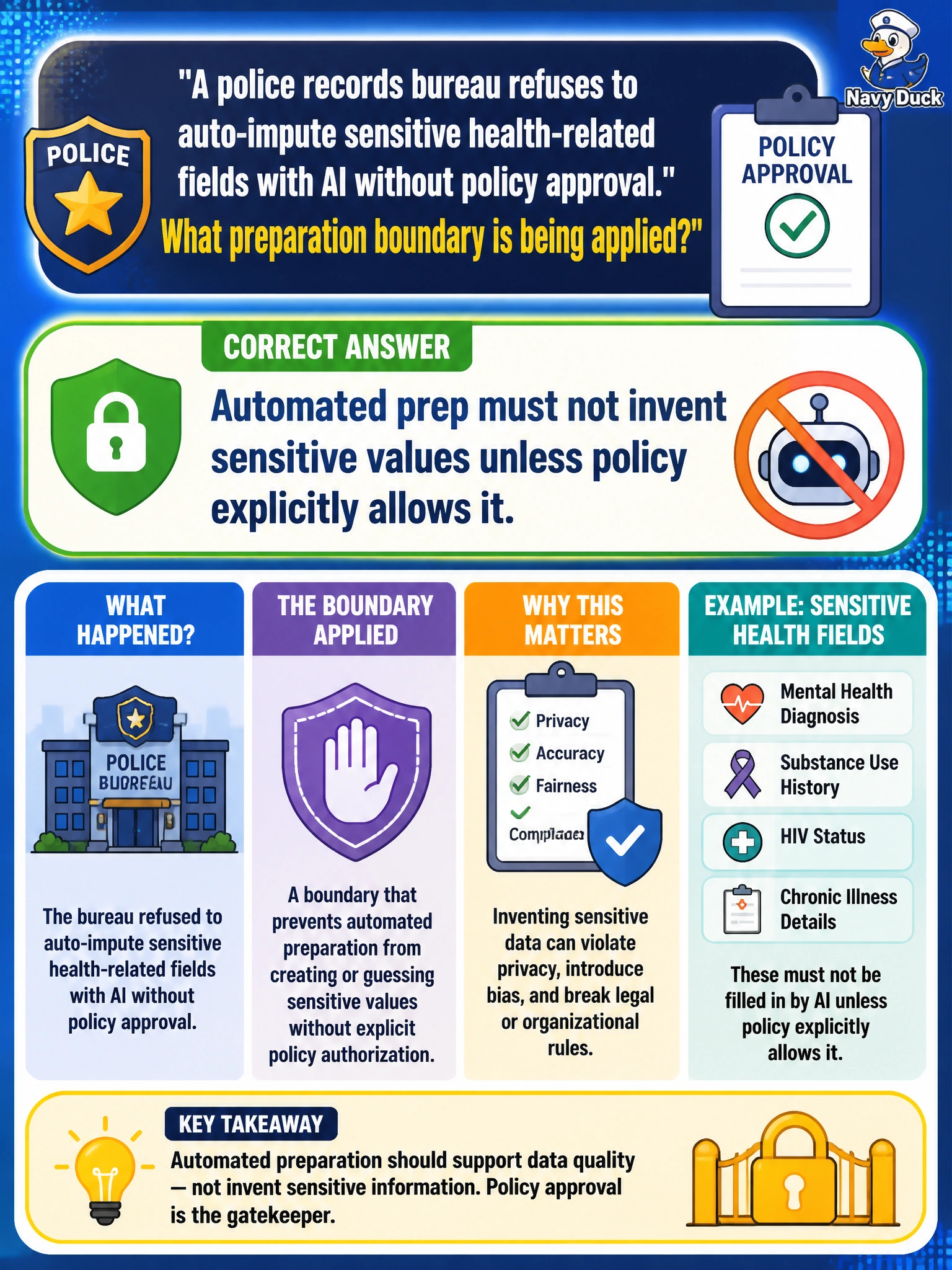
A police records bureau refuses to auto-impute sensitive health-related fields with AI without policy approval. What preparation boundary is being applied?
Select an answer to reveal the explanation.
Short Explanation
Filling in someone’s health-related blanks with a model guess is not “helpful cleanup”—it is making up sensitive facts. Without policy blessing, leave those fields alone or flag them. Automated prep has brakes for a reason.
Full Explanation
Refusing to auto-impute sensitive health-related fields with AI without policy approval applies a preparation boundary: automated prep must not invent sensitive values unless governance explicitly allows a defined method. Police or public-safety records bureaus correctly treat health-related gaps as high-risk rather than convenience fill-ins. Missingness handling for sensitive attributes is an ethics and legal control, not merely a modeling convenience.
Claiming health fields should always be filled with the column mode fails because modal imputation fabricates potentially stigmatizing attributes and can bias enforcement analytics. Claiming imputation is safer inside public chatbots fails by concept and privacy: consumer tools expand exposure and rarely meet CJIS/HIPAA-adjacent municipal controls. Posting missing sensitive fields to the open-data portal as guesses fails because open data must not publish fabricated health-related personal data.
Exam caveat: “Health-related” may include free-text that implies condition or disability even without a dedicated column—scan for sensitive content before any AI prep. Policy approval should specify method, purpose, retention, and prohibition on downstream secondary uses.
Operational check: Tag sensitive fields in the catalog, block AI imputation transforms by default, require written policy exception with method documentation if ever allowed, and audit prep pipelines for unauthorized fill logic. Prefer explicit missing codes over invented values for civic analysis.