
An emergency-management office uses AI assist to standardize mixed date formats across legacy permit CSVs before analysis. What preparation task is primary?
Select an answer to reveal the explanation.
Short Explanation
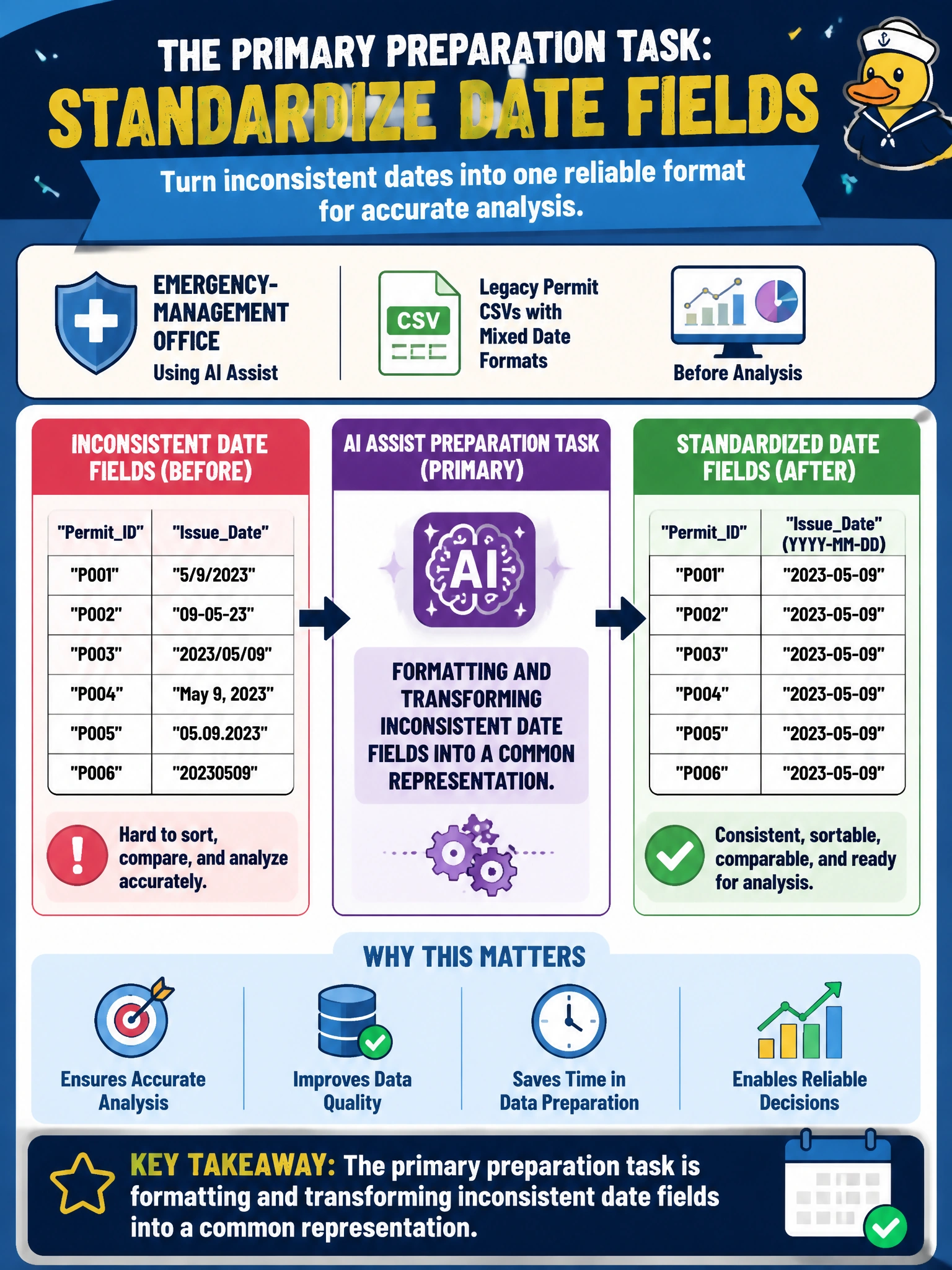
Legacy CSVs love inventing new ways to write Tuesday. You can use AI assist to normalize date formats—a preparation step that helps timelines line up. Keep historical permits and usable timestamps; don’t delete or scramble them.
Full Explanation
Formatting and transforming inconsistent date fields into a common representation is the primary preparation task: US and ISO layouts, Excel serials, and free-text months can be normalized so emergency-management timelines, joins, and sorts work. AI assist can suggest parses and mappings, but the goal is consistent temporal fields for analysis. Deleting historical permits older than thirty days fails because emergency and land-use analysis may need multi-year history; date preparation is not arbitrary truncation. Encrypting dates so analysts can never sort chronologically fails because it destroys the analytical meaning of time needed for chronological analysis. Replacing dates with random tokens to improve model creativity fails because random timestamps wreck trend detection and are not a legitimate preparation goal. Exam caveat: ambiguous day/month orderings and time zones are common failure modes, so AI parse suggestions need locale rules and validation samples. Standardizing dates does not mean keeping an ungoverned second clock that drifts from the system of record without lineage. Practical check: profile date patterns, define a canonical timezone-aware type, log transformation rules, spot-check two-digit years, nulls, and Excel serials, then confirm sorts and incident-to-permit joins work after normalization.