
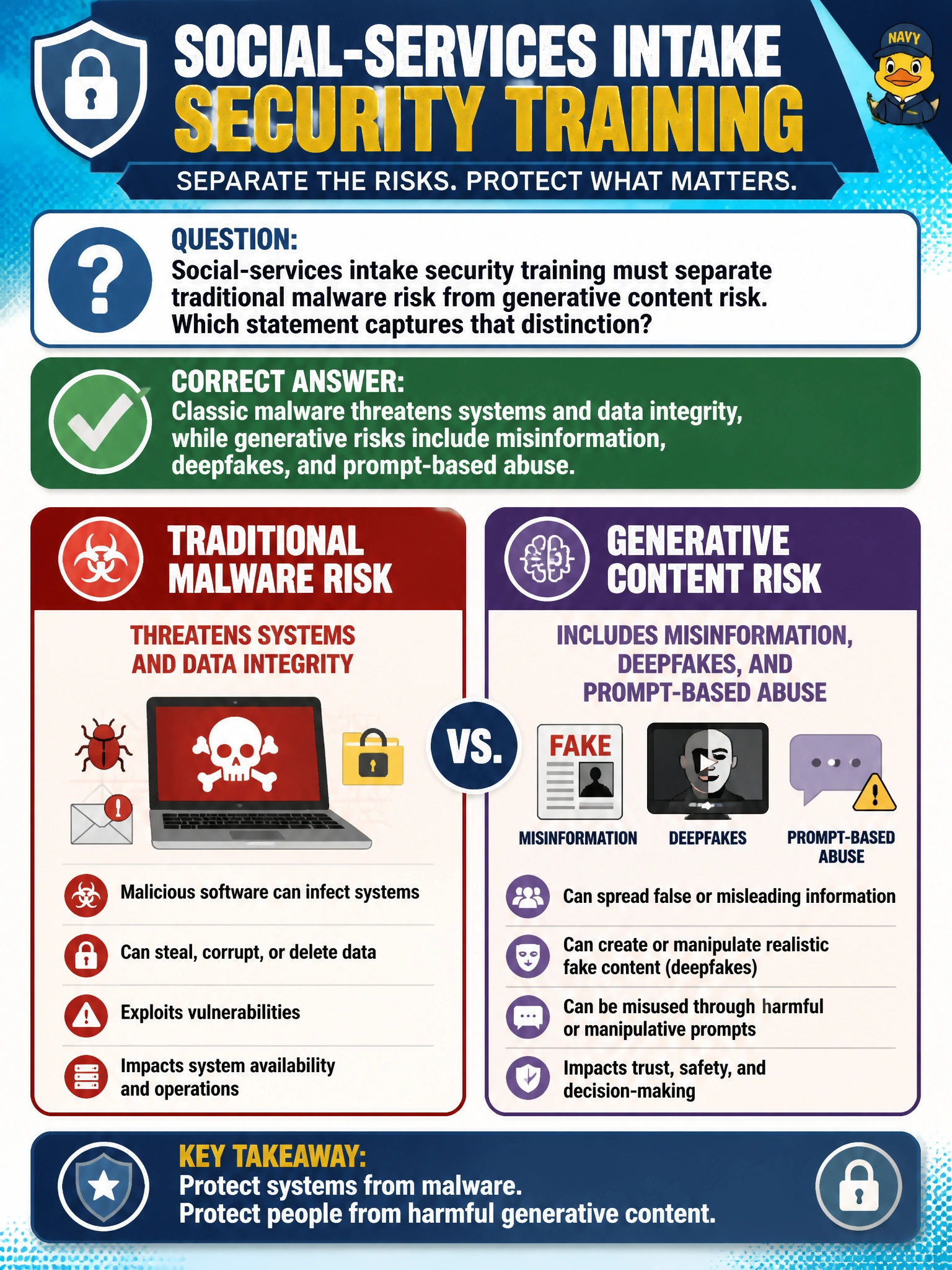
Social-services intake security training must separate traditional malware risk from generative content risk. Which statement captures that distinction?
Select an answer to reveal the explanation.
Short Explanation
Malware still wants your servers; generative risk often wants your residents’ trust. Keep patching and phishing drills—and add a lane for deepfakes, junk answers, and prompt tricks.
Full Explanation
Social-services intake security training should teach that classic malware threatens systems and data integrity, while generative risks include misinformation, deepfakes, and prompt-based abuse. Ransomware, trojans, and traditional phishing still aim at confidentiality, integrity, and availability of hosts and data. Generative AI adds pathways that manipulate trust and decision-making—false guidance to clients, synthetic media, and instruction attacks on assistants—without always looking like a classic malware detonation. Separating those lanes keeps defenses and drills appropriately dual-tracked.
Claiming ransomware and phishing no longer matter once any GenAI tool is installed is false and dangerous; GenAI does not retire patching, backups, or phishing resistance. Saying generative content risks are identical to disk encryption failures conflates cryptographic/availability controls with content authenticity and model-abuse problems. Asserting that only classic antivirus signatures can stop hallucinated policy answers misapplies malware detection to a class of failures that require grounding, human review, and AI-specific controls.
Exam caveat: the distinction is complementary threat categories, not a ranking that one replaces the other. Operational check: keep malware/phishing modules in intake security training, add a short module on deepfakes, hallucinated guidance, and prompt injection, and test staff on which playbook applies to which symptom.