
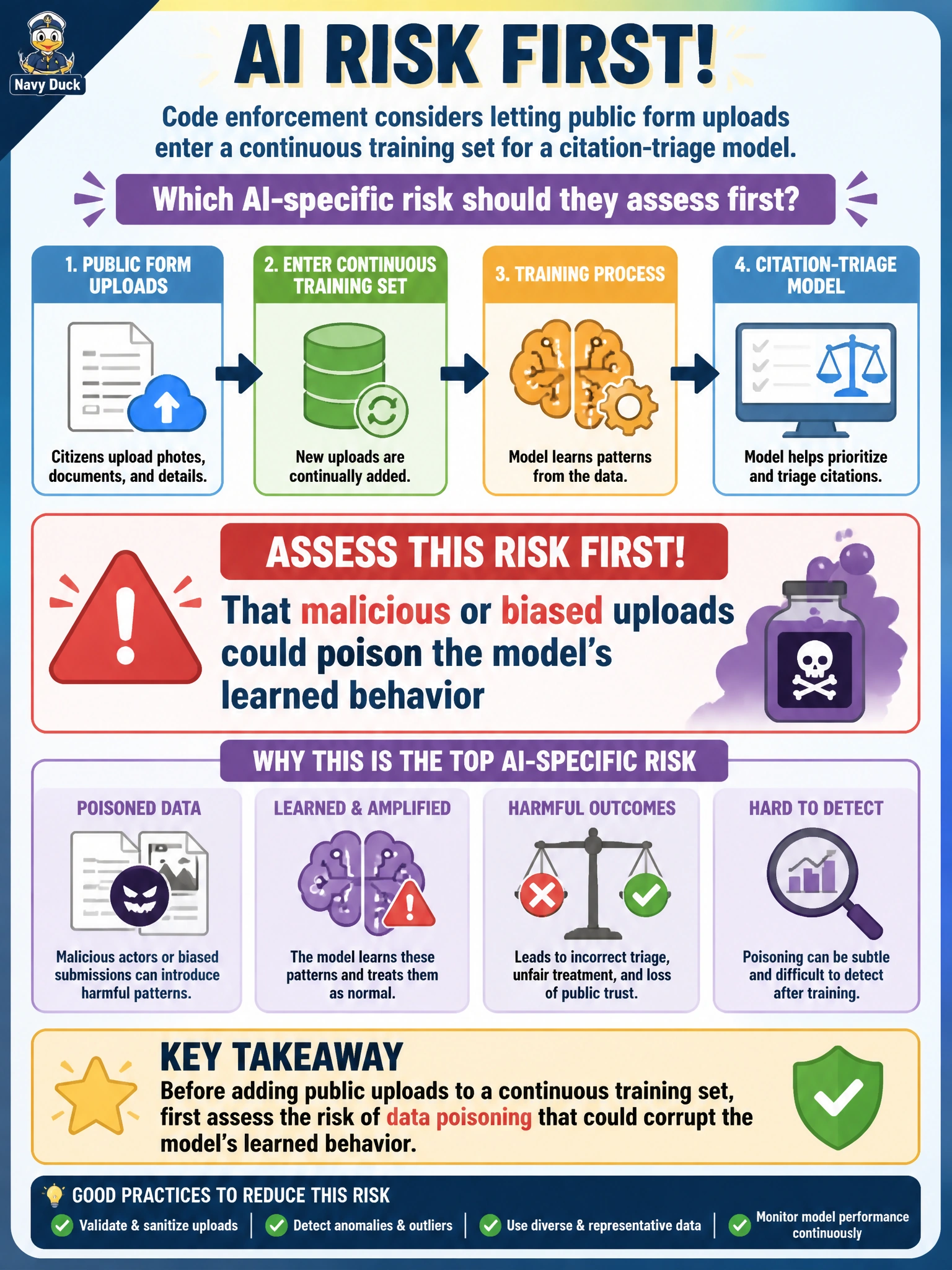
Code enforcement considers letting public form uploads enter a continuous training set for a citation-triage model. Which AI-specific risk should they assess first?
Select an answer to reveal the explanation.
Short Explanation
If you let the public feed the training bowl, someone could slip in junk—or carefully crafted poison—that teaches the model the wrong habits. Vet what enters continuous training before you let public uploads rewrite triage.
Full Explanation
If public form uploads enter a continuous training set for a citation-triage model, assess first whether malicious or biased uploads could poison the model’s learned behavior. Data poisoning corrupts training or fine-tuning data, causing decisions to drift—for example, favoring certain complainants, ignoring legitimate violations, or embedding attacker-chosen triggers. Continuous, unvetted ingestion is an attractive poisoning path because an adversary may only need to submit forms that the pipeline trusts as training truth. Toner costs rising if more citations print is an operational cost concern, not a threat to training integrity. Lobby clock drift without NTP is a time-sync facilities or IT hygiene issue, not model poisoning. Older copper Ethernet may add call latency, but it will not affect citation-triage model training; that is a network-performance concern, not a machine-learning data-integrity risk. Exam caveat: poisoning targets the learning pipeline; it is not the same as prompt injection against a deployed chat interface, though both are AI-specific. Practical check: gate what enters continuous training, sanitize and review samples, maintain provenance and hold-out evaluation sets, and monitor for sudden shifts in triage rates after ingest batches.