
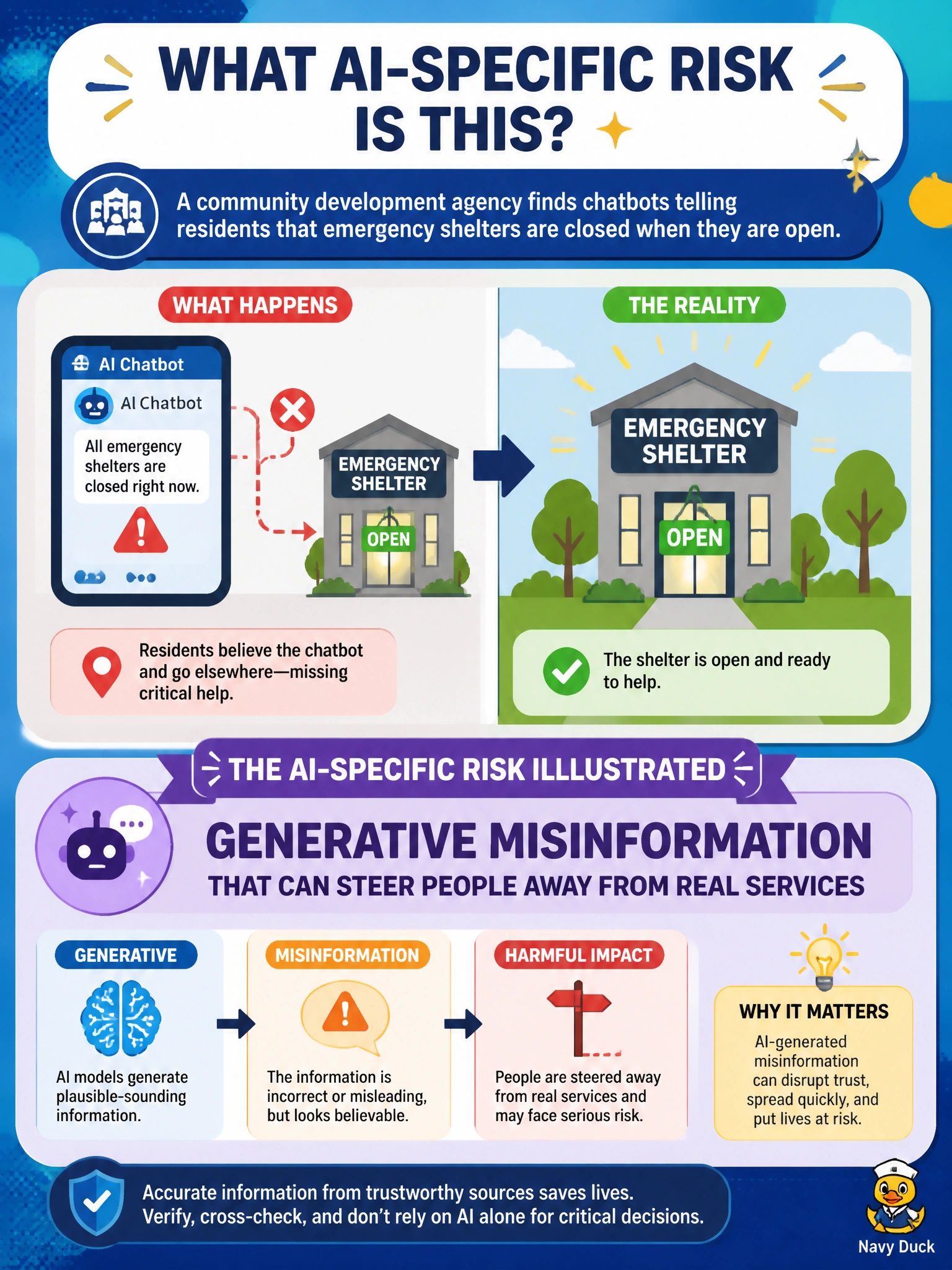
A community development agency finds chatbots telling residents that emergency shelters are closed when they are open. What AI-specific risk does that illustrate?
Select an answer to reveal the explanation.
Short Explanation
When a fluent chatbot invents a closed shelter, that’s not a toner problem—it’s generative misinformation with real human cost. Ground answers in live shelter data and make staff double-check before residents act on it.
Full Explanation
Chatbots telling residents that emergency shelters are closed when they are open illustrate generative misinformation that can steer people away from real services. Large language models can produce fluent, confident falsehoods—including invented closures, hours, or eligibility—especially when answers are not grounded in live operational data. In a community development or emergency-services context, that AI-specific risk has immediate human cost: residents may not seek open beds or aid because a civic assistant sounded authoritative.
A broken HVAC sensor in the shelter lobby is a facilities monitoring failure; it does not invent closure statements in a chatbot. An expired SSL certificate on the agency intranet is a transport-security / PKI issue for internal sites, not fabricated shelter status for the public. A toner shortage in the front-office printer is an office-supply problem unrelated to generative content accuracy.
Exam caveat: generative misinformation is about false or misleading model outputs, distinct from infrastructure failures that merely interrupt access to true information. Operational check: ground shelter answers in a live verified feed or staff-maintained source of truth, refuse to invent status when data is missing, require human confirmation for high-stakes guidance, and sample chatbot answers against the current shelter roster.